
Sights and Sounds
The Stories We Swallow: A Taste of Ghana’s Street Food Names

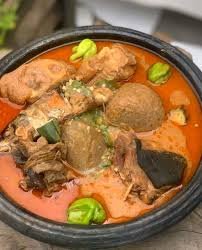
In Ghana, we do not just eat. We tell stories with our mouths full.
Walk down any busy street in Accra or Kumasi, and the food calls out to you by name. Not the fancy menu names. Real names. Names that make you laugh, think, and sometimes, feel a little embarrassed. Have you ever stopped mid-bite and wondered—who sat down and decided to call a meal Kofi Broke Man?
Let me introduce you to the logic of the Ghanaian stomach.
The Engineers Who Named Your Lunch
Start with the bowl of beans and fried plantain sitting in front of you. You might call it Red Red. You might call it Gobe. But where did that last one come from?
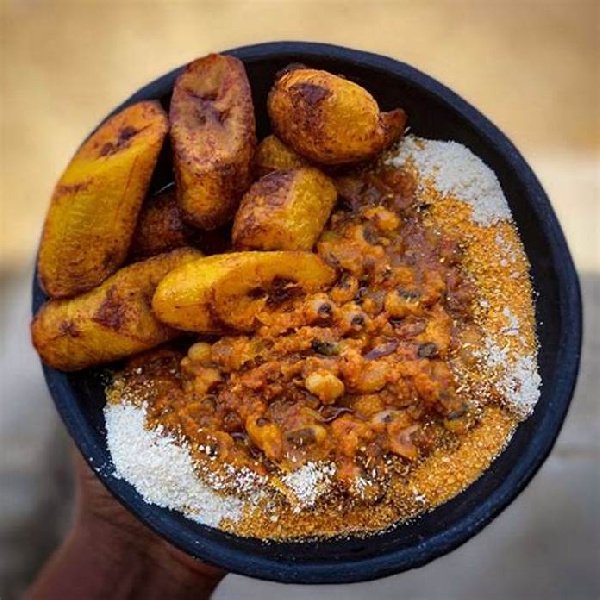
It turns out, we owe this one to the tech boys at Katanga Hall—one of the older, tougher halls of residence at KNUST. These were engineering students, practical minds who saw a bowl of food and thought in acronyms. G. O. B. E. Gari. Oil. Beans. Eggs. Say it fast, and it becomes Gobe. It is street food with a little sprinkle of brain behind it. The name stuck because it made sense. And because Katanga boys do not play about their food.
The Snack That Climbed the Ladder
Now, let us talk about the plantain we love. You see it everywhere now, roasted over charcoal, sold in neat packs with groundnuts and ginger. They call it Kofi Broke Man.
The name is Straight Talk. It means exactly what it sounds like—this is the meal for someone watching their wallet. Long ago, if your pocket ran dry, you turned to roasted plantain. It filled you up without emptying you.
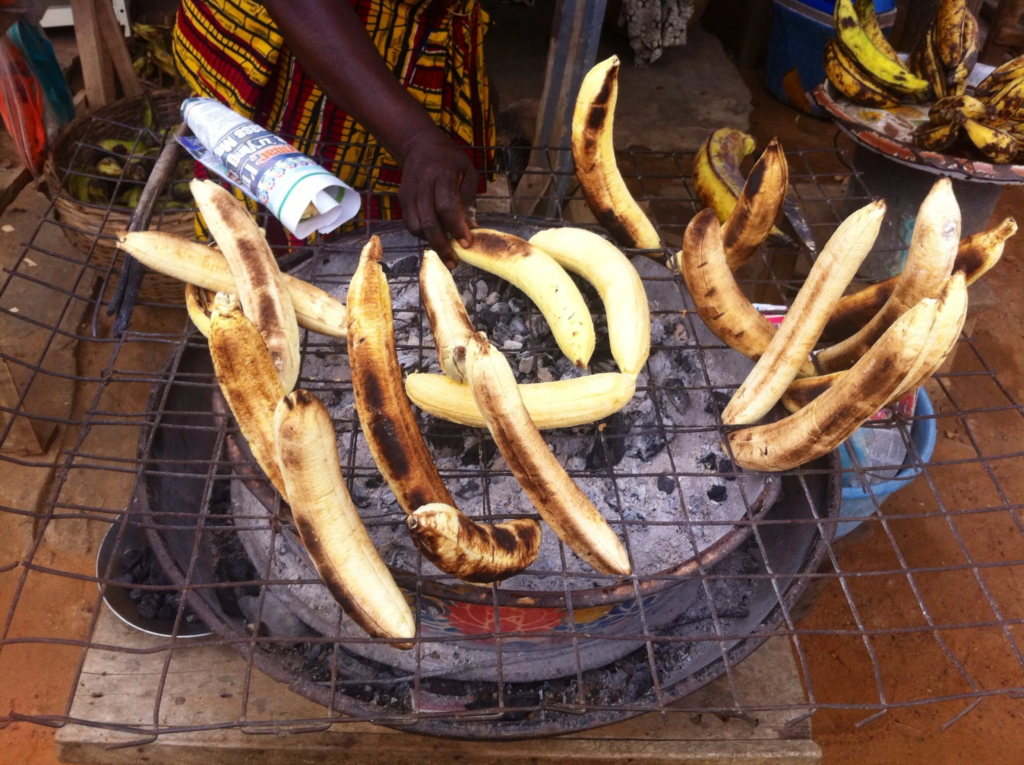
But here is the twist. Somewhere along the way, the broke snack went bougie. Prices went up. Demand exploded. Now, everyone eats it—the student, the banker, the tourist. It climbed the ladder while the rest of us stood in line. Honestly? It should have just stayed broke.
Eating with Your Back to the World
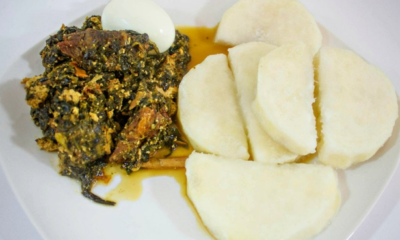
And then there is the one with the saddest name. Kokonte. The dark, sticky dough made from cassava. You might hear someone call it Face The Wall.
The name carries history. During colonial times, the dish drew negative attention for its dark appearance. People felt they had to hide while eating it, turning their faces to the wall so no one would see.
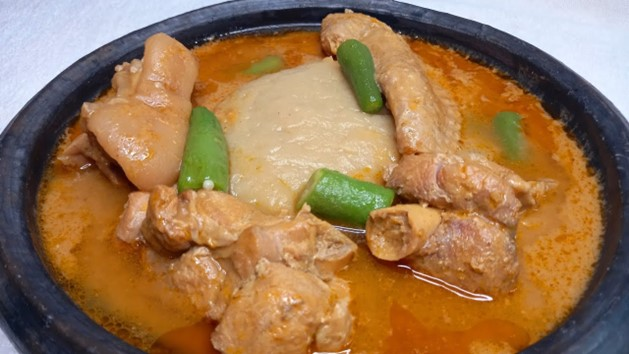
It was a meal of shame, eaten in private. But today? Things have changed. It sits proudly on tables, served with rich groundnut soup. We call it other names now—la pewa, or sometimes playfully Chris Brown after the singer. The food did not change. We just finally decided to face forward.
So next time you buy from a woman balancing a bowl on her head, ask her her name. The answer might just be a history lesson wrapped in wax print.











Sights and Sounds
Kotoka International Airport: The War Runway That Became West Africa’s Gateway
If you’ve ever arrived at Kotoka International Airport, you know the drill. You’re tired, you’re hot, and you just want to get outside and smell the Accra air.
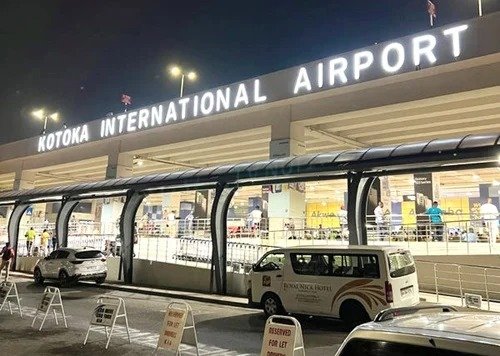
The immigration line is long. Your luggage may or may not have made it. And somewhere behind the glass, someone is stamping passports with a pace that suggests they have all the time in the world. If you’ve ever arrived at Kotoka International Airport, you know the drill. You’re tired, you’re hot, and you just want to get outside and smell the Accra air.
But here’s something to think about while you wait.
The ground beneath your feet wasn’t always polished terminal floors and duty-free shops. Back in the 1940s, this was a military operation. British forces needed a strategic position during World War II, and Accra’s location made perfect sense. So they built an airfield. Not for tourists or business travelers. For warplanes.
Fast forward to the 1950s. The war ends, the world changes, and air travel starts becoming a thing. That military runway slowly transforms. By 1956, just before Ghana gained independence, the airport underwent a serious upgrade and a name change: Accra International Airport. Suddenly, Ghana isn’t just watching the world from afar. It’s connected to it.
Then comes 1969. The airport gets renamed again, this time to honour Lieutenant General Emmanuel Kotoka, a figure from Ghana’s early political years. His story has layers, like most history does, but the name stuck. And so did the airport’s importance.
Today, Kotoka moves millions of people. Families returning for Christmas. Business travelers chasing opportunities. Strangers are coming to see what this country is about. The military runway is long gone, buried under decades of expansion and development. But it’s still there underneath, part of the foundation.
Read Also: Cantonments: Why Accra’s Posh Neighbourhood Still Carries a Soldier’s Name
So next time you’re waiting at baggage claim or sitting in departure lounge traffic, remember this. You’re not just passing through another airport. You’re standing where warplanes once parked. You’re walking through a piece of the story.
Welcome back. Or welcome for the first time. Either way, the ground you’re on has seen things.
Sights and Sounds
Cantonments: Why Accra’s Posh Neighbourhood Still Carries a Soldier’s Name
Cantonments. The name rolls off the tongue like it has always meant luxury, diplomacy, and expensive real estate.
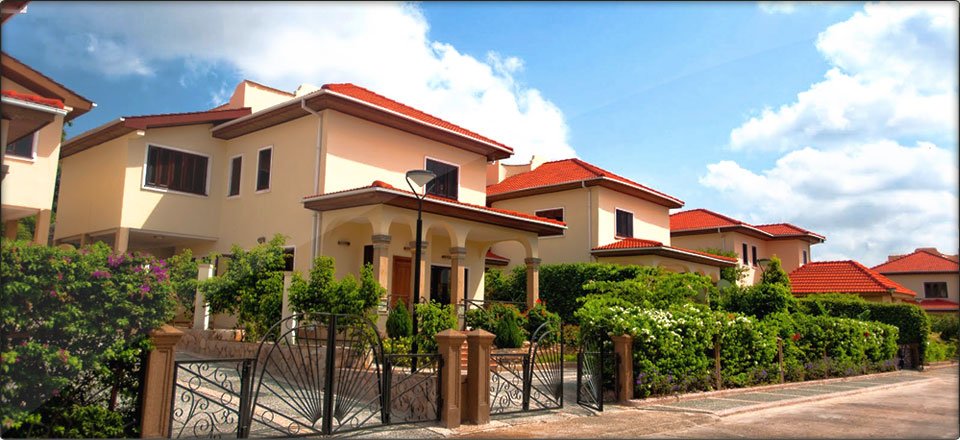
There is a corner of Accra where the streets are quiet, the walls are high, and the cars gliding through are mostly black with tinted windows. Cantonments. The name rolls off the tongue like it has always meant luxury, diplomacy, and expensive real estate.
But here is the part they don’t tell you in the brochures.
Cantonments did not start with ambassadors. It started with soldiers.
The word itself comes from the French cantonner, meaning to quarter troops. And during British colonial rule, that is exactly what this land was used for. A military base. A carefully chosen spot where European officers could live far removed from the noise and texture of local life. It was designed to be exclusive. Controlled. A physical line drawn between the rulers and the ruled.
Read Also: Bigger Than Manhyia: Discover the Grandeur of the Assin Kushea Palace, West Africa’s Largest
The irony is that the separation never really went away. It just changed faces.
Today, the boots are gone. In their place, black SUVs idling outside international schools. The officers have been replaced by diplomats, CEOs, and celebrities. The barracks made way for mansions. But if you walk those tree-lined streets, the original blueprint is still there. Wide roads. Spacious layouts. That unmistakable feeling of being tucked away from the rest of the city.
Cantonments did not accidentally become posh. It was built that way from the start.
The story was recently pieced together by @Sankofatapes on Instagram, reminding us that history does not always live in museums. Sometimes it lives in the places we drive through every day without a second glance.
So next time you find yourself stuck in traffic around Cantonments, look past the walls. Look past the luxury. The neighbourhood is not just expensive. It is historic. A piece of Accra’s past hiding in plain sight, still whispering the strategies of empire through the hum of generators and the click of automatic gates.
Sights and Sounds
Bigger Than Manhyia: Discover the Grandeur of the Assin Kushea Palace, West Africa’s Largest

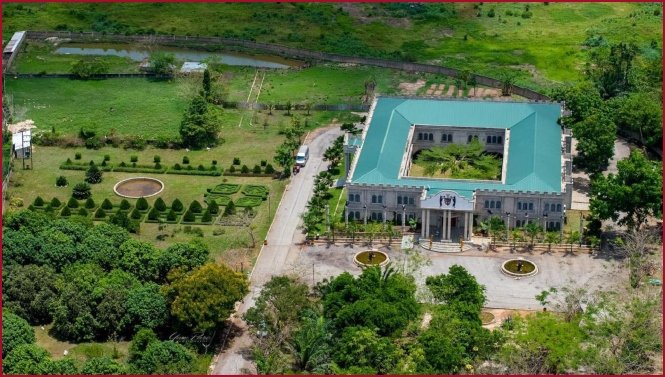
Tucked away in the quiet Central Region town of Assin Kushea lies a masterpiece of traditional architecture that is quietly redefining Ghana’s tourism landscape.
The Assin Kushea Palace, built by Nana Prah Agyensaim VI, Paramount Chief of the Owirenkyi Traditional Area, is believed to be the largest palace in West Africa—surpassing even the renowned Manhyia Palace in Kumasi in physical size and scale.
For travel influencer Gladys Cassandra Bugashie (@iamcassie_gh), the discovery was nothing short of revelation.
“I don’t even know why I am now discovering this gem,” she exclaims in a recent Instagram video that has since gone viral. “They said this is the largest palace in West Africa. Honestly, when I was coming, I just decided not to give myself any expectations. Guys, I absolutely agree this place is the biggest palace in West Africa. I am shocked, like properly shocked.”
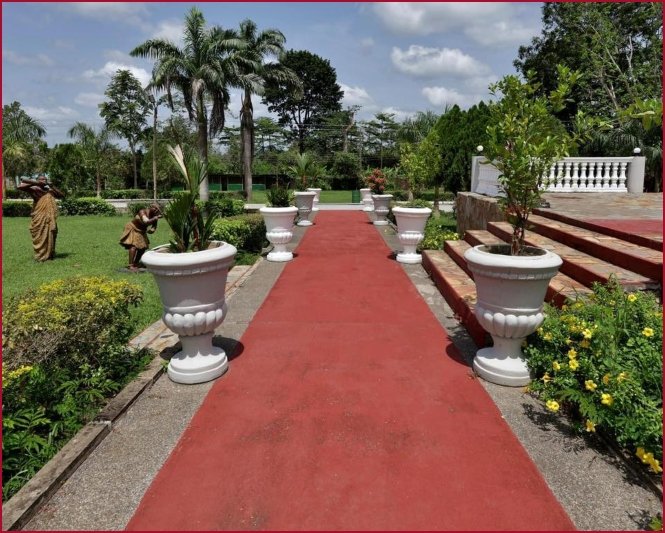
A Vision Born from a Wife’s Encouragement
The story of how this magnificent structure came to be is as compelling as the palace itself. Speaking to Etsey Atisu, host of People & Places on GhanaWeb TV, Nana Prah Agyensaim VI revealed that the inspiration came from an unexpected source: his wife.
“I remember one day, I was talking to my wife about Kushea and she said, ‘You should build a palace o, you should build a palace before you go—you should build a palace.’ I said OK, I hear. I will; I will. Little did she know all her ‘chop money’ would go into the palace,” the chief recounted with a chuckle.
Construction began 13 years ago, and on the very same day, the chief planted a tree on the palace grounds.
“So, they have the same birthdays; the tree and the palace,” he noted. Though still not fully completed, the palace already stands as a testament to what the chief calls “inter-generational leadership”—a legacy meant to endure long after he is gone.
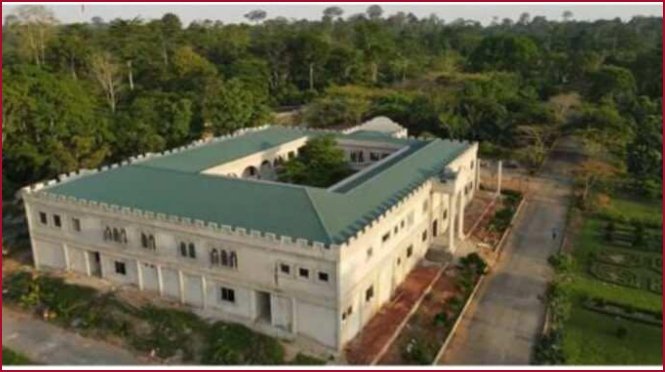
Grandeur on a 7.4-Acre Scale
Sitting on approximately 7.4 acres of land, the Assin Kushea Palace is a sprawling complex that defies expectations.
Unlike the more famous Manhyia Palace in the Ashanti Region—primarily a residence and historical museum for the Asantehene—the Assin Kushea Palace was conceived from the outset as a tourism and community asset.
The chief has stated that he does not intend to reside in the palace himself; rather, it is being built to promote tourism and showcase Ghanaian culture to the world.
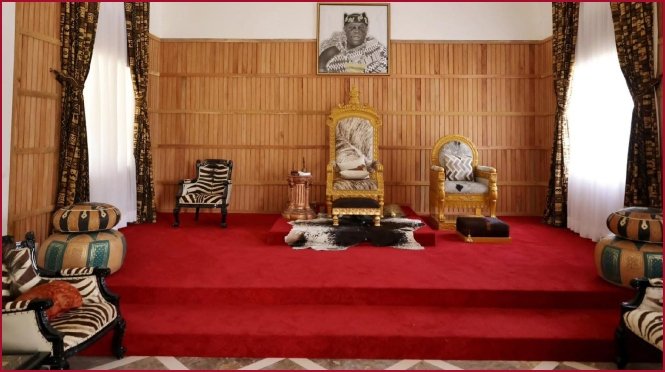
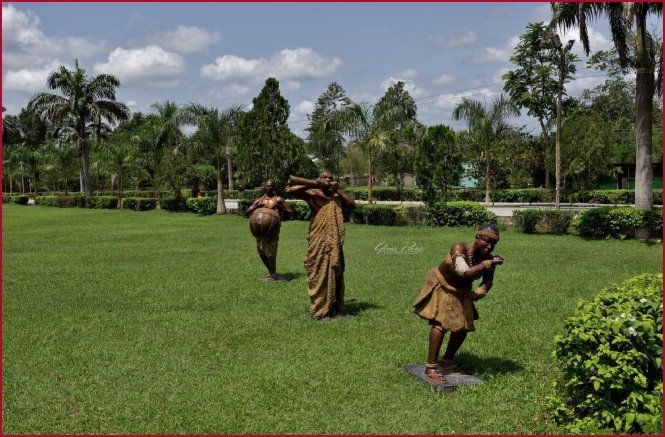
Visitors to the palace are greeted by an imposing entrance flanked by two statues of warriors, spears and shields in hand, standing guard. Beyond lies a massive courtyard suitable for ceremonial gatherings, complete with an elevated platform where the chief presides during functions.
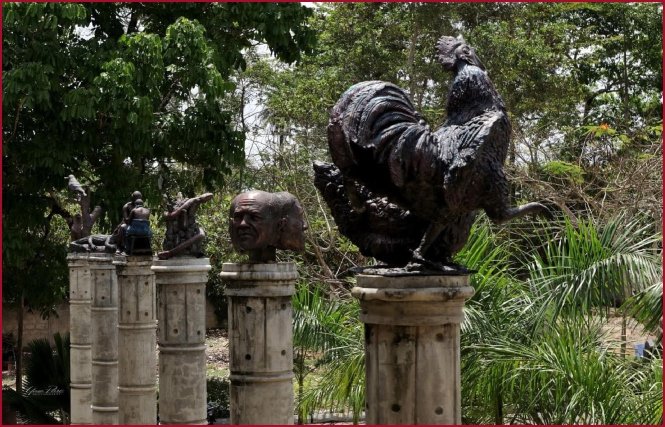
The architectural details tell stories. Throughout the complex, visitors will encounter numerous sculptures of dogs—the totem of the chief’s Aduana Clan. According to legend, a dog guided the clan during their migration, lighting the path with fire from its mouth. The dog represents honesty and industriousness, values that the chief has clearly embedded in his vision for the community.
More Than Just a Palace
What sets the Assin Kushea Palace apart is its multifaceted nature. The complex includes:
- A botanical garden showcasing local flora
- A mini-zoo housing various animals
- A fishpond, created by the chief to address potential future fish shortages resulting from the environmental impact of illegal mining (galamsey) on the Pra River
- Guest rooms for visitors who wish to stay overnight and immerse themselves in the peaceful environment
- Walls adorned with African proverbs, traditional artifacts, and depictions of animals and birds
“The place is huge, neat, and very grand,” Bugashie marvels in her video. “You just stand there and you’re like, whoa, so this is actually in my country. The funny thing is, it’s quietly tucked away in the Central Region of Ghana, not even loud about it. Just sitting there like a gem.”
The Cleanest Town in Ghana
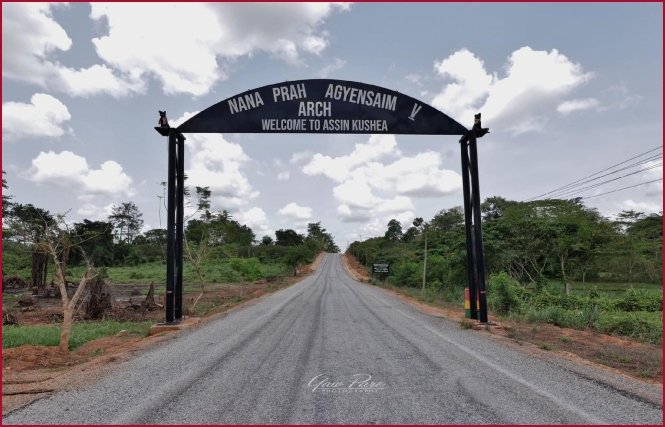
The palace is not the only point of pride for Assin Kushea. Under Nana Prah Agyensaim VI’s leadership, the town has earned the distinction of being the cleanest in Ghana . The chief recognized early that he could not compete with larger, wealthier paramountcies, so he chose to be different—focusing on sanitation as a unique selling point .
His approach was rooted in understanding Ghanaian cultural habits.
“We as Ghanaians had the tradition of throwing leaves away, when we used to eat from leaves… after you finish eating, the natural thing to do is throw the leaves away. In those days, it didn’t matter because the leaves would decompose. So, we were not littering, but the habit of throwing had been ingrained in us,” he explained. “So, when this creature called plastic came, we put our food in the plastic. After eating, we throw it away because that is the habit that we had inculcated in us. So, my problem was to stop the throwing away”.
Today, Assin Kushea’s streets are tarred, dustbins are ubiquitous, and the chief personally conducts visits to communities and schools to emphasize the importance of hygiene .
A Call to Domestic Tourism
For Bugashie, the experience carried a deeper message about how Ghanaians view their own country.
“Sometimes, we are just looking outside Ghana to find nice places to visit, but the real beauty is right here at home,” she reflects. “Trust me, you will love it. I loved it, so I’m sure you would.”
Her sentiment echoes a growing movement encouraging Ghanaians to explore their own backyard. While the slave castles of Cape Coast and Elmina draw international visitors, and the Manhyia Palace attracts those interested in Ashanti history, the Assin Kushea Palace offers something different: a living, growing monument to what visionary leadership can achieve.
Practical Information for Visitors
The Assin Kushea Palace is located approximately 12 kilometers off the Assin Fosu highway in the Central Region . Tour operators such as Obed B. offer guided day tours from Accra and surrounding areas, with itineraries that include the palace, the mini-zoo, and opportunities to learn about the history of the Akan people and the surrounding communities .
For those seeking a deeper experience, guest rooms are available on-site, allowing visitors to stay overnight and fully absorb the peaceful atmosphere that characterizes both the palace grounds and the town itself .
As Bugashie concludes in her video: “If you like traveling and exploring or just seeing nice places, please add this to your bucket list. Do not sleep on it. Go and experience it for yourself.”
The Assin Kushea Palace stands as proof that Ghana’s tourism treasures extend far beyond the well-trodden paths—and that sometimes, the most magnificent discoveries are hiding in plain sight.


UK Black Stars Launched to Honor Influential British-Ghanaians as Ghana Turns 69

Ghanaians and Other Africans in UAE Flood Social Media with Videos as Iranian Missile Strikes Hit Dubai

Ghana Maintains Over 5 Weeks of Fuel Stock Amid Middle East Tensions and Other Trending Topics in Ghana (March 2, 2026)
-

 Ghana News1 day ago
Ghanaian’s Terrifying Experience as Missile Explodes Amid Escalating Middle East Tensions and Other Trending Topics in Ghana (March 1, 2026)
-

 Ghana News1 day ago
Ghana’s Black Queens Stranded in UAE as Government Initiates Partial Evacuation from Tehran Embassy Amid Escalating Israel-Iran Conflict
-
 Ghana News6 hours ago
Ghana Maintains Over 5 Weeks of Fuel Stock Amid Middle East Tensions and Other Trending Topics in Ghana (March 2, 2026)
-

 Ghana News1 day ago
7 Ways the Escalating Middle East Crisis Could Hit Home in Ghana
-
 From the Diaspora5 hours ago
Ghanaians and Other Africans in UAE Flood Social Media with Videos as Iranian Missile Strikes Hit Dubai
-

 Ghana News6 hours ago
Newspaper Headlines Today: Monday, March 2, 2026
-

 Africa Watch22 hours ago
How African Nations Are Evacuating Their Nationals Amid the Escalating Middle East Crisis
-

 From the Diaspora1 day ago
Ghanaian-Heritage Scientist AJ Addae Develops Breakthrough Sunscreen That Protects Darker Skin Without White Cast