
Arts and GH Heritage
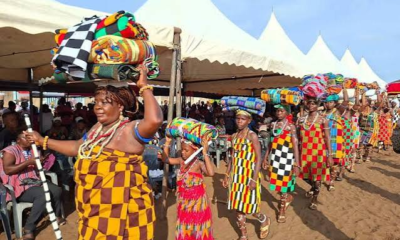
My Grandmother’s Funeral Taught Me More About Ghana Than Any Textbook Could

The first time I truly understood what it meant to be Ghanaian, I was seven years old, sitting on a wooden stool in my grandmother’s courtyard, watching her kill a chicken.
Not for drama. For dinner. And for the ancestors.
She spoke to the chicken before she killed it. Whispered words in Twi that I pretended to understand. Then she poured its blood at the base of a dried plantain tree and called it mpata—appeasement. I asked her why. She looked at me like I’d asked why the sky exists.
“The chicken knows,” she said. “The ancestors know. One day, you will know too.”
I’m thirty-two now. I still don’t fully know. And that terrifies me.
The Thing About Preservation
Ghana is doing a lot of talking about cultural preservation lately. Committees meet. Reports are written. Festivals are announced with press releases. The Ministry of Tourism, Arts and Culture releases statements about “leveraging our heritage for economic growth.”
But here’s what those statements don’t capture:
My cousin in London just named her daughter “Ama” because it sounded cute on Instagram. She doesn’t know that Ama means “born on Saturday.” She doesn’t know the naming ceremony involves water, gin, and prayers she’s never heard. She just liked the way it looked in her daughter’s birth announcement.
That’s the problem with preservation. We’re so busy building museums for our culture that we forgot culture actually lives in how we name our children, greet our elders, and pour libation before we open that expensive bottle of champagne.
The Funeral That Shifted Something
Last December, my great-aunt died. She was ninety-four. Maybe ninety-seven. Nobody kept exact records because, as she always said, “The ancestors know my age. Why do you people need papers?”
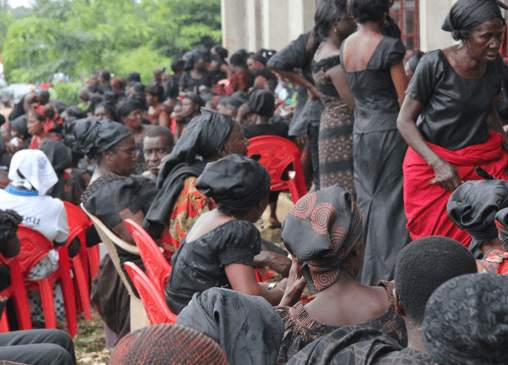
Her funeral became the event of the season. Three days. Two villages. One cow. And somewhere between the firing of muskets and the distribution of aseda—thank-you money—I watched my London cousins struggle.
They didn’t know when to remove their sandals. They didn’t know why the widow had to sit on a mat. They didn’t understand that the wailing wasn’t just grief—it was a performance, a required ritual, a language the dead understand.
One of them whispered to me: “Why didn’t anyone teach us this?”
I didn’t have an answer.
The Kente Weaver’s Empty Loom
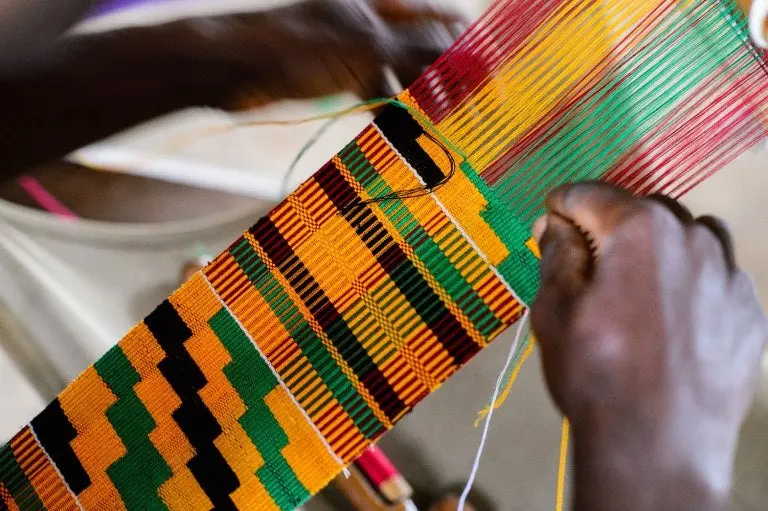
Two weeks ago, I visited a kente weaving village in the Volta Region. The master weaver—seventy-three years old, hands that move like water—showed me his loom. Beautiful. Intricate. Ancient.
“Nobody wants to learn,” he said. “The young people say it takes too long. They want to make money fast. They go to Accra. They sell phone credit.”
I asked him what happens when he’s gone.
He laughed. Not a happy laugh.
“The loom will wait,” he said. “For who? I don’t know. Maybe a ghost.”
His grandson was there, glued to TikTok. Wearing a Manchester United jersey. Speaking English with an accent he learned from American YouTubers. When I asked him in Twi what his favourite kente pattern meant, he shrugged.
“I don’t speak Twi well,” he said. In perfect English.
The Language Problem Nobody Wants to Address
Here’s the uncomfortable truth Ghanaians don’t say out loud:
We’re embarrassed.
We send our children to international schools and feel proud when they struggle with Twi. We correct each other’s English in mixed company but never correct someone who butchers our own language. We’ve decided, collectively and silently, that speaking our mother tongues fluently is somehow less sophisticated.
A friend told me recently, “I speak English to my kids because I want them to succeed globally.”
Global success, it seems, requires local amnesia.
But here’s what I’ve noticed: the most successful Ghanaians abroad aren’t the ones who assimilated completely. They’re the ones who brought something with them. The ones who could explain sankofa to their American coworkers. The ones who wore batik to the office potluck and told the story behind it.
The Ancestors Are Not on Wi-Fi
There’s a moment in every traditional ceremony—whether it’s a wedding, a funeral, or a puberty rite—where the elder pauses. Looks up. And speaks to those who came before.
“Grandfathers,” they say. “Grandmothers. We have not forgotten you.”
The first time I witnessed this, I was embarrassed. Who are they talking to? The air? The ceiling?
Now I understand. They’re talking to continuity. To the thread that connects a chicken killed in 1994 to a chicken killed in 1820. To the idea that we are not alone, not the first, not the last.
My grandmother died ten years ago. Sometimes, when I’m cooking her groundnut soup recipe—the one she never wrote down, the one I had to watch and memorise—I find myself talking to her.
“Too much pepper?” I ask.
And somehow, I know the answer.
That’s culture. Not the festivals. Not the museum exhibits. Not the tourism board campaigns. That quiet knowing. That sense that you’re not starting from zero.
The Good News Nobody’s Reporting
Not everything is dying.
Walk through Nima Market on a Friday afternoon. Young women buying waakye from women who’ve sold it for forty years. Young men arguing about politics in Hausa and Twi mixed together. Children running between legs, speaking whatever language gets them the best response.
Visit any funeral in any village. Watch the teenagers. They’re rolling their eyes, yes. They’re on their phones, yes. But they’re also watching. They’re also learning. They know more than they admit.
And there’s this: the same globalisation that threatens our culture is also preserving it. YouTube videos of adowa dancing. TikTok tutorials on tying kente. Instagram pages dedicated to Ghanaian proverbs with English translations.
A girl in New York can learn her grandmother’s funeral songs from a phone. A boy in London can watch his uncle pour libation and understand why.
It’s not the same as sitting in the courtyard. But it’s something.
What I’m Actually Trying to Say
Ghana’s culture isn’t fragile. It survived colonialism. It survived the transatlantic slave trade. It survived missionaries telling our ancestors their gods were false. It survived independence, structural adjustment, and now, globalisation.
What I’m worried about isn’t survival.
I’m worried about meaning.
We can preserve the forms—the dances, the drums, the cloth—while losing what they actually mean. We can have festivals without understanding why we’re celebrating. We can wear kente without knowing which pattern belongs to which clan. We can call ourselves Ghanaian without knowing what that actually requires.
My grandmother didn’t worry about cultural preservation. She just lived. She greeted properly. She poured libation. She named her children on the day they were born. She didn’t need a committee to tell her what mattered.
We do now. Because we’ve forgotten.
The Challenge
If you’re reading this and you’re Ghanaian, here’s my challenge:
Learn one thing this year.
Not everything. Just one thing.
Learn the story behind your surname. Learn why your family eats that weird thing at Christmas. Learn to cook one dish your grandmother made. Learn what the symbols on your funeral cloth actually mean. Learn to greet an elder properly—not just the words, but the bend, the pause, the eye contact.
And if you’re not Ghanaian, if you’re reading this from somewhere else:
Pay attention to what you’re losing too. Because I promise you, something is slipping. Something your grandchildren will wish you’d held onto.
The ancestors are watching. They’re patient. But even patience runs out eventually.








Arts and GH Heritage
When Second-Hand Clothes Become a Playground for Community
Using Broni Wawu garments purchased at a local market, Bamfo creates enclosed and open environments designed for participation rather than distant observation.
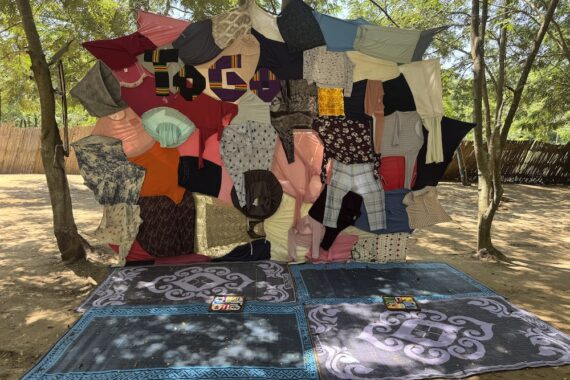
In Atakpamé, Ghanaian artist Dr. Frederick Bamfo transforms discarded garments into interactive spaces where children, cultural memory and collective play meet.
A discarded shirt can carry more than the memory of a former owner. In the hands of Ghanaian artist and academic Dr. Frederick Bamfo, it can become part of a place where children gather, games begin and strangers find reasons to connect.
His installation, The Games Feast, developed during the Karp Artists’ and Researchers’ Residency in Atakpamé, Togo, gives second-hand clothing a new social life.
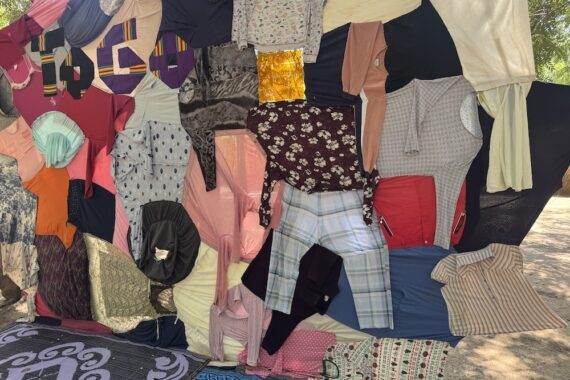
Using Broni Wawu garments purchased at a local market, Bamfo creates enclosed and open environments designed for participation rather than distant observation.
The choice of material speaks to a familiar West African reality. Second-hand clothing circulates through markets, connecting consumers to international trade networks while raising questions about consumption, waste and the afterlife of textiles.
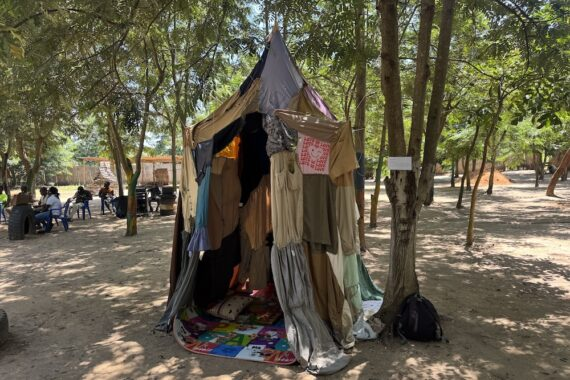
Often valued primarily for their usefulness or affordability, these garments become something different in Bamfo’s work: vessels of memory and possibilities for human connection.
The installation’s defining feature, however, is not simply its reuse of clothing. It is what happens inside these improvised spaces.
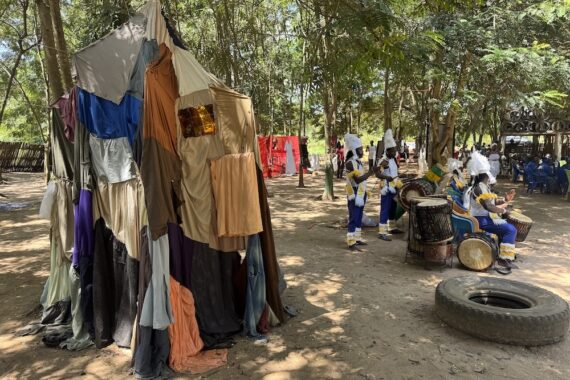
Children help shape the project’s collaborative spirit, while games such as ludo and oware, alongside dancing and skipping, turn the artwork into a setting for shared experience.
These activities draw on familiar forms of play that have long helped communities build relationships and pass cultural knowledge between generations.
Here, they also challenge conventional ideas of an art installation as something to admire without touching or entering.
For Bamfo, the transformation is both material and social. Clothing once associated with individual bodies becomes a collective environment, while everyday games become tools for participation.
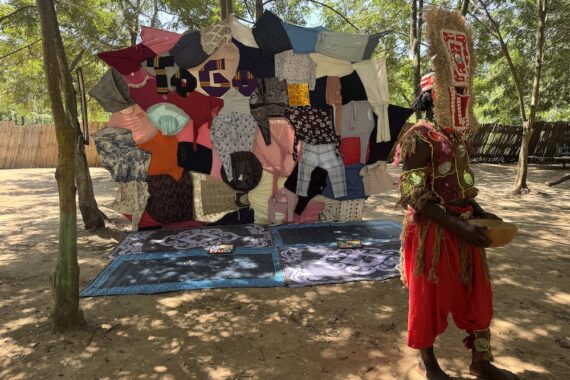
In Atakpamé, The Games Feast suggests that the most meaningful second life of a discarded garment may not be another wardrobe, but a space where people come together.
Arts and GH Heritage
Who Owns the Right to Be Called an Artist? A Debate in Togo Challenges the Rules of Art
From Ghana’s traditional craftsmen to self-taught street artists, creative excellence rarely follows a single road.
An artist may spend years in a university studio learning perspective, composition and art history.
Another may acquire the same confidence with materials through years of observation, experimentation and work passed down through generations. Which deserves greater recognition?
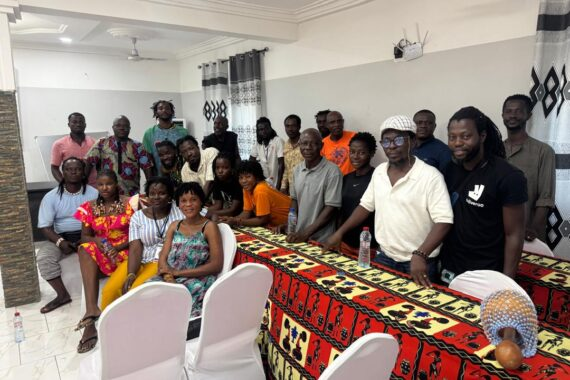
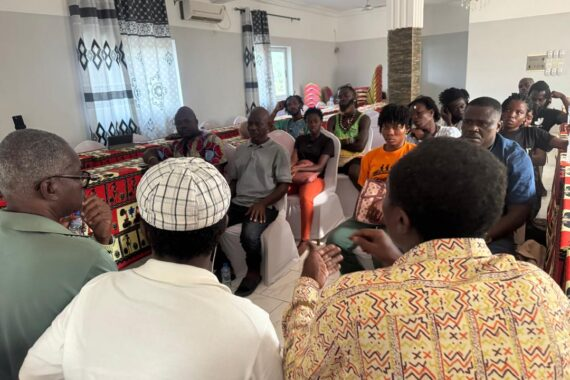
At Hotel Hong Kong in Atakpamé, Togo, this question became a starting point for a wider conversation about who gets to define artistic excellence.
Beyond the walls of the academy
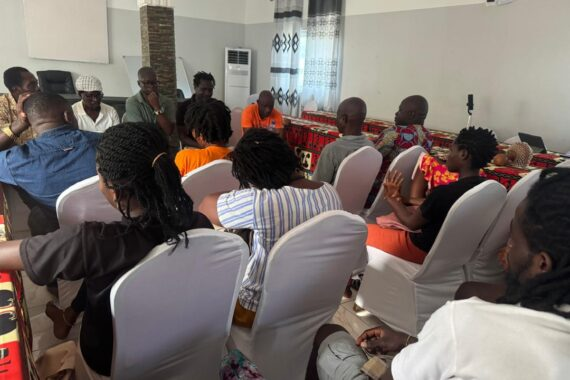
The panel discussion, organised as part of the ongoing Karp Kamina Artists and Researchers Residency, brought together Ghanaian artists Frederick Bamfo, Livingstone Amoako and Ray Agbo.
Moderated by Kojo Biney, with Samuel Olou, the residency’s director, translating into French, the conversation examined the opportunities and limitations of formal and self-directed artistic education.
Art academies offer structured training, experienced mentors, studio facilities and access to professional networks.
Yet these advantages do not automatically produce originality. Outside institutional settings, artists often develop distinctive approaches through everyday encounters, community knowledge, apprenticeships and experimentation.
Ghana’s traditions offer another lesson
Ghana’s fantasy coffin makers illustrate why artistic knowledge cannot be measured by academic qualifications alone.
These craftspeople transform wood into elaborate forms representing professions, personal identities and family histories.
Their expertise is built through practical experience, inherited techniques and close relationships between makers and their communities.
Such traditions challenge institutions to reconsider what counts as legitimate artistic training and whose work deserves exhibition space, critical attention and commercial support.
Making room for different creative journeys
The discussion at Hotel Hong Kong did not present formal education and independent practice as opposing forces.
Instead, it highlighted the need for an art world that values technical knowledge without dismissing unconventional paths.
For African artists navigating galleries, museums and international exhibitions, that distinction matters.
Creativity may begin in a classroom, a workshop or on the street. The greater challenge is ensuring that opportunity does not depend solely on where an artist learned to create.
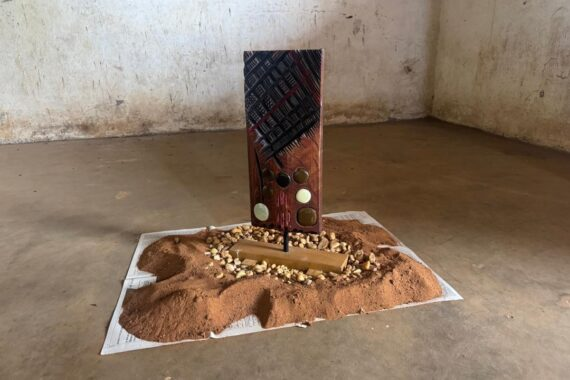
An old building can hold more than dust and silence. In Atakpamé, Togo, an abandoned German colonial structure is finding a new purpose as a space where African cultural expression challenges the weight of history.
Through Conversations: Symbolism and Lifestyle, Ghanaian artists Kojo Biney and Ray Agbo invite audiences to look afresh at the ordinary encounters that bind communities together.
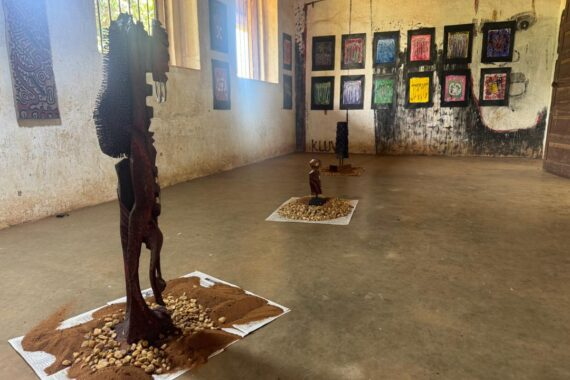
Their paintings and sculptures explore a language that often needs no words: the exchange of kola nuts, bargaining between market traders and customers, and the sharing of palm wine.
These gestures may appear familiar, yet each carries social meaning. They can express welcome, negotiate relationships, establish trust and pass knowledge between generations.
By bringing such moments into the gallery, the artists suggest that culture is not preserved only in museums or ceremonial performances. It lives in everyday interactions.
A building becomes part of the conversation
Presented during the Karp Kamina Artists and Researchers Residency 2026, the exhibition draws on Atakpamé’s cultural landscape, where Ana and Ewe-speaking communities meet. Known as the “city of seven hills”, the town provides a fitting setting for an exploration of identity and shared heritage.
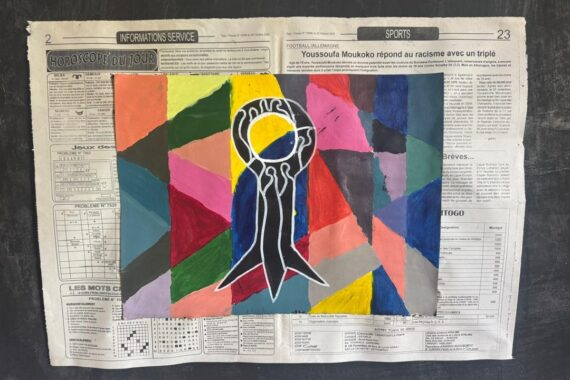
The installation also places paintings alongside newspaper pages, linking artistic interpretation with the ways public events and personal memories become part of the historical record.
Yet the building itself may be the exhibition’s most powerful statement. Once associated with German colonial rule, the structure now houses contemporary African perspectives. Its past is not erased; instead, it becomes part of the encounter.
For older visitors, the space may recall another era. For younger audiences, it offers an opportunity to question how history shapes the present.
As the exhibition closes on Friday, October 16, 2026, its lasting invitation is to recognise that heritage is not frozen in time. Like conversation itself, it remains alive through the meanings people continue to create and share.


Funding Fears Loom For Ghana’s Life-Saving Malaria Vaccine Five Years After Roll Out

‘There was a Coordinated Disclosure Plan’: AI-Discovered Flaw in PHP Triggers Global Internet Chaos as Cybercriminals Race to Exploit It

Yandex Strikes: Can Moscow Host Africa Under Drone Threat?
-
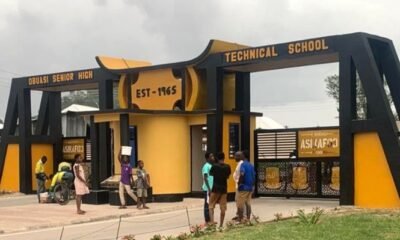
 Ghana News10 hours ago
Major Sexual Abuse Scandal Rocks Ghana High School: Obuasi School Headmaster Sues Journalist for GH¢2 Million as Investigation Into Alleged Misconduct Widens
-

 Reels & Social Media Highlights1 day ago
Ghana’s Digital Heartbeat: Outrage, Satire, and the Fight for Accountability
-
 Festivals & Events15 hours ago
Compozers Fest Ghana Edition: Welcoming 2027 with Music in Accra
-
 Taste GH14 hours ago
Airport Residential Area: Where Accra’s Dining Scene Meets Global Flavours
-

 Health & Wellness2 days ago
Beyond Bigger Muscles: Why Strength Training Matters for Healthy Ageing
-

 Health & Wellness1 day ago
Four Everyday Lifestyle Habits That Can Make Weight Loss Easier
-

 Fashion & Style2 days ago
Wyclef Jean Gives Ghanaian Kaftan a Global Spotlight After ‘Chineke’ Fashion Inspiration
-
 Health & Wellness14 hours ago
Why Keeping Weight Off Can Be Harder Than Losing It