
Opinion
Staying the Course of Ethical Journalism in an Era of Misinformation and AI


In this opinion piece, experienced journalist Kizito Cudjoe urges Ghanaian media to uphold ethical standards amid rising misinformation and AI tools. While technology aids reporting, rushed event-driven coverage and lack of verification erode public trust. He advocates reaffirming verification, balance, and integrity—using AI as an assistant, not a replacement—for journalism to maintain relevance and credibility.
Staying the Course of Ethical Journalism in an Era of Misinformation and AI
By Kizito Cudjoe
Journalism, at its best, is anchored in professionalism, a passion to inform and educate, and an unrelenting commitment to the public good. These principles have guided the craft for generations. Yet today, amid the rapid rise of digital technology and artificial intelligence, the profession faces a new and serious test.
Technology was meant to strengthen journalism. Properly used, it allows reporters to gather data faster, verify facts more thoroughly, and reach wider audiences.
But tools can also be misused.
In recent years, the ease with which content can be generated, especially with AI systems, has lowered the barrier to entry in ways that sometimes erode standards. Anyone can now produce something that looks like a news story, but not everyone practices journalism.
After more than 14 years working both locally and beyond our borders, one pattern continues to concern me. Here in Ghana, much of our reporting remains heavily event-driven, and too often facts are reproduced without rigorous questioning or verification. The pressure to be first has replaced the duty to be right. This culture risks weakening public trust in the media.
When stories are rushed without scrutiny, misinformation spreads easily. Worse, it reinforces the perception among professionals in other fields that journalists are merely conduits for press releases or talking points. That perception is unfair to many hardworking reporters, but it grows each time unverified information reaches the public.
The answer is not to reject technology or fear AI. It is to reaffirm the discipline that defines our craft. Verification, balance, context, and accountability must remain non-negotiable. Every newsroom, regardless of size or editorial style, should insist on basic checks and balances before publication, not only to protect the public from falsehoods, but also to protect journalists themselves from reputational and legal harm.
Artificial intelligence can assist with research, transcription, and analysis. It cannot replace judgement, integrity, or experience. Those qualities still define professional journalism. Tools may evolve, but ethics must endure.
If journalism in this country is to retain its relevance and respect, we must recommit to those principles.
The future of the profession will not be decided by technology alone, but by the standards we choose to uphold.









Opinion
Resetting Sovereignty: Mahama’s Foreign Policy and the Constitutional Revival of NKRUMAHISM 60 years after the 1966 Coup
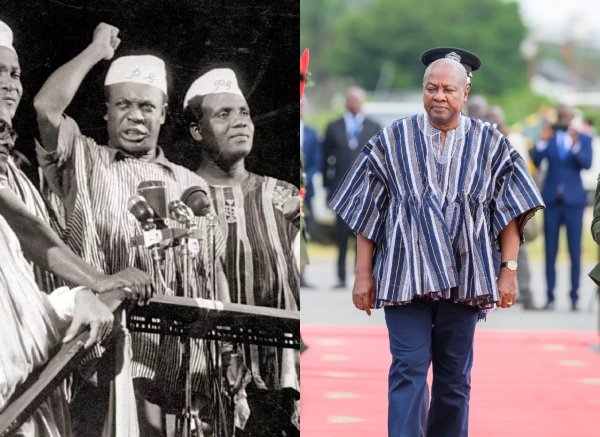
This opinion piece by Victoria Hamah (PhD) argues that President John Dramani Mahama’s foreign-policy direction reflects a renewed commitment to Kwame Nkrumah’s ideas of sovereignty, non-alignment, and economic independence. It points to symbolic actions—such as renaming Kotoka International Airport back to Accra International Airport—as part of a broader effort to correct historical narratives, strengthen national autonomy, and revive a modern, constitutional form of Nkrumahism 60 years after the 1966 coup.
Resetting Sovereignty: Mahama’s Foreign Policy and the Constitutional Revival of NKRUMAHISM 60 years after the 1966 Coup
After 60 years, the most shameful blot on the page of national dignity has finally been erased. The Kotoka International Airport has been reverted to its rightful name, Accra International Airport.
This decision by President John Mahama represents more than just an administrative rebranding. It signals an effort to interrogate the historical foundations upon which the postcolonial Ghanaian state was constructed.
The airport was named after Lieutenant General Emmanuel Kwasi Kotoka, a central figure in the 1966 coup which overthrew Kwame Nkrumah. That coup marked a decisive interruption of Ghana’s early post-independence developmental trajectory and inaugurated a period of political instability, throwing Ghana, then the lodestar of Africa, into the decadence of neocolonial subjugation.
Recently declassified records from the Central Intelligence Agency have confirmed that the United States, Britain and France were actively involved in the planning of the coup. While debates persist regarding the precise degree of foreign involvement, the broader historical consensus recognises that the overthrow of Nkrumah occurred within a broader context of Western imperialist efforts to derail the independent developmental model in particular and the pan-African vision in general.
Within this frame, the renaming of the airport functions as an act of narrative correction. It does not merely revisit the legacy of one military officer who was nothing more than a soldier of fortune; it symbolically re-centres Ghana’s identity around civilian constitutional sovereignty rather than military intervention.
In doing so, it aligns with the broader philosophical thrust of President Mahama: that political and economic independence must be reclaimed not only through fiscal and industrial policy, but through the stories nations tell about their own past.
This symbolic gesture addresses an earlier rupture in Ghana’s sovereign development. Together, they articulate a consistent thesis: that independence is neither a completed event nor a ceremonial inheritance, but an ongoing political project requiring institutional, economic, and historical recalibration.
The symbolic timing is equally significant. Sixty years after the infamous 24th February 1966 coup d’état, the renaming signals more than historical reconsideration; it suggests an ideological repositioning.
It indicates an aspiration by the National Democratic Congress (NDC) government toward a consciously pro-Nkrumahist orientation, one grounded in non-alignment, strategic autonomy, and policy independence amid an increasingly turbulent global order.
For John Dramani Mahama’s administration, this does not imply a retreat into isolationism nor a rejection of global engagement. Rather, it reflects a recalibration of Ghana’s external posture: cooperation without subordination, partnership without policy capture.
In a period marked by intensifying geopolitical rivalry and assertive economic diplomacy from powerful states in the Global North, particularly Western nations. The gesture evokes the earlier doctrine of Kwame Nkrumah, who situated Ghana within the Non-Aligned Movement as a sovereign actor rather than a peripheral client.
Read in this light, the act is not revisionist symbolism for its own sake. It articulates a continuity between the Accra Reset and Ghana’s unfinished post-independence project. The 1966 coup interrupted an ambitious experiment in autonomous development and continental leadership.
To revisit that rupture six decades later is to suggest that the questions posed in the 1960s -abhorrent alignment, dependency, and the boundaries of sovereignty – should define the character of political debate.
Economic Sovereignty as a Foreign Policy: The Reset in Practice:
President John Dramani Mahama’s unprecedented post-Rawlings era electoral victory carries significance beyond partisan transition. It represents, symbolically, a renaissance of Nkrumahism within Ghana’s contemporary democratic framework.
For the first time since the revolutionary and post-revolutionary dominance of Jerry Rawlings, a renewed mandate has been secured on a platform explicitly invoking structural transformation, strategic autonomy, and continental alignment rather than mere macroeconomic stabilisation.
This moment also clarifies an older historical debate. Prior to the 24 February 1966 coup that overthrew Kwame Nkrumah, there were persistent allegations, advanced by Nkrumah himself, that Western powers, uneasy with Ghana’s non-aligned posture and pan-African activism, exerted economic pressure by manipulating global cocoa markets.
As cocoa was Ghana’s principal export and foreign exchange earner, its price volatility had profound fiscal implications. Some historical interpretations further suggest tacit alignment by neighbouring Côte d’Ivoire, which is also a major cocoa producer within broader Western-aligned commodity structures, thereby compounding Ghana’s vulnerability and creating the mood for violent regime change.
Whether interpreted as deliberate sabotage or structural dependency within a commodity-based global economy, the episode reinforced a central Nkrumahist lesson: political sovereignty without economic autonomy is fragile.
Mahama’s present mandate appears framed as an effort to transcend that vulnerability without repudiating constitutional democracy or global engagement.
A key example is the decision to move away from syndicated external financing arrangements in the cocoa sector and to prioritise domestic value addition by processing up to half of Ghana’s cocoa output locally. This signals a deliberate shift from dependence on raw commodities toward industrial upgrading.
If implemented effectively, this approach aligns closely with classical Nkrumahist economic thought: retaining greater value within the domestic economy, reducing exposure to external price shocks, and building industrial capacity anchored in existing comparative advantage. It is not autarky but strategic repositioning within global markets.
Describing this moment as a renaissance of Nkrumahism, therefore, does not imply a return to one-party statism or Cold War binaries. Rather, it signals the re-emergence of core principles of economic self-determination, continental integration, and calibrated non-alignment within a competitive multiparty order.
Taken together, the symbolic reconsideration of colonial-era commemorations, the Nkrumahist articulation of foreign policy by Samuel Okudzeto Ablakwa, reforms within the cocoa financing architecture, and Mahama’s renewed electoral mandate, the moment can be read as deliberate ideological consolidation. It suggests that the questions suspended in 1966 have re-entered Ghana’s political centre, not as nostalgia, but as a strategy: a constitutionalised revival of the unfinished project of autonomous development.
Thus, the Reset Agenda operates on three registers simultaneously: economic restructuring, institutional reform, and historical re-anchoring. Together, they imply that sovereignty is not merely territorial integrity nor formal democratic procedure, but the sustained capacity to determine national priorities without external veto.
If the coup marked the suspension of that ambition, the present moment is framed as its cautious revival.

As Russia’s war in Ukraine enters its fifth year, Peter Rutland and Elizaveta Gaufman, surmise in this article that public support for President Vladimir Putin and the “special military operation” remains high in polls (over 80% approval for Putin, 60-70% for the war). However, the authors argue that this “Putin consensus” is fragile.

Peter Rutland, Wesleyan University and Elizaveta Gaufman, University of Groningen
Perceived wisdom has it that the longer a war goes on, the less enthusiastic a public becomes for continuing the conflict. After all, it is ordinary citizens who tend to bear the economic and human costs.
And yet, as the war following Russia’s full-scale invasion of Ukraine in February 2022 enters its fifth year, the attitude of the Russian public remains difficult to gauge: Just over half of Russians, according to one recent poll, expect the war to end in 2026; yet a majority say that should negotiations fail, Moscow needs to “escalate” with greater use of force.
As observers of Russian society, we believe this ambiguity in Russian public opinion gives President Vladimir Putin the cover to continue pushing hard for his goals in Ukraine. Yet at the same time, a deeper dive into the Russian public’s apparent support for the war suggests that it is more fragile than the Russian president would like to believe.
Putin’s social contract
From Day 1 of the conflict, Western strategy has been predicated on the belief that economic sanctions would eventually cause either the Russian elite or its society to persuade Putin to abandon the war.
This, in turn, is based on the assumption that the legitimacy of Putinism rests on a social contract of sorts: The Russian people will be loyal to the Kremlin if they enjoy a stable standard of living and are allowed to pursue their private lives without interference from the state.
The Russian economy has been struggling since 2014, so many analysts believed that this social contract was coming under strain even before the full-scale invasion of Ukraine. However, after four years of war, the combination of exclusion from European markets and a tripling of military spending has led to economic stagnation and mounting pressure on living standards.
One problem with the social contract approach is that it tends to downplay the role of ideology.
It is possible that Putin’s “Make Russia Great Again” propaganda resonates with a significant part of the Russian public. Polling has consistently placed Putin’s approval rating above 80% since the beginning of the Ukraine conflict.
Of course, the validity of the results of polls in an authoritarian society at war cannot be taken at face value. Yet, one shouldn’t rule out that some of that support is genuine and rests not just on a stable economy but also on popular endorsement of Putin’s pledge to restore Russia’s power and influence on the world stage.
Rallying Russians
Some scholars point to a “rally around the flag” effect. There was an apparent surge in Putin’s approval rating after the use of military force against Ukraine in 2014 and 2022.
It is hard to tell whether the surge in support for Putin reflects a genuine shift in opinion or just a response to media coverage and what people perceive as the acceptable response.
The Kremlin has tried to hide the costs of the war from the public: concealing the true death toll and avoiding full-scale mobilization of conscripts by recruiting highly paid volunteers. It is also trying to keep the economy stable by drawing down the country’s reserve funds.
That leaves open the question of whether the “Putin consensus” will break down at some point in the future if the costs of the war start to hit home for a majority of Russians.
The problem with polls
The consensus view among observers is that a small minority of Russians oppose the war, a slightly larger minority enthusiastically support the war, and the majority passively go along with what the state is doing.
There are still some independent pollsters conducting surveys in Russia that report a high level of support among respondents for the “special military operation” against Ukraine, with figures ranging between 60% and 70%.
A number of researchers have pointed out the difficulty in getting an accurate snapshot of Russian public opinion, given that the polling questions might make the respondent fearful of being accused of breaking laws that penalize “spreading fake news” and “discrediting the army” with a lengthy prison sentence.
The Levada Center, which is still regarded as an independent and relatively reliable pollster, conducts its interviews face to face in people’s homes but has a very low response rate. Polls conducted online, in return for monetary rewards, can try to find demographically balanced respondents, but the problem of wariness about giving answers that are critical of the regime remains. In Russia’s current political environment, refusing to answer or giving a socially acceptable response is a rational strategy.
Some scholars, such as those associated with the Public Sociology Laboratory, which looks at public sentiment in post-Soviet states, still conduct fieldwork inside Russia, sending researchers to live incognito in provincial towns and observe social practices involving support for the war.
Their ethnographic research finds little evidence for a “rally around the flag” effect in provincial Russian society. Other analysts have turned to digital ethnography of social media as an alternative source of insight. But analysts unfamiliar with the local and digital context risk mistaking performative loyalty for genuine belief.
‘Internal emigration’
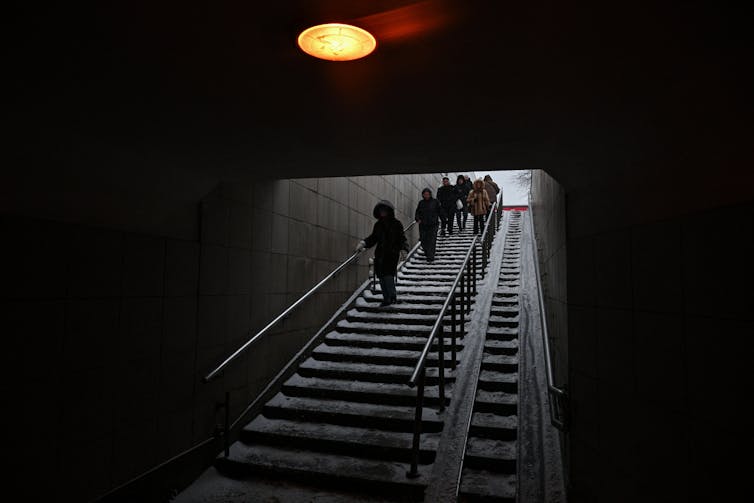
Most Russian citizens try to avoid political discussion altogether and retreat into what is often described as “internal emigration” – living their own lives while keeping interactions with the authorities to a minimum.
This practice dates back to the Soviet period but resurfaced as political repression increased after Putin’s return to the presidency in 2012.
There is no doubt that there are many fervent war supporters in Russia. They are quite vocal and visible because the state allows them to be – such as the military bloggers reporting from the front lines.
Apart from looking at opinion polls and social media, one can also probe the level of genuine support for the war by looking at everyday practices. If popular support for the war were enthusiastic, recruitment offices would be overwhelmed. They are not.
Instead, Russia has relied heavily on financial incentives, aggressive advertising, prison recruitment and coercive mobilization. At the same time, hundreds of thousands of men have sought to avoid conscription by leaving the country, hiding from authorities or exploiting legal exemptions.
Symbolic participation follows a similar pattern. State-sponsored Z symbols continue to dominate public space – the letter Z is used as a symbol of support for the war, in slogans such as “Za pobedu,” which translates to “for victory.” But privately displayed signs of support have largely disappeared.

Humanitarian aid to be sent to soldiers on the front lines or occupied Ukraine is often collected through schools and churches, where participation is shaped by social or administrative pressure. But many participants frame their involvement as helping individuals rather than supporting the war itself.
Reality vs. lived experience
High-profile propaganda products frequently fail to resonate. Music charts and streaming platforms in Russia are dominated not by patriotic anthems but by an eclectic mix of songs about personal relationships, such as Jakone’s moody ballad “Eyes As Wet As Asphalt,” songs in praise of “Hoodies” and even a catchy Bashkir folk song.
Book sales show strong demand for works such as George Orwell’s “1984” and Viktor Frankl’s Holocaust memoir “Man’s Search for Meaning,” suggesting that readers are searching for ways to understand authoritarianism, trauma and moral responsibility rather than celebrating militarism.
And instead of watching the state-backed film “Tolerance,” a dystopian tale of moral decay in the West, Russians are streaming the “Heated Rivalry” gay hockey romance.
Putin’s campaign to promote what he sees as traditional values appears not to be cutting through. Divorce rates are among the highest in the world – and birth rates continue to fall.
Heading into the Ukraine war’s fifth year, the gulf between the Kremlin version of reality and the lived experience of ordinary Russians remains. It echoes a pattern we have seen before: In the final decade of the Soviet Union the Kremlin became increasingly out of touch with the views of its people.
History will not necessarily repeat itself – but the masters of the Kremlin should be conscious of the parallels.
Peter Rutland, Professor of Government, Wesleyan University and Elizaveta Gaufman, Assistant Professor of Russian Discourse and Politics, University of Groningen
This article is republished from The Conversation under a Creative Commons license. Read the original article.

Ghana produces some of the world’s finest cocoa beans, yet the majority of its cocoa farmers remain trapped in poverty due to low farmgate prices, exploitative supply-chain structures, middlemen taking large margins, high input costs, climate change impacts, illegal mining (galamsey) destroying farms, and limited access to credit and modern farming techniques. This article by H. Aku Kwapong argues that while multinational chocolate companies earn billions from Ghanaian cocoa, farmers receive only a tiny fraction of the final retail value, calling for urgent reforms in pricing, local processing, cooperative models, and government intervention to ensure fairer wealth distribution along the cocoa value chain.
The cocoa conundrum: Why Ghana’s farmers are poor despite making the world’s best chocolate
Every so often, you come across an economic situation so perverse, so utterly divorced from basic market logic, that you have to wonder how it has survived for so long.
The case of Ghana’s cocoa sector is a textbook example. Here we have a country that produces some of the world’s finest cocoa—the essential ingredient for a multi-billion dollar global chocolate industry. Yet the smallholder farmers who are the bedrock of this industry remain trapped in extreme poverty, many earning less than a dollar a day. How can this be?
The answer, as is so often the case, lies in a toxic mix of well-intentioned but misguided policy, institutional sclerosis, and a fundamental misunderstanding of how markets actually work. For over seven decades, Ghana has operated a state-run monopoly, the Ghana Cocoa Board (COCOBOD), that controls every aspect of the industry from farm gate to export. The result is a classic case of monopsony power, a single buyer that can dictate prices to sellers. And when a single buyer dictates prices, the sellers inevitably get a raw deal.
When cocoa prices quadrupled on the world market in 2023-2025, reaching nearly $12,000 per metric ton, Ghanaian farmers should have seen a windfall. They didn’t. Because of COCOBOD’s byzantine system of forward contracts and price-fixing, they were locked into prices that bore no resemblance to market reality. The very system designed to protect them from volatility ended up shielding them from prosperity. It’s an economic tragedy, and it’s long past time to end it.

This report is not an academic exercise. It is a call for a pragmatic, clear-eyed revolution in how Ghana manages its most important agricultural sector. It lays out a framework for dismantling a failed state monopoly and building a modern, competitive market in its place.
This isn’t about blind faith in laissez-faire economics—the history of commodity markets is littered with the victims of chaotic, unsupported liberalization. Instead, it’s about getting the institutions right, creating what I call a “meso-model” where a lean, effective government regulates a dynamic private sector. It’s about finally letting the market work for, not against, the people who make it possible.
1.The Economics of a Broken System
Let’s be clear about the diagnosis. Ghana’s cocoa problem isn’t a mystery; it’s a straightforward story of bad economics compounded by institutional inertia.
The current model, where COCOBOD acts as the sole buyer and seller of cocoa, is a relic of a bygone era of state-led development that most of the world has moved beyond. Its defenders will point to the premium quality of Ghanaian cocoa as justification for the system. And yes, the quality is good. But at what cost?
The Monopsony Trap
Here’s the fundamental problem: COCOBOD’s monopoly on purchasing cocoa from farmers means it faces no competition. Basic economics tells us what happens when a buyer has monopsony power – it can, and does, pay a price far below what a competitive market would deliver. Farmers in Ghana typically receive around 55% of the Free on Board (FOB) export price for their beans. Compare that to the 70-75% received by their counterparts in the more liberalized markets of Indonesia and Ecuador.
That 15-20 percentage point difference isn’t just a number on a spreadsheet. For a farming family, it’s the difference between a living income and grinding poverty. It’s the difference between being able to afford fertilizer and watching your trees succumb to disease. It’s the difference between sending your children to school and sending them to work in the fields.
And let’s be honest about what’s happening to that missing 40-45% of the export value. Some of it goes to legitimate costs – quality control, research, extension services. But a large chunk disappears into the maw of an inefficient, bloated bureaucracy that employs thousands of people and operates subsidiaries that would make a Soviet-era ministry proud.
The Illusion of Stability
The great promise of the COCOBOD system was price stability. By selling the crop forward on international markets, it was supposed to shield farmers from the notorious volatility of commodity prices. This sounds good in theory. In practice, it’s been a disaster.
The 2023-2025 price crisis exposed the fundamental flaw in this approach. When world cocoa prices exploded due to supply shortages in West Africa, the forward-selling system didn’t just fail to deliver the upside to farmers – it nearly bankrupted COCOBOD itself, which found itself on the wrong side of its own hedges. The institution recorded massive losses while farmers continued to receive their fixed, below-market prices.
This is the perverse logic of the current system: it privatizes the risks (which farmers bear through chronically low prices) and socializes the losses (which the state, and ultimately the taxpayer, has to cover). It’s heads the middlemen win, tails the farmers lose.
The Stagnation Effect
When you insulate an entire industry from market signals, you get stagnation. There is no incentive for innovation, no drive for efficiency, no pressure to improve. Why should a private company invest in better logistics or processing facilities if it can’t compete on price? Why should a farmer invest in higher quality beans or replant aging trees if they get paid the same as everyone else regardless of quality?
The result is an industry operating far below its potential. Production has collapsed from over 1 million tonnes in 2010/11 to just 654,000 tonnes in 2023 – a 14-year low. The tree stock is aging, with an estimated 40% of cocoa trees past their productive prime. The farming population itself is aging, with an average age over 50, as young people flee for better opportunities, including the destructive illegal gold mining (‘galamsey’) that is eating away at cocoa farmland.
This is what happens when you try to run an agricultural sector like a command economy. You get all the inefficiency of central planning with none of the dynamism of a market.
So the argument that we must choose between the chaos of a fully free market and the stagnation of a state monopoly is a false dichotomy. The real task is to design a system that combines the dynamism of competition with the stability of smart regulation. That’s what I mean by a “meso-model,” and that’s what the rest of this report is about.
2.Learning from Others: The Liberalization Spectrum
Before we dive into the specifics of reform, it’s worth looking at what has happened in other cocoa-producing countries that have experimented with different models. The evidence is actually quite instructive.
The Cautionary Tale of Full Liberalization
Nigeria liberalized its cocoa market in 1986, dismantling its marketing board and letting the market rip. The results were mixed at best. On the positive side, competition increased, more private traders entered the market, and farmers gained more options for selling their cocoa. Production initially increased as farmers responded to better price signals.
But there was a dark side. The abolition of the marketing board led to a collapse in quality control and extension services. Nigerian cocoa, once renowned for its quality, saw its reputation deteriorate as beans of varying quality flooded the market. Farmers lost access to credit and inputs that the marketing board had previously provided. And the market became dominated by a handful of large export firms, which used their oligopsony power to squeeze farmers.
The lesson here is clear: simply smashing the state monopoly and walking away is not a recipe for success. Markets need institutions to function properly.
The Ivorian Alternative
Côte d’Ivoire, the world’s largest cocoa producer, offers a more promising model. After its own chaotic liberalization in the 1990s, the country established a hybrid system built around the Conseil du Café-Cacao (CCC), a regulatory body that works in partnership with the private sector.
Here’s how it works: The CCC sets a guaranteed minimum price for farmers at the beginning of each season, providing a safety net against price crashes. But it also licenses private companies to compete in buying and exporting cocoa. These companies can offer bonuses above the minimum price for higher quality beans or faster payment. The result is a system that provides both stability and competition.
The Ivorian model isn’t perfect – it still involves significant state intervention, and there are concerns about corruption and the fiscal costs of the price guarantee. But it has managed to maintain quality standards while allowing for private sector dynamism. Production has grown steadily, and farmers receive a higher share of the export price than their Ghanaian counterparts.
What Ghana Can Learn
The lesson from this comparative analysis is straightforward: Ghana needs to move away from its current fully regulated model, but it should not leap to full liberalization. The optimal path is a middle ground – a “meso-model” that retains essential state functions (regulation, quality control, research) while introducing competition in commercial activities (buying, processing, exporting).
This is not a radical idea. It’s basically what most successful agricultural sectors around the world do. The government sets the rules and provides public goods; the private sector competes to deliver services and create value. It’s time Ghana joined the 21st century.
3.The Reform Framework: Eight Pillars for a New Dawn
So what does a sensible reform program look like? It rests on eight interconnected pillars, each addressing a specific dysfunction in the current system. Let me walk through them.
Pillar 1: Transforming COCOBOD from Monopolist to Regulator
The first and most critical step is to fundamentally restructure COCOBOD. The institution needs to go on a serious diet, shedding its commercial functions and focusing on the essential public goods that only government can provide.
What COCOBOD Should Keep:
•Quality Control: This is a genuine public good and a crucial national asset. Ghana’s reputation for premium cocoa is worth protecting, and a centralized quality control system is the best way to do it. The Quality Control Company (QCC) should remain under COCOBOD’s umbrella, ensuring that all exported cocoa meets high standards.
•Research and Development: The Cocoa Research Institute of Ghana (CRIG) has done valuable work developing high-yielding, disease-resistant varieties. This is exactly the kind of basic research that the private sector tends to under-invest in. CRIG should continue to receive public funding and should be encouraged to partner with universities and international research institutions.
•Regulation: Someone needs to set the rules for a competitive market – licensing buyers and exporters, monitoring for anti-competitive behavior, ensuring traceability and compliance with international standards. This is a core government function.
What COCOBOD Should Lose:
•Internal Marketing: The business of buying cocoa from farmers should be opened to competition among Licensed Buying Companies (LBCs), farmer cooperatives, and processing companies. Let them compete on price, payment terms, and services. The farmers will benefit.
•Input Supply: The procurement and distribution of fertilizers and pesticides should be handled by private agro-dealers. The current system of heavily subsidized inputs distributed through COCOBOD is costly, inefficient, and subject to political manipulation. A competitive market for inputs, perhaps supported by targeted vouchers for the poorest farmers, would work better.
•Export Marketing: The Cocoa Marketing Company (CMC), which currently has a monopoly on exports, should either be privatized or forced to compete with other licensed exporters. This would allow for more innovative marketing arrangements and better price discovery.
This transformation will not be easy. It will require significant downsizing and restructuring. COCOBOD currently employs thousands of people; a lean regulatory body would need far fewer. A comprehensive staff rationalization plan, including voluntary retirement schemes and retraining programs, will be essential. But the alternative is the slow-motion collapse of the entire institution, which helps no one.
Pillar 2: Creating Space for Private Enterprise
Once COCOBOD gets out of the way, private companies can step in to compete across the value chain. But they won’t do so unless the government creates an enabling environment. This means three things:
Regulatory Certainty: Investors need to know that the rules won’t change overnight. A clear, transparent, and stable regulatory framework is essential. This includes straightforward licensing procedures, well-defined quality standards, and consistent enforcement.
Infrastructure: You can’t build a competitive industry on crumbling roads and unreliable electricity. The government needs to invest in the basics – farm-to-market roads, port facilities, warehousing, and above all, reliable and affordable power. The fact that electricity costs in Ghana are nearly double those in Côte d’Ivoire is a major barrier to developing a domestic processing industry.
Targeted Incentives: To encourage investment in value addition – turning raw beans into cocoa liquor, butter, powder, and finished chocolate – the government should offer tax holidays, reduced import duties on processing equipment, and perhaps subsidized electricity for processing facilities. The goal is to move Ghana up the value chain, capturing more of the value that currently goes to processors in Europe and Asia.
The potential here is enormous. Ghana currently processes only about 23% of its cocoa production domestically, and existing facilities operate at less than 50% capacity. With the right policies, Ghana could become a major exporter of processed cocoa products and even build globally recognized chocolate brands. Companies like Fairafric are already showing what’s possible.
Pillar 3: Fixing the Price Mechanism
The current pricing system is, to put it bluntly, a joke. It’s opaque, it’s rigid, and it systematically underpays farmers. The Producer Price Review Committee (PPRC) sets a fixed price at the beginning of each season based on projections that often turn out to be wildly wrong. Farmers have no idea how the price is calculated, and they have no recourse if they think it’s unfair.
This needs to be replaced with a transparent, market-based system. There are several options:
Auction System: Cocoa could be sold through regular auctions where buyers bid competitively for lots. This ensures transparent price discovery and allows farmers to benefit directly from market prices. Ethiopia’s commodity exchange provides a successful model.
Commodity Exchange: The proposed Africa Commodity Exchange (AfCX) could provide a pan-African platform for trading cocoa, with prices determined by supply and demand.
Direct Contracts: Farmers and cooperatives could negotiate direct contracts with buyers, allowing for differentiated pricing based on quality, volume, and delivery terms.
Hybrid Model: My preferred option is a hybrid approach that combines a guaranteed minimum price (a floor) with market-based pricing above that level. This is similar to Côte d’Ivoire’s model. The floor provides security against price crashes, but farmers can earn more if they produce higher quality beans or if market conditions are favorable.
The key principle is simple: farmers should receive at least 70% of the FOB export price. This isn’t charity; it’s basic market efficiency. Farmers who are paid a fair price will invest in their farms, leading to higher production and better quality. Everyone wins.
Of course, a market-based system means price volatility. But there are sensible ways to manage this risk. A price stabilization fund can smooth out fluctuations by saving money in good years to support prices in bad years. Crop insurance can protect farmers from severe price drops. And over time, as farmers and cooperatives gain experience, they can use financial instruments like futures contracts to hedge their own risk.
Pillar 4: Building a Real Processing Industry
Here’s a shocking fact: Ghana captures only about 6.6% of the total value of its cocoa production. The rest – the vast majority—is captured by processors and manufacturers in
Europe, North America, and Asia. This is economic madness. Ghana is exporting raw materials and importing finished products, exactly the colonial pattern that developing countries are supposed to have moved beyond.
The solution is to dramatically expand domestic processing capacity. Ghana already has several major processing facilities, but they operate at less than 50% capacity because they can’t get enough beans. In the current system, COCOBOD’s forward sales contracts commit most of the crop to international buyers, leaving domestic processors scrambling for supply.
In a liberalized market, processors would be able to source beans directly from farmers. But during the transition, the government should guarantee that a certain percentage of production, say, 30-40%, is reserved for domestic processors at competitive prices. This would ensure that processors can operate at full capacity.
The barriers to processing are well-known: high energy costs, limited access to finance, and a shortage of skilled workers. Each of these can be addressed with targeted policies:
•Energy subsidies for processing facilities to offset Ghana’s high electricity costs.
•Tax incentives, including corporate tax holidays and duty-free imports of processing equipment.
•Dedicated financing facilities, perhaps through a Cocoa Development Bank, to provide long-term, affordable credit.
•Skills development programs in partnership with technical universities and international training institutions.
Beyond semi-processed products, Ghana should aim to build its own chocolate manufacturing industry and develop globally recognized Ghanaian chocolate brands. The market for premium, single-origin, ethically sourced chocolate is growing rapidly. Ghanaian brands can capitalize on the country’s reputation for quality, its sustainability credentials, and its unique cultural heritage. With the right support, “Made in Ghana” chocolate could become a premium product on the world market.
Pillar 5: Empowering Farmers Through Cooperatives and Land Reform
Individual smallholder farmers have essentially no bargaining power when facing large buyers. This is why strong, well-organized farmer cooperatives are essential. Cooperatives can negotiate collectively, secure better prices, access credit, and provide services to their members.
Ghana has a history of farmer cooperatives, including the well-known Kuapa Kokoo, a Fairtrade cooperative with over 100,000 members. But many cooperatives suffer from weak governance, poor financial management, and limited capacity. They need support, training in governance and financial management, access to credit, and a clear legal framework that protects their rights.
In a liberalized market, cooperatives should be able to negotiate directly with buyers and processors on behalf of their members. This collective bargaining power is the best defense against exploitation.
But there’s an even more fundamental issue: land tenure. Many cocoa farmers in Ghana don’t have secure title to the land they farm. Under the traditional Customary Land Tenure System, they have only usufruct rights – the right to use the land but not to own it. This creates a massive disincentive to long-term investment.
Why would you cut down old, unproductive trees and replant if you’re not sure you’ll still have the land in five years when the new trees start producing? Why would you invest in soil improvement or irrigation if you could lose the land at any time? And without formal title, you can’t use your land as collateral for a loan.
This is a politically sensitive issue, involving traditional authorities and complex customary law. But it must be addressed. Options include formalizing long-term leases, providing legal protections for farmers who replant, and gradually introducing formal land titling in cocoa- growing regions. Women farmers, who often have even more insecure land rights than men, need special attention.
Pillar 6: Leveraging Technology
We live in the 21st century, but much of Ghana’s cocoa sector operates as if it’s still the 20th. Technology can change this, and it doesn’t require massive investments in fancy equipment. Simple, accessible technologies can make a huge difference.
Mobile Payments: Ghana already has widespread mobile money platforms like MTN Mobile Money. Extending these to cocoa payments would mean farmers get paid immediately upon delivery, with a digital record that reduces disputes and fraud. It would also give farmers access to savings and credit products linked to their mobile wallets.
Digital Extension Services: Mobile apps and SMS platforms can deliver timely advice on weather, pest control, best practices, and market prices. The Cocoa Link program has already demonstrated the potential of this approach.
Traceability Systems: The EU Deforestation Regulation now requires full traceability of cocoa imports. Digital systems using GPS mapping and mobile data collection can help Ghanaian farmers comply with these requirements and access premium markets. This isn’t optional anymore; it’s a necessity.
And here’s the thing: attracting young people back to cocoa farming requires making it less of a backbreaking, low-tech drudgery and more of a modern, tech-enabled business. Higher incomes are part of the answer, but so is modernization.
Pillar 7: Building the Regulatory Architecture
A liberalized market needs a strong regulatory framework. The current system, where COCOBOD is both player and referee, is fundamentally flawed. Ghana needs an independent Cocoa Regulatory Authority (CRA) that is separate from COCOBOD and reports to Parliament rather than to a government ministry.
The CRA’s job would be to:
•License buyers, processors, and exporters.
•Set and enforce quality standards.
•Monitor the market for anti-competitive behavior.
•Resolve disputes between farmers and buyers.
•Oversee traceability and compliance with international regulations.
Ghana also needs to strengthen its competition law and apply it rigorously to the cocoa sector to prevent price-fixing and market manipulation. And it needs a clear legal framework for contracts, with fast-track arbitration and mediation services for disputes.
The goal is to create a level playing field where companies compete on efficiency and service, not on political connections or market manipulation.
Pillar 8: Financing the Transition
For decades, Ghana’s cocoa sector has been financed through an annual syndicated loan arranged by COCOBOD, typically in the range of $1.5-2 billion. This model is no longer sustainable. The cost of the loan has risen sharply, and COCOBOD has struggled to service its debt.
A liberalized sector needs a diversified financing ecosystem:
•Commercial bank lending to LBCs, processors, and farmer cooperatives.
•Warehouse receipt financing, which allows farmers to use stored cocoa as collateral for loans.
•Supply chain finance, where buyers provide advance payments to farmers in exchange for guaranteed supply.
•Microfinance and impact investing for small farmers and businesses.
•A Cocoa Development Bank to provide long-term, affordable credit for the sector.
The Ghana Stock Exchange could also play a role, with large processors and LBCs listing to raise equity capital, and cocoa-backed bonds to finance infrastructure.
The key is to move away from the current model where the entire sector depends on a single, increasingly expensive loan, and toward a system where financing flows from multiple sources based on commercial viability.
4.The Politics of Reform: Why This Is Hard (But Necessary)
Let me be blunt: the economics of cocoa reform are straightforward. The path to a more prosperous and competitive sector is clear. The real challenge, as always, is politics.
Any serious reform will threaten entrenched interests that benefit from the current system. COCOBOD employs thousands of people, many of whom will resist downsizing. The current system creates opportunities for rent-seeking and corruption that will be harder to maintain in a competitive market. And there’s a genuine, if misguided, ideological attachment to the idea of state control among some policymakers.
There will be resistance. There will be scare stories about how liberalization will lead to chaos and exploitation. There will be warnings that Ghana will lose its quality premium. These arguments need to be confronted head-on with evidence and clear communication.
This is why the transition must be carefully managed, with a clear roadmap, strong governance, and constant engagement with all stakeholders. A “big bang” approach is likely to fail, as Nigeria’s experience shows. A phased, 5-10 year transition, with clear milestones and measurable targets, is the only realistic way forward.
Phase 1 (Years 1-2): Establish the legal framework, launch pilot programs in selected regions, begin COCOBOD restructuring.
Phase 2 (Years 3-5): Roll out liberalized internal marketing nationwide, operationalize the CRA, introduce market-linked pricing, implement processing incentives.
Phase 3 (Years 6-10): Complete export liberalization, finish COCOBOD transformation, achieve 70% farmer share target, reach 40% domestic processing target.
Success will require political courage and long-term vision. It will require resisting the temptation to backslide when things get difficult. And it will require constant monitoring and adjustment, because no reform plan survives first contact with reality unchanged.
But the alternative is to continue presiding over a system that is failing its farmers, failing the nation, and slowly collapsing under the weight of its own contradictions. The choice is stark, but it is also clear.
5.Conclusion: The Case for Optimism
I am, by temperament and training, a skeptic. I’ve seen too many grand reform plans fail, too many well-intentioned policies produce perverse outcomes. But I’m also an economist, and I believe that when you get the incentives right, when you build the right institutions, good things can happen.
Ghana’s cocoa sector is broken, but it’s not beyond repair. The country has enormous advantages: a reputation for quality, a large and experienced farming population, existing
processing infrastructure, and a strategic location. What it lacks is a sensible institutional framework that allows these advantages to be fully realized.
The reform framework laid out in this report is not utopian. It’s pragmatic, evidence-based, and grounded in the real-world experiences of other countries. It doesn’t require Ghana to become something it’s not; it requires Ghana to become a better version of itself.
If implemented with determination and skill, these reforms could transform Ghana’s cocoa sector from a struggling commodity exporter into a globally competitive industrial powerhouse. Farmers could earn a decent living. Young people could see a future in agriculture. Ghana could capture more of the value from its most important export crop.
This is not just about cocoa. It’s about whether Ghana can build the kind of modern, market- based institutions that are essential for sustained economic development. It’s about whether the country can move beyond the legacy of colonialism and state-led development to create a system that works for its people.
The time for a new dawn for Ghana’s cocoa is now. The question is whether Ghana’s leaders are ready to seize it.
By: H. Aku Kwapong Hene Aku Kwapong can be reached on oak@songhai.com. He is a founder of The Songhai Group and NBOSI (National Blue Ocean Strategy Institute). He formerly worked with GE Capital, Deutsche Bank and Royal Bank of Scotland and had been a Senior Vice President at the New York City Economic Development Corporation.


UK Black Stars Launched to Honor Influential British-Ghanaians as Ghana Turns 69

Ghanaians and Other Africans in UAE Flood Social Media with Videos as Iranian Missile Strikes Hit Dubai

Ghana Maintains Over 5 Weeks of Fuel Stock Amid Middle East Tensions and Other Trending Topics in Ghana (March 2, 2026)
-

 Ghana News1 day ago
Ghanaian’s Terrifying Experience as Missile Explodes Amid Escalating Middle East Tensions and Other Trending Topics in Ghana (March 1, 2026)
-

 Ghana News1 day ago
Ghana’s Black Queens Stranded in UAE as Government Initiates Partial Evacuation from Tehran Embassy Amid Escalating Israel-Iran Conflict
-
 Ghana News6 hours ago
Ghana Maintains Over 5 Weeks of Fuel Stock Amid Middle East Tensions and Other Trending Topics in Ghana (March 2, 2026)
-

 Ghana News1 day ago
7 Ways the Escalating Middle East Crisis Could Hit Home in Ghana
-
 From the Diaspora5 hours ago
Ghanaians and Other Africans in UAE Flood Social Media with Videos as Iranian Missile Strikes Hit Dubai
-

 Ghana News6 hours ago
Newspaper Headlines Today: Monday, March 2, 2026
-

 Africa Watch22 hours ago
How African Nations Are Evacuating Their Nationals Amid the Escalating Middle East Crisis
-

 From the Diaspora1 day ago
Ghanaian-Heritage Scientist AJ Addae Develops Breakthrough Sunscreen That Protects Darker Skin Without White Cast