
Festivals & Events
The Day After the Parade: Where Accra Goes to Hear Itself Think

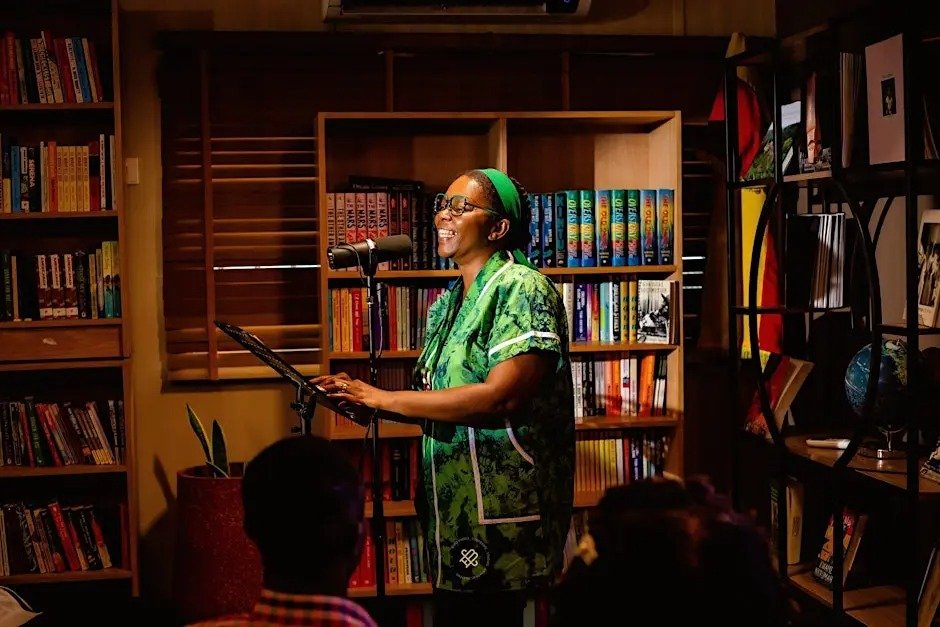
On 6 March, the official programme will proceed as usual. Speeches. A parade. Schoolchildren standing in the sun. It is important, yes. But if you want to feel independent, not just watch it, there is another place you should be.
The day after the flags go up, on Saturday, 7 March, a different kind of celebration is taking over East Legon. It is called Our Heritage through Music and Literature. And it is built on a simple idea: that Ghana’s freedom did not just happen in a conference room in 1957. It happens every time we tell our own stories.
Where the Stories Live
The event runs from midday until evening at the e-Ananse Library. If you do not know the name, you should. Ananse is the spider. The storyteller. The trickster who taught us that words have power. Holding an independence celebration in a place named after him tells you everything about what this day will feel like.
It opens with something quiet but necessary. A reading from Poetra Asantewa’s book, Someone Birthed Them Broken, put together with the Bibliophiles and Vibes Book Club. Before the music starts, before the crowd grows, there will be people sitting with a book, asking themselves what it means to be Ghanaian right now. That is the foundation.
Games That Remember
Between the literature and the music, the organisers have made space for something we do not do enough anymore. Play.
There will be outdoor and indoor Ghanaian games. The kind our parents played before screens arrived. It sounds simple. But watch a child learn ampe from an elder, or watch a tourist try to figure out our local board games, and you will see something shift. Culture passes from hand to hand in those moments. No lecture required.
Poetry That Listens
As the sun softens, the poets take over. Ancestors Answer Me is the name of the session, curated by Creatives Project Ghana. Four poets will stand up and try to connect the people who came before to the questions we are asking now. It could get heavy. It could get beautiful. Probably both.
The Evening Belongs to the Musicians
Then, the music.
TSIE, whose voice carries the weight of highlife and the lightness of now. Elsie Raad, who moves between genres like someone who refuses to be pinned down. Koo Kumi and Mr. Poetivist, both carrying the torch for spoken word and sound.
They will play acoustic. No heavy bass to drown out the thinking. Just voices and instruments, asking you to listen.
Why You Should Come
If you are visiting Ghana, you could spend your Independence Day weekend at a hotel pool. You would miss nothing but heat. Or you could come here, to East Legon, and sit in a room with people who are still figuring out what freedom means.
If you are Ghanaian, you could stay home. Or you could bring yourself and your questions to a place where we use music and words to do what Ananse always did—remind ourselves that the story is not over yet.
Date: Saturday, 7 March
Time: 12 pm – 8 pm
Location: e-Ananse Library, East Legon, Accra






Festivals & Events
The Old Playbook Says Keep Your Secrets. This Women’s Summit Says Give Them Away.

For years, the unspoken rule of getting ahead was simple: guard your contacts, protect your knowledge, and climb the ladder alone. It created a lot of successful, exhausted women. It also left a lot of other women standing at the bottom, looking up.
This March, a gathering in Accra is betting on a different formula.
The 8th National Women’s Summit & Expo (NWSE) lands at the Palms Convention Centre on Friday, 13 March 2026, and the people behind it are asking attendees to try something that might feel uncomfortable at first: give.
Not your money. Your time. Your contacts. Your hard-won wisdom.
The “Give to Gain” Mindset
The theme this year is “Give to Gain.” It is not one of those corporate slogans that sound nice and means nothing. It is a direct challenge to the scarcity mindset that tells women there is only one seat at the table.
Organizers are pushing the idea that success actually multiplies when you share it. If you mentor someone, you learn something. If you open a door for another woman, you build an ally. If you invest in a female founder, you grow the economy for everyone. It is a shift from asking “How do I get mine?” to asking “How do we build ours?”
More Than a Day of Speeches
If you have been to a few conferences in your time, you know the drill. Nice keynote. Warm coffee. A brochure you throw away on the way out.
NWSE has been running for seven years now, and the people who go actually seem to do things afterwards. It pulls in a mix you don’t often see in the same room: corporate board members sitting next to students who just started their first business, bankers chatting with creatives, founders looking for capital sitting across from the people who control it.
This year, they are leaning hard into the practical stuff. There will be the usual panels on leadership and entrepreneurship, but the focus is on access—access to money, access to networks, and access to the kind of advice you usually have to buy a very expensive lunch to get.
The Speed Mentorship Sessions
One of the more useful parts of the day is the speed mentorship. Imagine sitting down with a woman who has already made the mistakes you are about to make, and she tells you exactly how to avoid them in ten minutes. No fluff. No business card collecting. Just a quick, honest conversation that might change your direction.
Who Is Showing Up
The partners backing this thing are names you trust: Charterhouse, Geisha, and MTN Ghana, with support from Bayport, Standard Chartered, and Bel-Aqua. That mix matters. It signals that this is not a side project or a “women’s issue” event tucked away in a small hall. It is a mainstream business platform.
If You Want a Table
Organizers are also putting out the call for vendors. If you run a small business, a startup, or a brand trying to reach women who actually make decisions, the Expo floor might be worth your time. Spaces are limited, and they tend to go to people who book early rather than people who think about it.
Why Bother?
The world does not need another event where people take photos and post inspirational quotes. What it needs is the thing this summit is trying to manufacture: actual connection.
In a time when everyone is selling a course or guarding their “secret sauce,” the radical act might just be opening your mouth and sharing what you know.
When: Friday, 13 March 2026, 9:00 am – 6:00 pm
Where: Palms Convention Centre, La Palm Royal Beach Hotel
Registration: Open now
Vendor/Partnership Enquiries: 020 471 4598 or 024 646 9062
If you find yourself in Accra on the 7th of March, 2026, forget whatever dinner plans you had. There is only one place to be, and it is at the Efua Sutherland Park.
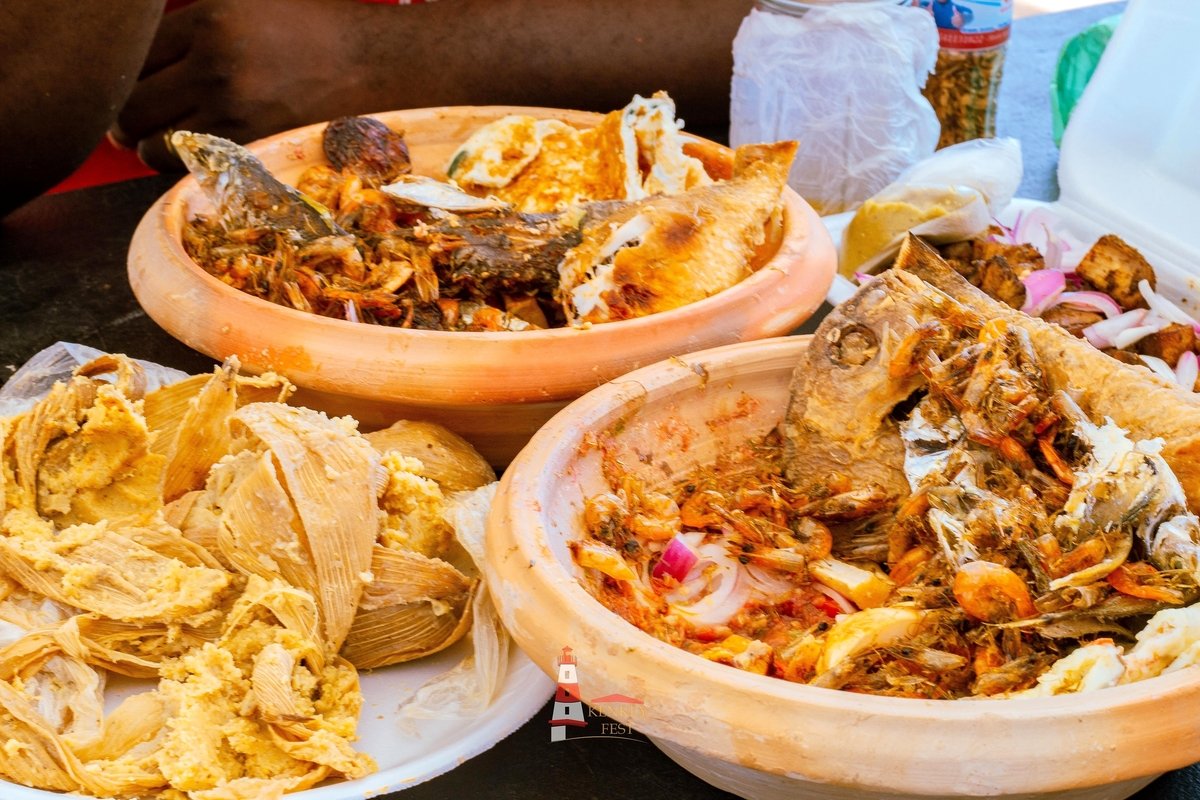
The Kenkey Festival is turning ten. A decade ago, it started as a small gathering of people who simply loved this fermented staple too much to keep quiet about it. Today, it has grown into one of the most anticipated food gatherings on the Ghanaian calendar. And on March 7th, the park will fill up with smoke, music, and the unmistakable aroma of corn dough steaming in dried leaves.
What Happens at the Festival?
This is not a sit-down dinner. This is a carnival.
Vendors from across the country will set up stations, each serving their version of the perfect kenkey. You will find the classic Accra style—white, sour balls of Ga kenkey served with fried fish, raw pepper, and a side of shito that demands respect. Right next to them, you will spot the Fante people with their soft, wrapped dokono, darker in color and sweeter on the palate. The friendly arguments over which one is better usually last until the music starts.
And the music will start. Expect live bands, DJs spinning Highlife and Afrobeats, and a crowd that treats the walkways as dance floors. There are eating competitions for the brave, cooking demonstrations for the curious, and plenty of seats under the trees for those who just want to soak it in.
The 10th Anniversary Vibe
Reaching ten years is a milestone for any event in Accra. The organizers are promising something special. Think limited-edition merchandise, a look back at photos from the past decade, and a few surprises that nod to the journey from 2016 to 2026.
The atmosphere is family-friendly but lively. You will see toddlers wobbling with their first taste of kenkey, right next to uncles who have been eating it for sixty years. It is a day when Ghanaians from all walks of life come together, and tourists get a front-row seat to the real Accra.
Plan Your Day
The date is set: Saturday, the 7th of March, 2026.
The place: Efua Sutherland Park, right in the heart of the city.
Come hungry. Come with cash for the vendors. Bring a friend who doesn’t mind sharing a table. Whether you are a lifelong fan of kenkey or you have never tried it before, this festival is your invitation to taste, dance, and celebrate something truly local.
If you think you have seen everything Ghana has to offer, let me tell you about a place where time seems to stand still. Up in the Upper East Region, nestled among the rocky outcrops of the Tongo Hills, the Talensi people hold onto a tradition that refuses to fade. This is the Gologo Festival. It is not the kind of event where you show up for a quick photo and leave. It grabs hold of something deeper.
A Prayer Before the Planting
Picture this: it is the end of March, the dry season has parched the land, and the air shimmers with heat. The rains are just around the corner, and the soil waits for the first seeds. For the Talensi, you do not just rush into farming. You have to ask permission. You have to seek blessings. That is what Gologo—sometimes called the Golib Festival—is all about. It is a plea to the gods and ancestors for a good harvest, for plentiful rain, and for the community’s safety.
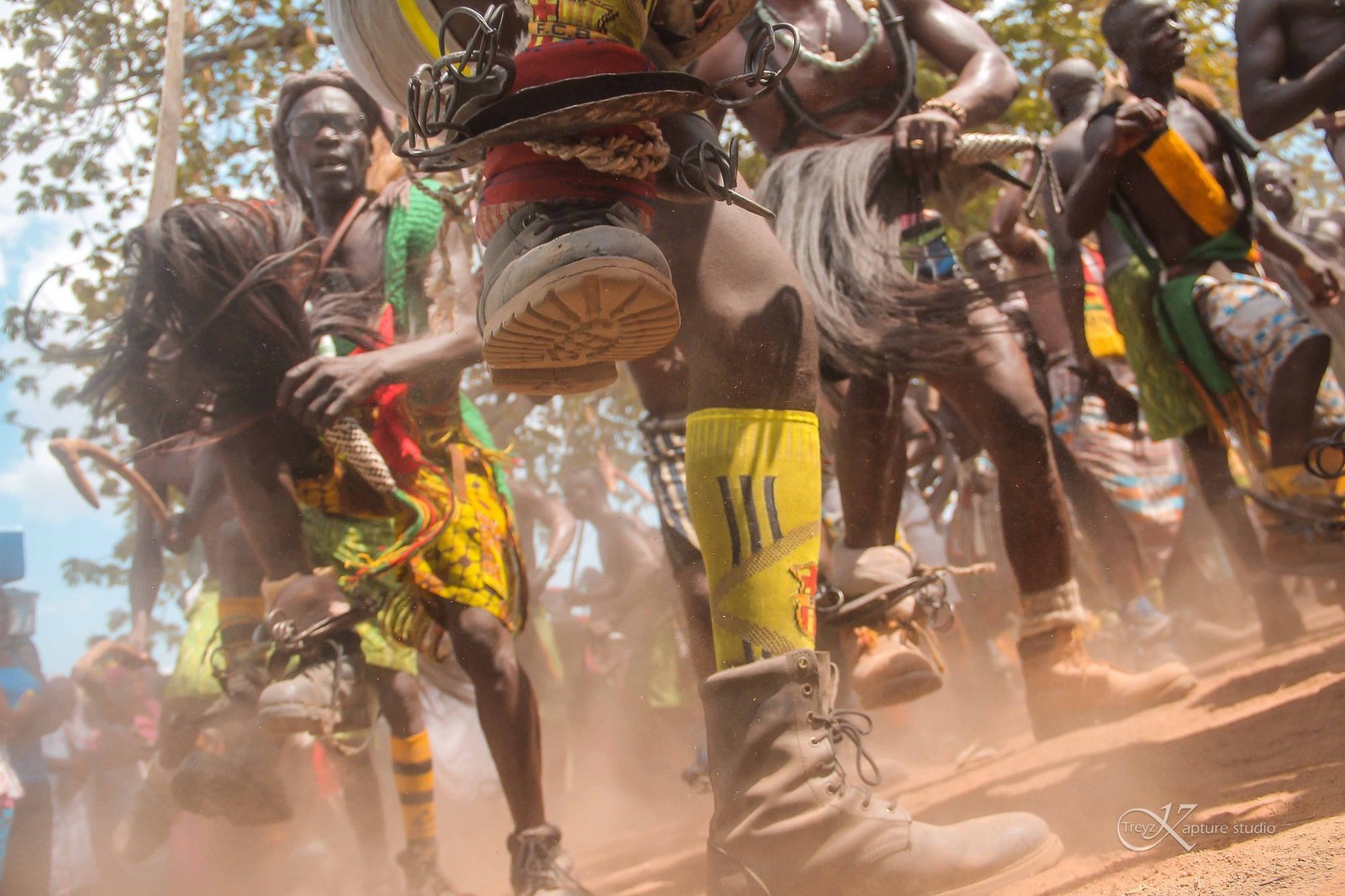
For three days, the celebration moves across different villages—Gorogo, Yinduri, and finally climaxes at Teng-Zug. This is not a loud, flashy street parade. It is raw and spiritual. The earth priests, known as the Tindaana, lead the way up to the sacred shrines tucked within the hills. They pour libations and offer sacrifices so that when the first millet is sown, it will grow strong.
The Look of Humility
What makes Gologo stand out from every other festival in the country is its look. If you visit during this time, you will notice something striking. The men wear only short knickers with a towel draped across their chest. The women wrap a long cloth from their chest down to their feet, their heads covered in fabric woven right there in the community. There is no room for flashy designer prints here. This simplicity is deliberate—it is about humility before the spirits. In fact, for a whole month leading up to the main event, you will not hear drums blasting or see people mourning loudly. Noise is forbidden. It is a time of quiet reflection.
Why You Belong There
As a tourist, you might wonder—is this something I can just walk into? The answer is yes, but you have to come with respect. The Ghana Tourism Authority has been pushing to repackage Gologo to attract more visitors, not to turn it into a circus, but to let the world see how culture can survive against all odds. Watching the Golob dancers move to rhythms that seem to shake the very ground is something else. They dress in what looks like war attire, clutching knives, moving with an energy that makes you forget your phone exists.
For the local Ghanaian reading this, especially those who grew up in the cities where these traditions feel distant, Gologo is a homecoming. It reminds you that our identity is not just in the highlife music or the jollof wars. It is in the earth. It is in the way our people look at the sky and talk to God before they plant a seed.
A Link to the Ancient World
The significance goes beyond the dancing. At its core, the festival reinforces the community’s belief in the Nnoo shrine, the spiritual bedrock of Talensi life. It is a time when the young learn the songs composed by the elders, when families come together, and when the past meets the present. If you time your visit right, usually around March or early April, depending on the moon, you will leave with more than just photos. You will leave with a story about people who refuse to let the modern world silence their prayers.
So pack light, leave the noisy distractions behind, and head to Teng-Zug. Let the earth shake beneath your feet.


Ghana’s Top Muslim Leader Condemns Khamenei Assassination, Calls for New World Order Based on ‘Right Over Might’

The New Wave of “Afro-Minimalism”: Redefining Luxury Beyond the Print

The Day After the Parade: Where Accra Goes to Hear Itself Think
-
 News10 hours ago
Ghana Gears Up for Vibrant 69th Independence Day Celebrations: Parades, Plays, Poetry, and Heritage in Focus
-

 Tourism8 hours ago
Emirates Resumes Limited Flights from Dubai as Middle East Airspace Slowly Reopens Amid Ongoing Conflict
-

 Ghana News11 hours ago
Newspaper Headlines Today: Tuesday, March 3, 2026
-
 Ghana News11 hours ago
Ayawaso East By-Election Results Trickle in, ECG Audits Fast-Reading Meters, and Other Trending Topics in Ghana (March 3, 2026)
-

 Ghana News1 day ago
Court Slaps Barker-Vormawor with GH₵5m for Defaming Kan Dapaah and Other Trending Topics in Ghana (March 2, 2026)
-

 From the Diaspora1 day ago
Ghanaians and Other Africans in UAE Flood Social Media with Videos as Iranian Missile Strikes Hit Dubai
-

 Commentary8 hours ago
At a glance: US‑Israel attack on Iran
-
 Fashion & Style1 hour ago
The New Wave of “Afro-Minimalism”: Redefining Luxury Beyond the Print