
Business
Bright Simons: Group Nduom’s Court Victory Doesn’t End Ghana Banking ‘Capital War’


Ghana’s Court of Appeal has quashed the Bank of Ghana’s (BoG) 2019 revocation of GN Savings & Loans’ license, handing a significant legal victory to Group Nduom. But renowned policy analyst Bright Simons warns that the ruling may prove hollow unless the embattled financial institution can resolve deep-seated prudential challenges.
The Appeals Court held that the central bank’s decision was “unfair and unreasonable” because it failed to properly account for Government of Ghana indebtedness to GN Savings & Loans, represented by Interim Payment Certificates (IPCs).
The judges ruled that even if the institution was cashflow insolvent, its balance sheet strength — including those receivables — could have generated future liquidity.
However, Simons, in a detailed analysis published recently, argues that the judgment sidestepped critical prudential questions.
While acknowledging the goodwill toward the Nduom family and their entrepreneurial struggles, he noted that BoG’s 2019 revocation notice alleged far more than a disputed receivable problem — including a negative 61% Capital Adequacy Ratio, a severe liquidity crisis, and GH¢761.55 million in problematic related-party placements.
“The judgment, if it becomes precedent, will seriously clip the wings of the Bank of Ghana,” Simons wrote. But he added: “The Judges did not, in my view, demonstrate an adequate grasp of modern prudential supervision.”
The analyst outlined several hurdles ahead, including the need for fresh capitalization, validation of disputed IPCs, resolution of state claims against GN affiliates, and a credible plan to protect depositors. He noted that GN’s affiliate Blackshield/Gold Coast has been part of a SEC bailout process, with billions of cedis already paid to affected investors, raising questions about the true value of GN’s claimed receivables.
“Fans and friends of the Nduom family deserve to bask in the court victory,” Simons concluded. “But the hard work is only now beginning and the choppy waters have yet to recede.”
The Bank of Ghana is expected to restore the license following the ruling, though operational and capitalization challenges remain unresolved.
Below is Bright Simons’ article in full:
Group Nduom has won one battle but the capital war continues
I just finished reading the judgment of the Court of Appeal in the GN Savings & Loans license revocation saga.
(Quite a few people seem confused. The ruling wasn’t about “GN Bank.” There was a prior downgrade to the Savings & Loans category done with the consent of GN Bank’s directors before the license revocation.)
Quick overview of the judgment
Reading the judgment, I kept smiling because it reinforces my long-held view that policy literacy requires multidisciplinary fluency. No way that judgment can be made sense of in anyway without some basic familiarity and willingness to engage with law, banking, public finance, financial regulation, accounting, auditing, risk management, etc. etc. And, of course, political economy. But this reality seems lost on quite a few people who believe that somehow the complex policy issues facing society can be addressed through siloed commentary. Anyways.
The judgment is well argued, at least judicially. But I think their Lordships retreated to their comfort zone and made the whole issue about “fairness and reasonableness” constitutional tests when quite a big part of the dispute relates to PRUDENTIAL REGULATION.
The judgment, if it becomes precedent, will thus seriously clip the wings of the Bank of Ghana. I doubt that this was the intention of their Lordships. Let’s go over the core findings and issues.
The Appeal Court held that the Bank of Ghana’s (BoG’s) 2019 decision to revoke GN Savings & Loans (S&L) licence on the grounds of insolvency was unfair and unreasonable because, in the court’s view, BoG did not properly account for Government of Ghana / MDA indebtedness to GN S&L. This “indebtedness”, represented by Interim Payment Certificates, should, in their Lordships’ view, have been regarded as receivables assigned to GN S&L, and therefore part of their “asset base”. Properly accounted for, GN S&L’s assets would have exceeded their liabilities. Hence, even if they were cashflow insolvent, they may have still been balance sheet solvent.
The Judges immediately recognised that this holding needed fortification. Because according to the Bank of Ghana Law (Act 930), one can revoke a financial institution’s license EITHER because they are balance sheet insolvent OR because they are cashflow insolvent. There is no dispute that GN S&L were struggling to pay customers and thus were cashflow insolvent.
The Judges dealt with the issue by introducing a caveat into the law. Even if a financial institution is cashflow insolvent but its balance sheet strength could generate liquidity down the line, then the central bank would be unreasonable to declare it insolvent and revoke the license. In short, temporary liquidity problems do not amount to insolvency.
Those of us in public policy would immediately recognise the parallel with IMF debt sustainability analysis. Ghana was asked to restructure its debts because the IMF ruled that the country’s problems were insolvency-related rather than due to mere temporary liquidity challenges.
The issue here is that there are very elaborate technical tests for determining what is temporary illiquidity versus structural insolvency. The Court naturally shied away from that analysis simply by arguing that the Bank of Ghana failed to place any analysis about asset valuation, impairment policies, and long-term liquidity measures before it. Effectively, they were blaming lawyers of the central bank for doing a shoddy job in their representations before the Court.
Without a judicial test to guide the regulator in future, it would be interesting to see how it determines when seemingly impaired balance sheet items can still be regarded as good enough to address liquidity constraints, and over what period or horizon. What is “short-term” in this regard exactly?
Another pillar of the court’s reasoning relates to the essence of the “burden of proof.” The High Court, whose decision GN S&L was appealing, had effectively required the Group Nduom to prove GN was solvent. The Court of Appeal said BoG was the party claiming it was insolvent, and so they should be the ones required to justify their claim.
As far as the Appeal Court was concerned, the High Court should have given real weight to the claimed Government/MDA debts that GN says its affiliate Gold Coast Advisors (GCA) had assigned to it. The ultimate debtors – COCOBOD, Road Fund, GETFund, and ministries, etc. – were all treated as government entities. At this point, the Court makes the argument in passing that lending to the government should be regarded as safe conduct.
Next, the Appeal Court relied heavily on the BoG-appointed supervisor/advisor’s report. Before the license revocation, BoG had appointed an expert to supervise GN’s operations. The final report of the expert was before the Court. In the Judges’ view, the report demonstrated that the supervisor did not recommend immediate revocation and instead recommended remedial measures: removing or restricting Dr Nduom, restricting affiliate transactions, improving ICT/legal systems, branch rationalisation, training, software changes, and assisting GN to recover IPC proceeds.
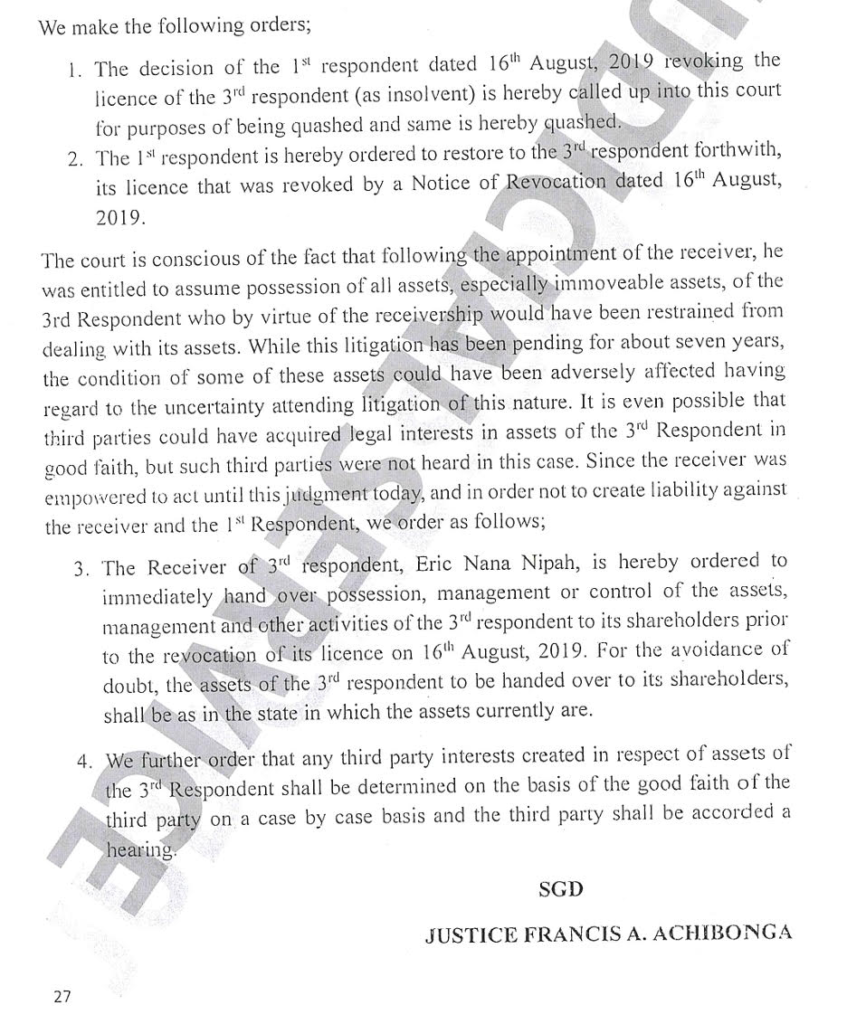
On the back of the analysis, the Court made the following sweeping orders: the revocation decision is quashed; BoG is ordered to restore the licence; the receiver is ordered to hand over possession, management, control of assets and activities to the pre-revocation shareholders; assets are to be handed over “in their current state”; and third-party interests created during receivership are to be handled case by case with hearings.
Issues Arising
Because the Court stayed firmly in the “administrative decision-making reasonableness” domain (what lawyers sometimes call “Wednesbury unreasonableness”), the judgment is understandable as a reaction to a perceived administrative defect: BoG allegedly had evidence from its own supervisor that pointed to remedial action rather than immediate revocation, and yet revoked without sufficiently engaging the IPC/receivables issue. BoG had information about assets that could be used to cure the liquidity constraint, but still chose not to take them into account. Etc.
Still, I am not too sure that the Court’s decision not to wade into the bank-resolution analysis on prudential grounds led to a full and safe disposition of the issues. The judgment feels thin.
BoG’s 2019 revocation notice alleged much more than a disputed receivable problem. It said GN had a Capital Adequacy Ratio of about negative 61%, a severe liquidity crisis, numerous depositor complaints, failure to meet the 10% cash reserve requirement since Q1 2019, failure by shareholders to restore capital/liquidity, and only GH¢30.33m of IPCs confirmed by the Ministry of Finance, which BoG said still did not address a claimed GH¢683.66m capital deficit. The Court very hurriedly skimmed the regulator’s findings, pointed to claims of indebtedness made by GN exceeding the amount of the deficit and then pronounced balance sheet solvency.
BoG also alleged that the insolvency was largely caused by related-party placements/facilities to Groupe Nduom entities, including GH¢761.55m placed with Ghana Growth Fund / Gold Coast Advisors and Gold Coast Fund Management / Blackshield; that some of those funds were used to repay investment-company customers or finance contractors; and that the IPCs were not direct GN-to-Government transactions.
The regulator’s assertions raise serious prudential issues that the Court should have treated with more seriousness because they go to the heart of whether the assets GN claims it has are, enforceable, owned by GN, timely collectible, unencumbered, and valued after impairment.
Under Act 930, banks must maintain policies for non-accrual, provisioning and bad-debt treatment for loans and other exposures. Thus, the IPCs the Court chose to recognise would need to go through “risk adjustment” to ascertain their real value.
The problem, as the Court itself acknowledged, is that these IPCs are the subject of ongoing dispute, seven years on. It is still not clear how much the government of Ghana admits to owing; whether, in light of GN’s other conflicts with third parties, they could have been converted to cash in GN’s favour; and whether the timeline of any conversion would have been realistic under the conditions of commercial deposit-taking banking.
The global accounting standards raise similar issues. IFRS 9 requires expected-credit-loss analysis based on probability-weighted cash-flow expectations, and not hope of eventual collection. IFRS 13 fair-value logic also requires market-participant assumptions, credit risk, timing, and valuation uncertainty. Fair value goes beyond mere invoice face value.
On BoG’s version, the IPCs did not provide assurance since only GH¢30.33m was confirmed by the Ministry of Finance, while the alleged capital deficit was far larger. The Court rejected BoG’s treatment of the evidence, but it did not itself perform a valuation in the prudential sense before deciding to give full weight to GN’s claims.
The Court’s reasoning may throw a wrench into prudential regulation
Where the Court’s judgment introduces some rather hairy concerns is the treatment of liquidity realisation timelines in a banking safety and soundness context.
Banks are confidence institutions. Their core liability – deposits – is often payable on demand or short notice. If a bank cannot pay depositors, the fact that it may hold long-dated, disputed, illiquid receivables is rarely enough assurance. In bank resolution, liquidity failure can itself become solvency failure because asset fire sales, depositor runs, reputational collapse, and regulatory sanctions destroy franchise value, necessitating early intervention. This is the central equation in prudential regulation that seemed to have completely escaped Their Lordships.
The Financial Stability Board’s Key Attributes say resolution should be initiated when a firm is no longer viable or likely no longer viable, with no reasonable prospect of recovery, and that entry should occur before balance-sheet insolvency and before equity is fully wiped out. The BIS summary says something similar.
One cannot fault the Court for privileging administrative fairness, however. They understood that a regulator cannot ignore relevant evidence. They made it clear that BoG should have treated its own advisor/supervisor’s report with more seriousness. I am a long-term critic of the Ghanaian central bank. As I read the judgment, I found myself wistfully remembering many of my clashes with the BoG. A central bank should be much more clinical than the Ghanaian version is wont to be.
But the Judges did not, in my view, demonstrate an adequate grasp of modern prudential supervision.
Modern safety-and-soundness supervision ask questions such as:
-Is capital real, loss-absorbing, and immediately available?
-Are related-party exposures within limits and independently underwritten (BoG flagged GN’s persistent breach of single obligor limits, which itself can be a source of serious asset impairment)?
-Are assets properly classified and provisioned?
-Are liabilities payable on demand being met?
-Is governance fit and proper?
-Can the institution produce reliable accounts?
-Are liquidity ratios being met?
-Is there a credible capital restoration plan?
-Are depositors and financial stability at risk?
Act 930 gives BoG broad powers to set capital methodology, define eligible capital, prescribe capital buffers, impose additional capital for concentration risk, prescribe liquidity requirements, and impose remedial measures. If a Court intends to override that technical judgment, it has no option than to dig into the details. The judgment unfortunately skates the corners.
What now? The Devil is in the Detail
I have a lot of empathy for the Nduom family and Groupe Nduom. Their entrepreneurial travails have been legend. It is so damn hard to build any entrepreneurial edifice of consequence in Africa that one naturally feels a spiritual bond to those trying.
In the midst of GN’s issues in Ghana, GN Bank USA, based in Chicago, also started to face serious challenges leading to regulatory restrictions in 2020 that were only lifted in 2025. The already small bank has now shrunk to a third of its size since 2018. Group Nduom has suffered!
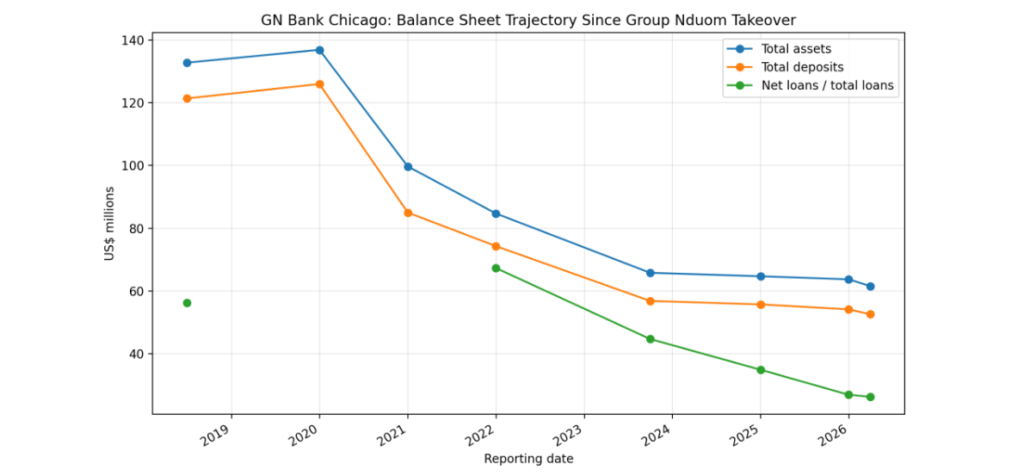
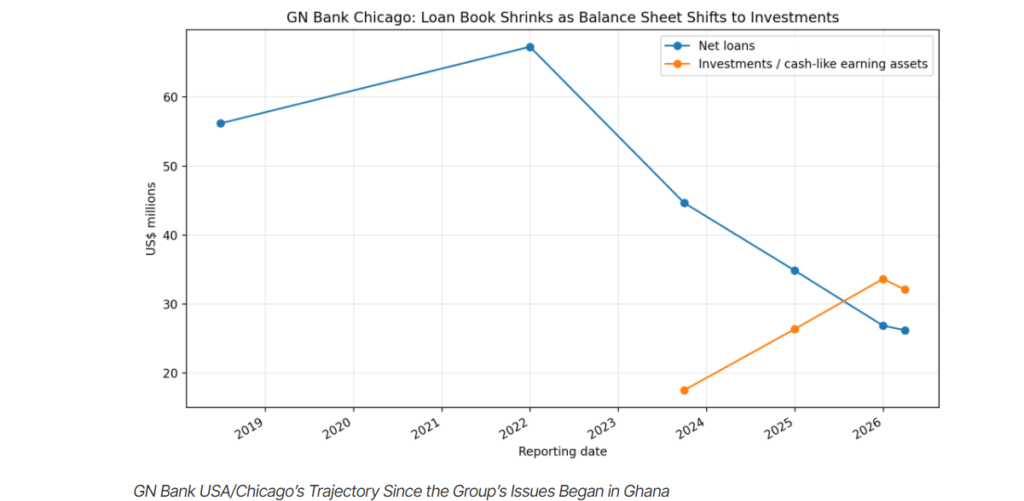
GN Bank USA/Chicago’s Trajectory Since the Group’s Issues Began in Ghana
For that reason alone, there is substantial goodwill. Quite a number of people would like to see the GN brand restored. Even the angry litigants still chasing their money from GN may see glimpses of hope in a restored GN S&L.
But I fear that the road ahead could be bumpy.
Prudential issues remain
The BoG is likely to restore the GN license without further appeals because of the clear political position of the ruling party, which has been to dismiss the prudential issues raised by the previous BoG administration.
But operationally, BoG may worry about whether it can safely allow immediate deposit-taking without a fresh supervisory assessment. GN meanwhile would need a massive deposit mobilisation drive to have the slightest chance of operational success.
Yet, if BoG simply lets GN reopen counters and starts taking deposits, some may argue that it is taking enormous depositor-protection/insurance risk.
Assets “in their current state”
The Judges avoided massive liability risk for the government by ordering that GN’s assets should be returned in their “current state.” This phrase avoids making GN’s receiver liable for all deterioration, but it creates a swamp.
The receiver may have collected loans, sold assets, paid depositors, terminated leases, retrenched staff, transferred records, defended claims, repudiated contracts, paid taxes, and incurred professional fees. Some third parties may have bought assets from the receiver in good faith. Some loans may have been written down or settled. Some depositors may have been paid by the state or through bailout/resolution mechanisms.
Every one of those events creates a massive reconciliation problem.
Depositors and state subrogation
If customers were paid by the state, receiver, deposit-protection scheme, or bailout vehicle, those payments do not vanish. The paying entity may become subrogated to the customers’ claims. That means GN’s liability stack today may include Government or resolution-vehicle claims, not only original retail depositor claims. In patching up the balance sheet, it may emerge that liabilities now far exceeds assets, especially if the IPCs being relied upon end up heavily impaired following recent auditor general evaluations.
The Security & Exchange Commission’s (SEC’s) updates on key affiliates of GN such as Blackshield/Gold Coast are relevant here by analogy and possibly substantively because Gold Coast/Blackshield was part of the same receivable/affiliate story.
SEC has said in the recent past that Blackshield/Gold Coast clients received partial bailout payments and that GHS1.34bn had been paid to 73,541 Blackshield/Gold Coast claims, with GHS757.5m fully settling 61,734 claims. In 2024, SEC announced another GHS1.5bn release for affected investors, including Blackshield/Gold Coast and Kron Capital, on top of GHS4.46bn previously released to affected investors.
If the implication is that Gold Coast/Blackshield or Ghana Growth Fund are insolvent or subject to investor/state claims, then GN’s receivables from those entities may be severely impaired after netting off. A claim against an affiliate with massive crystallised liabilities is not equivalent to cash or, for that matter, Tier 1 capital.
Capitalisation
Which boils down to the most critical question of all: fresh capitalisation. Does GN today have:
-positive net worth after impairment;
-sufficient unimpaired paid-up capital;
-adequate risk-based capital ratio;
-adequate liquidity;
-clean audited accounts;
-no disqualifying related-party exposures;
-reliable systems and governance;
-capacity to resume deposit-taking without threatening depositors.
What all GN’s fans are hoping to hear is when the Government will pay validated receivables; if shareholders are in the position to inject fresh capital; how investors are being brought on to recapitalise; and by what process liabilities will be legally restructured. The IPCs story pales in insignificance before the sheer scale of the challenge.
The Bottomline
For independent analysts, the way forward, if GN Bank is to avoid the zombie status of being a licensed bank on paper without operational activity, appears to be the following:
Completion of the IPC validation (possibly with court cases discontinued);
A determination of what Government truly owes and to whom;
A set off or settlement of state/resolution claims;
A clear plan for shareholder recapitalisation;
A ring-fencing of old claims into a specialised resolution vehicle;
And a final reopening of the institution once a new audited balance sheet and liquidity plan has met objective BoG prudential requirements.
Fans and friends of the Nduom family deserve to bask in the court victory. They have suffered for long.
But the hard work is only now beginning and the choppy waters have yet to recede.
Extract from Judgment











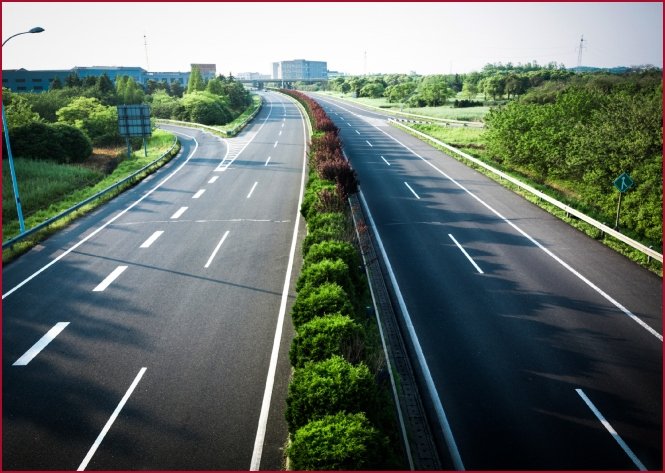
In a bold departure from Ghana’s traditional reliance on external debt, the government has announced that the entire $2 billion needed to finance the Accra-Kumasi Expressway has been secured from domestic sources, with no borrowing involved.
President John Dramani Mahama has confirmed that $2 billion, sourced from taxpayers’ money, has been deposited in a special account at the Bank of Ghana.
“And let me also announce that this is our own money. We have not gone to borrow money from anywhere. This money is the taxpayers’ money,” the President stated at the handover ceremony of the cleared right-of-way on September 14, 2026.
No Borrowing, No Debt Burden
Finance Minister Dr. Cassiel Ato Forson has reinforced this commitment, assuring the nation that “we will not borrow a pesewa for this construction”.
He stated that the full amount required will be ready by December 31, 2026, and reiterated that the government plans to mobilise the required funds entirely from domestic sources, allowing the project to proceed without adding to Ghana’s debt burden.
Timely Payments to Contractors
The funds are lodged in a dedicated account to facilitate timely payments to the contractor throughout the duration of the project.
President Mahama assured that all payment certificates submitted by the contractor would be honoured promptly to prevent delays and ensure the project progresses as scheduled. The project is being managed by a special purpose vehicle, Accra Kumasi Expressway Limited, registered for this purpose.
The GAF Factor in Cost Savings
The government’s domestic financing strategy has been bolstered by significant cost savings from the involvement of the Ghana Armed Forces (GAF) Engineers.
The GAF cleared 175.6 kilometres of the right-of-way in just 19 weeks—beating a 20-week target—at an estimated cost of GH₵10.9 billion, compared with commercial contractor baselines of GH₵15–18 billion. This yielded billions of cedis in net savings.
The $2 billion domestic financing model represents a significant shift in Ghana’s infrastructure funding approach. If successfully executed, it could provide a template for future mega-projects, demonstrating that national development need not come at the cost of mounting external debt.
Business
From Raw Minerals to Luxury Brand: Ghana’s Gold Value-Addition Strategy Gains Global Momentum with UK Showroom


Ghana’s ambition to transform its gold sector from a raw mineral exporter into a competitive player in the global luxury jewelry market has received a significant boost, with indigenous company GOLDBOD Jewellery setting its sights on establishing a flagship showroom in the United Kingdom.
The move, which aligns with the government’s broader strategy of increasing value addition within the gold sector, reflects Ghana’s determination to maximize returns from its mineral resources through local beneficiation, manufacturing and branding initiatives designed to generate employment and enhance export earnings.
Chief Executive Officer of GOLDBOD Jewellery, Gertrude Emefa Donkor, recently paid a courtesy call on Ghana’s High Commissioner to the United Kingdom, Sabah Zita Benson, to present the company’s vision of showcasing premium jewelry and investment-grade gold products crafted from responsibly sourced Ghanaian gold.

During the discussions, Miss Donkor highlighted the growing demand for the company’s innovative Gold Tablet, revealing that the product sold out during this year’s Ghana Party in the Park in London, one of the largest annual gatherings of the Ghanaian diaspora in Europe. She noted that the overwhelming patronage reflects growing confidence among diaspora communities and international consumers in authenticated Ghanaian gold products.
The planned expansion comes as Ghana, Africa’s leading gold producer, intensifies efforts to move beyond the export of raw minerals and establish a reputation as a trusted source of responsibly produced, value-added gold products.
The strategy is central to the country’s industrialization agenda, which seeks to create jobs, boost foreign exchange earnings and reduce dependence on primary commodity exports.
High Commissioner Benson reaffirmed the Mission’s commitment to supporting Made-in-Ghana products in the UK market, noting that the High Commission continues to collaborate with relevant public institutions, private sector stakeholders and business associations to create opportunities for Ghanaian enterprises seeking to expand internationally.

She expressed optimism that the proposed showroom would not only showcase the quality and craftsmanship of Ghanaian jewelry but also reinforce Ghana’s reputation as a trusted source of responsibly produced gold products. She added that initiatives of this nature complement the government’s broader agenda of leveraging trade, investment and economic diplomacy to promote sustainable national development.
The engagement underscores the evolving role of Ghana’s diplomatic missions in advancing economic diplomacy by facilitating market access for Ghanaian businesses and strengthening commercial partnerships abroad. The United Kingdom remains one of Ghana’s key trading partners and a strategic destination for Ghanaian exports, investment and diaspora engagement.
As Africa’s leading gold producer, Ghana has long been a major supplier of raw gold to international markets. However, successive governments have recognised that real economic transformation lies in retaining more value from the mineral through local processing, manufacturing and branding. GOLDBOD Jewellery’s UK expansion represents a tangible example of this vision taking shape on the global stage.
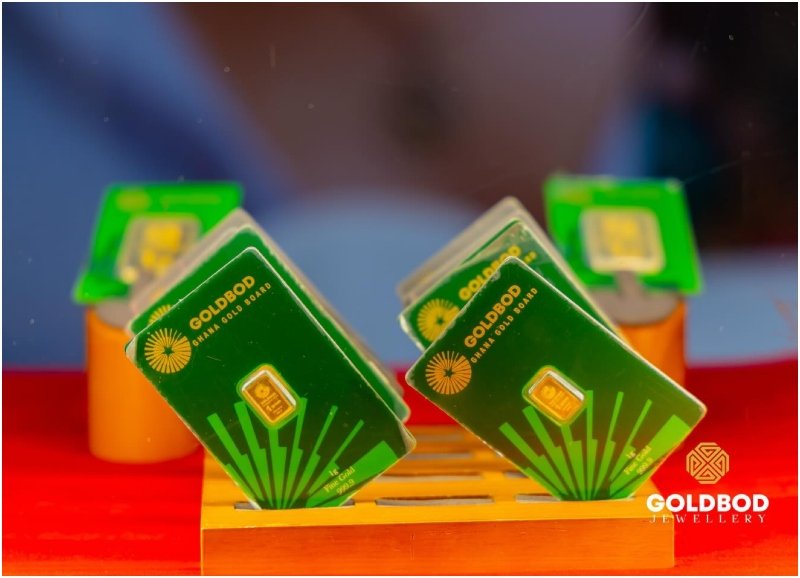
Industry observers note that the success of such initiatives could encourage more Ghanaian companies to explore international markets, particularly in sectors where the country holds a comparative advantage. The diaspora market, in particular, presents a significant opportunity for Ghanaian brands seeking to build consumer confidence and establish a foothold in competitive markets.
The meeting between Miss Donkor and High Commissioner Benson reflects growing collaboration between Ghana’s diplomatic missions and indigenous businesses as the country seeks to strengthen its presence in international markets while advancing industrialization, export diversification and value addition within the mining sector.
With the proposed showroom in the United Kingdom, GOLDBOD Jewellery is positioning itself as a flagship brand for Ghanaian gold, demonstrating that African products can compete at the highest levels of the global luxury market.
The move signals a new chapter in Ghana’s economic story, one in which the nation’s natural resources are transformed into globally recognised brands that tell the story of Ghanaian craftsmanship, quality and innovation.
Business
Ghana Beats the Odds: IMF Approves Final Review, Offering Blueprint for Africa’s Debt-Ridden Economies
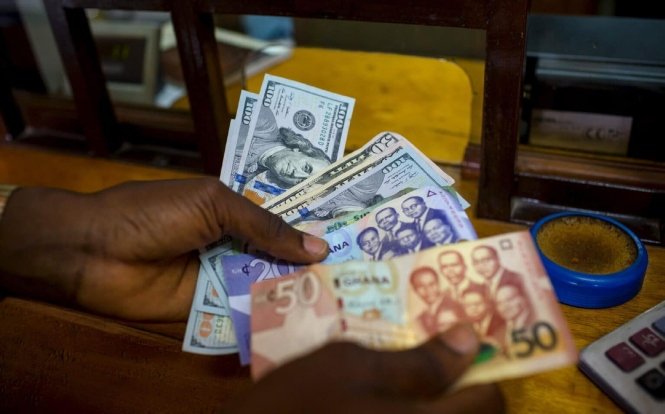
Three years after defaulting on its debt, Ghana formally exits the IMF bailout program with a $318 million final disbursement—and a new reform framework that could show other distressed African nations the way forward
The Executive Board of the International Monetary Fund on Monday approved Ghana’s sixth and final review under the Extended Credit Facility (ECF) program, formally concluding the country’s three-year, $3 billion bailout arrangement and unlocking a final disbursement of approximately $318 million.
The Board also approved Ghana’s request for a 36-month Policy Coordination Instrument (PCI), a non-financing arrangement that will guide the country’s economic reforms now that the bailout has ended.
The approval marks the culmination of one of the most dramatic economic turnarounds in recent African history—a recovery that began in the depths of crisis in late 2022, when Ghana defaulted on most of its external debt, inflation topped 54%, and the cedi was in free fall.
“Ghana’s ECF-supported economic program has delivered substantial stabilization gains,” the IMF said in a May statement after reaching a staff-level agreement with the government. “Inflation has declined rapidly, international reserves have been rebuilt, and confidence in the cedi has improved.”
From Default to Credibility
Ghana entered the 36-month ECF arrangement in May 2023 with access to about $3 billion to help restore macroeconomic stability, implement fiscal reforms, and support the country’s debt restructuring program. At the time, the country was in the throes of its worst economic crisis in a generation.
The turnaround has been striking. Inflation has plunged from 54% in December 2022 to just 5.3% in June 2026. Gross international reserves have reached an all-time high of approximately $14.5 billion as of February 2026, providing nearly six months of import cover. The public debt-to-GDP ratio has fallen sharply from a peak of over 80% to 45% by June 2026.
Perhaps most significantly, Ghana’s sovereign credit ratings have improved from restricted default—”junk status”—to ‘B’ with a positive outlook, representing five distinct rating level upgrades.
“Every quantitative performance criterion, but one, set for the final review has been met,” Finance Minister Dr. Cassiel Ato Forson told Parliament while presenting the 2026 Mid-Year Budget Review. He noted that Ghana achieved 10 out of 11 quantitative targets and 8 out of 10 structural benchmarks.
A Blueprint for Africa
For other African nations struggling with debt distress—including Zambia, Ethiopia, and Kenya—Ghana’s trajectory offers a potential roadmap. The country’s success demonstrates that aggressive fiscal consolidation, coupled with credible IMF engagement and good-faith debt restructuring, can restore market confidence within a relatively short timeframe.
The PCI framework that Ghana is now entering is particularly instructive. Unlike the ECF, the PCI does not provide direct funding. Instead, it offers closer policy engagement with the IMF and signals a country’s commitment to reforms, helping to strengthen investor confidence and attract support from development partners.
“Completing the ECF does not mean Ghana walks away from the IMF,” Forson explained. “It means Ghana changes the nature of the relationship.”
The new program will focus on six priority areas: growth-friendly fiscal consolidation, debt sustainability, fiscal transparency and governance, stronger monetary and exchange rate policy frameworks, financial sector stability, and economic diversification.
Forson described the PCI as “a structured, internationally monitored platform through which Ghana commits to a specific set of macroeconomic and structural reform policies, submits to regular independent review, and signals to the world that the discipline of the past eighteen months is not a temporary posture adopted under crisis conditions. It is a permanent feature of how this country will be governed.”
The Work Isn’t Over
Despite the celebration, the IMF has made clear that Ghana’s reform agenda is far from complete. The Fund has urged the government to press ahead with reforms in the energy sector, particularly efforts to improve efficiency at the Electricity Company of Ghana (ECG) through private sector participation.
“Priority should be given to tackling distribution and collection losses at ECG, including advancing private sector participation in the distribution segment,” the IMF stated.
The government has indicated that private sector participation in ECG is expected to commence by early 2027.
The PCI is also designed to help Ghana maintain macroeconomic stability, build resilience against external shocks, address structural imbalances, and support sustainable economic growth. With the global environment remaining uncertain—including potential spillovers from conflicts and volatile commodity prices—sustaining the reform momentum will be critical.
A New Chapter
Monday’s approval formally concludes Ghana’s 16th IMF program since independence. For a country that was written off by many international investors just three years ago, the milestone represents a remarkable redemption story.
“This milestone reflects improved fiscal performance, normalized relations with global creditors, and renewed market confidence,” said Felix Kwakye Ofosu, Minister of State for Government Communications.
Finance Minister Forson has already declared that Ghana does not expect to seek another IMF bailout in the foreseeable future. The country now aims to achieve “Investment Grade” status, a goal that would further lower borrowing costs and unlock long-term institutional investment for critical infrastructure.
For now, however, the immediate priority is clear: cement the gains, stay the course, and prove that Ghana’s recovery is not just a temporary reprieve—but a permanent transformation.


Funding Fears Loom For Ghana’s Life-Saving Malaria Vaccine Five Years After Roll Out

‘There was a Coordinated Disclosure Plan’: AI-Discovered Flaw in PHP Triggers Global Internet Chaos as Cybercriminals Race to Exploit It

Yandex Strikes: Can Moscow Host Africa Under Drone Threat?
-

 Sights and Sounds2 days ago
Mind Craft Camps Accra Turns School Holidays into Adventures in Creativity and Discovery
-

 Ghana News5 hours ago
Major Sexual Abuse Scandal Rocks Ghana High School: Obuasi School Headmaster Sues Journalist for GH¢2 Million as Investigation Into Alleged Misconduct Widens
-

 Reels & Social Media Highlights21 hours ago
Ghana’s Digital Heartbeat: Outrage, Satire, and the Fight for Accountability
-

 Festivals & Events9 hours ago
Compozers Fest Ghana Edition: Welcoming 2027 with Music in Accra
-
 Taste GH9 hours ago
Airport Residential Area: Where Accra’s Dining Scene Meets Global Flavours
-

 Fashion & Style1 day ago
Wyclef Jean Gives Ghanaian Kaftan a Global Spotlight After ‘Chineke’ Fashion Inspiration
-

 Health & Wellness1 day ago
Beyond Bigger Muscles: Why Strength Training Matters for Healthy Ageing
-

 Health & Wellness21 hours ago
Four Everyday Lifestyle Habits That Can Make Weight Loss Easier