
Taste GH
Why Ghanaians Keep Coming Back to Rice Balls and Groundnut Soup

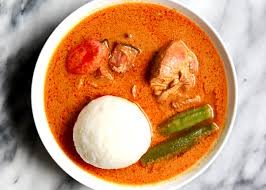
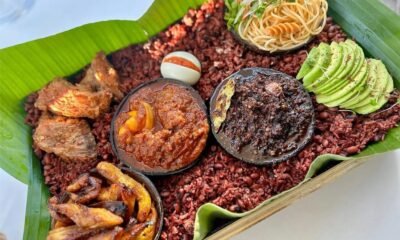
There is a moment when the rice ball meets the soup that tells you everything you need to know about Ghanaian cooking. The rice holds. The soup clings. And for a few seconds, nothing else matters.
Omo Tuo—rice balls—do not try to be fancy. They are simply rice cooked soft, mashed until smooth, and shaped into rounds that sit patiently on the plate. They wait. Across from them sits the groundnut soup, thick and orange, carrying the weight of tomatoes, ginger, and a handful of meat or fish that has been simmering long enough to forget where it came from.
@chefabbys AUTHENTIC GHANAIAN OMOTUO & GROUNDNUT SOUP ! An excellent Ghanaian Staple Food❤️🇬🇭. It's so delicious Comment ❤️🇬🇭 if you love omotuo! #viral #foryou #fyp #foryoupage ♬ Big Baller – Flavour
You do not eat this with cutlery. You pinch. You dip. You watch the soup coat your fingers, and you understand why some meals refuse to be rushed.
The beauty of Omo Tuo is not in the ingredients. It is in the feel. The soft resistance when you press it. The way it soaks up the groundnut without falling apart. In every home, the recipe shifts slightly—more groundnuts here, less pepper there—but the ritual stays the same.
People travel from different regions just to sit at a chop bar and wait for this plate. Students survive on it. Families gather around it. And when the soup is finished, there is always that last piece of rice ball, wiped slowly around the bowl, catching whatever remains.
It is not complicated food. It is honest food. And in a world full of dishes that try too hard, that honesty tastes like home.

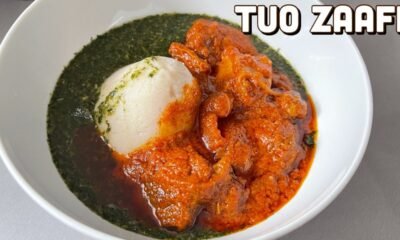


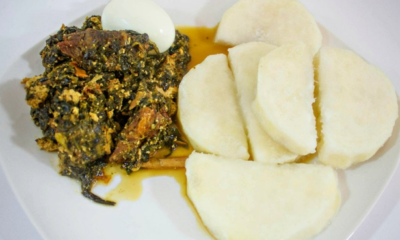





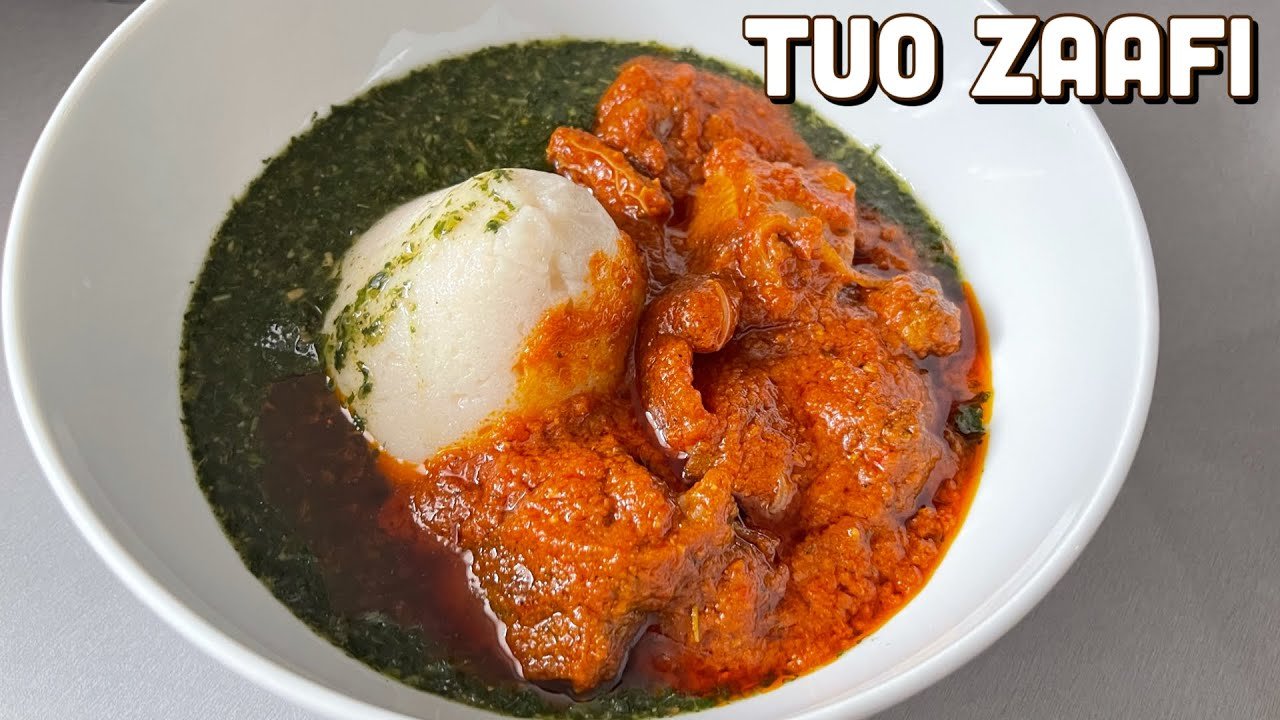
There are some dishes that merely feed you, and then there is Tuo Zaafi—the Northern Ghanaian staple that practically hugs you from the inside.
Known affectionately as “TZ” or “Saakbo” among the Frafra, this soft, smooth dumpling of corn or millet flour has migrated from the rural compounds of the North to become a street food sensation in Accra’s bustling Nima and beyond. But to call it just “street food” misses the point entirely.
What makes TZ a must-taste isn’t merely its texture—that pillowy, less-sticky cousin of banku—but the ritual that surrounds it. The name itself tells a story: from the Hausa tuo (stirring) and zaafi (hot), a nod to the arm-work required to paddle this dough into submission.
Yet the real magic happens when it meets its soulmate: a slimy, aromatic ayoyo soup,stained green with jute leaves and turbocharged with dawadawa, that fermented locust bean that tastes as umami exploded.
@chefabbys Final Episode of my Outdoor Ghana Staple Food Series and on todays menu is TUOZAFI with Ayoyo Soup and Stew! This is so delicious. With the training I got from my Hajia friend , I'm glad I made this. #foryou #fyp #foryoupage #viral ♬ OZEBA – Rema
Here’s the thing nutritionists won’t stop whispering about: TZ is secretly a superhero. That slippery soup? Lowers cholesterol. The whole combination? A balanced meal that keeps diabetics stable and skin glowing.
But honestly, locals don’t eat it for the health kick. They eat it because nothing else says “you are home” quite like this.
Anthropologists studying the Dagaaba observe that households will prepare TZ for guests even when they‘ve cooked something else for themselves.
It is the edible handshake, the carbohydrate cordiality. So when you finally tip that hot, shea-butter-garnished ball into the peppery soup, you’re not just tasting grain and greens. You’re tasting generations of welcome.
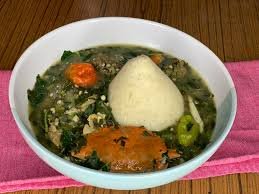
There is a moment, just before the first bite of okro stew meets a pinch of banku, when the wise eater pauses.
You brace yourself for the slide. That slick, almost stubborn glossiness that coats each piece of okro—it’s not a texture to fear, but one to surrender to. And for the uninitiated, that surrender is the first step into something real.
In Ghana, we don’t shy away from the slimy comments. We lean in. Because okro stew, particularly when it catches that light sheen of palm oil, isn’t trying to be polite. It’s deep, savory, and unapologetically rich.
The oil isn’t grease for grease’s sake—it carries the smoked fish, the scotch bonnet heat, the crushed tomatoes down into every corner of the stew. It’s the vehicle for flavor, the thing that makes you reach for another hunk of banku before you’ve even swallowed.
@sweetohemaa1st Oil less Okro soup Banku with Okro soup, Natural food
♬ original sound – SWEET OHEMAA
And then there’s the banku itself. Fermented just enough to get that gentle sourness, smooth and cool against the warmth of the stew.
You pinch it, roll it, drag it through the oil. This isn’t dainty food, and thank goodness for that. It’s the kind of meal that demands your hands, your focus, your full presence at the table.
For the global reader scrolling from a world of convenience meals, let this be the dish that wakes you up.
Okro and banku aren’t just sustenance—it’s a conversation between texture and taste, a lesson in trusting the cook who knew exactly when to stop stirring. If you ever find yourself on this side of the Atlantic, skip the fork. Let the oil run down your wrist a little. That’s the memory you came for.
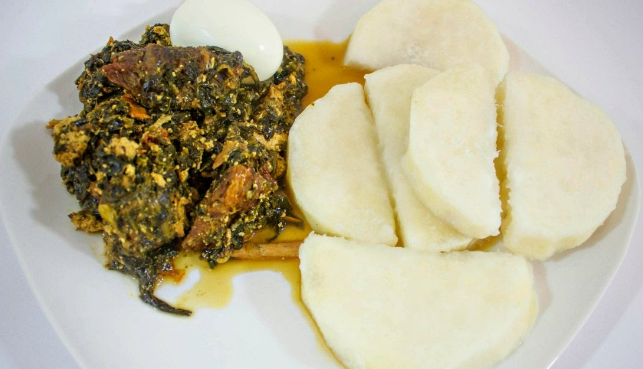
There is a certain quiet magic in simplicity. In Ghana, we wrap it in leaves, fry it golden, or steam it into fluffy balls. But sometimes, the deepest comfort comes from a plate that looks like it took no effort at all. That plate is Ampesi.
Walk into any Ghanaian home on a Sunday afternoon, and you might find it. A generous cut of boiled yam, soft and white, lying next to a pool of vibrant green kontomire stew. The yam is not mashed or pounded. It is simply boiled. The stew is not ground with onions and ginger. The leaves are chopped, wilted with palm oil, tomatoes, and onions, and sometimes enriched with boiled eggs or salted fish.
@foodstoriesgh Yam & Kontomire Stew with groceries from @adwoaagbogbloshie My first twi voiceover 😂 #foodstoriesgh #ghanacuisine #ghanafood #palavasauce #kontomirestew #Ampesi #yam #foodtok #foodie #twivoiceoverchallenge #fyp #recipesoftiktok #learnwithme #learnwithkhabylame #viral ♬ love nwantinti (ah ah ah) – CKay
On paper, it is the most basic meal. But put it in your mouth, and you understand why grown men and women crave it.
The yam, when boiled properly, retains its structure while offering a gentle bite. It is earthy. It is filling. The kontomire stew—made from cocoyam leaves—brings a slight bitterness that is quickly tamed by the richness of the red palm oil. Together, they create a balance that no amount of spice can replicate.
Read Also: Gari and Beans: The One Ghanaian Dish That Brings Everyone Together
For the visitor to Ghana, ampesi is a quiet education. It tells you that before the jollof wars and the fancy rice dishes, there was the land. There was the yam. And there was the leaf. It is the food of grandmothers. It is the meal you ask for when you are tired of eating out.
Do not let the simplicity fool you. Ampesi is not plain. It is peaceful.


Mahama on Independence Day: Ghana Must Lead in AfCFTA to Unlock Africa’s Economic Destiny

Ghana’s 5G Future Hinges on Speed and Scale – Telecom Expert Warns as NCA Targets Exclusivity Clause

5 Foreign Governments Pressure Ghana to Abandon Proposed Gold Royalty Overhaul
-

 Ghana News19 hours ago
69 Years of Independence: Quick Timeline of Ghana’s Biggest Milestones Since 1957
-

 Ghana News4 hours ago
Independence Day Spending Scaled Down, CIA’s Role in Nkrumah’s Overthrow and Other Trending Issues in Ghana Today (March 6, 2026)
-

 Reels & Social Media Highlights4 hours ago
The ‘Ghanaian’ Saturday Morning Rhyme That Crossed the Ocean
-
 Ghana News1 day ago
Vendor Defends Frying With Plastic in Oil, Missing Young Woman, and Other Trending Topics in Ghana Today (March 5, 2026)
-

 Ghana News4 hours ago
Video: How Kwame Nkrumah, Ghana’s Founding Father, Became Its ‘Prisoner’
-

 Culture21 hours ago
“You’re Supposed to Be Creating Jobs”: Ghana’s Ministry of Creative Arts Under Fire for Using AI Instead of Real Creatives For New Ad
-
 Business3 hours ago
5 Foreign Governments Pressure Ghana to Abandon Proposed Gold Royalty Overhaul
-
 Ghana News52 minutes ago
Mahama on Independence Day: Ghana Must Lead in AfCFTA to Unlock Africa’s Economic Destiny