
Culture
Aura V Edges Blue Ivy Carter to Become Youngest Grammy Winner in History


Aura V has officially edged out Blue Ivy Carter to become the youngest Grammy winner in history, rewriting the record books at just eight years old.
Her landmark win at the 2026 Grammy Awards places her ahead of one of the most high-profile child winners in recent memory and signals a new chapter in how young talent is recognized on the global music stage.
Here are the key things you need to know about Aura V’s historic Grammy moment.
6 Things You Need to Know About the Youngest Grammy Winner in History

Youngest Individual Grammy Winner Ever
Eight-year-old Aura V made music history at the 68th Annual Grammy Awards by becoming the youngest individually credited Grammy winner in the ceremony’s long history. She accomplished this remarkable feat at just eight years and several months old, surpassing the previous record.
Record-Breaking Win in Children’s Music
Aura V won the Best Children’s Music Album award for Harmony, a collaborative project she created with her father, musician and educator Fyütch (Harold Simmons II). This accolade was presented at the Grammy Awards Premiere Ceremony in Los Angeles.
Beating a Notable Previous Record Holder
Before Aura V’s achievement, the youngest Grammy winner title belonged to Blue Ivy Carter, daughter of Beyoncé and Jay-Z, who won her award at age nine for her contribution to Brown Skin Girl at the 63rd Grammys in 2021. Aura V’s win now places her at the top of the list of youngest individual winners.
A Collaboration Rooted in Family and Creativity
The album Harmony began as a musical project inspired by Fyütch’s background in education and his desire to explore themes of unity, joy, and connection through music with his daughter. Their creative bond was key to the album’s success and its critical acclaim.
A Fun and Heartfelt Reaction
After the win, Aura V shared that working on music with her dad was “fun,” demonstrating the joy and closeness their collaboration brought. Fyütch highlighted the album’s mission to combine education and entertainment, particularly for young audiences.
Grammy History and Legacy
Aura V’s milestone underscores the Academy’s recognition of young creative talent and the evolving landscape of music genres. Her story adds to the legacy of notable young artists recognised by the Grammys and opens the door for even younger talents to be celebrated on the world’s biggest music stage.




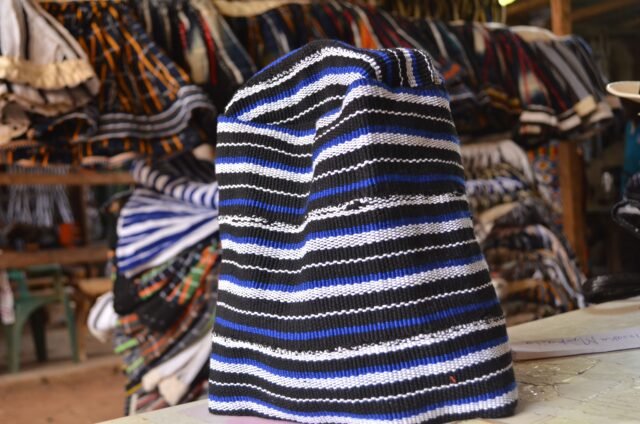
In Ghana’s Upper East Region, a seemingly simple fold of fabric can speak louder than words. Wear your fugu hat the wrong way, and you might just find yourself paying a fine — in goats, sheep, or even a cow.
The fugu, also known as batakari, is a handwoven smock beloved across Ghana. But it’s the matching hat — soft, flexible, and worn like a beanie — that carries a traditional code many outsiders overlook.
Depending on how you fold its topmost part, you could be signalling loyalty to a chief, declaring friendship with all, or, dangerously, claiming spiritual power you don’t possess.
Isaaka Munkaila, a smock dealer with 25 years of experience in Bolgatanga’s fugu market, knows the rules well. He demonstrates the styles one by one.
First, fold the hat’s tip to the back. “That is how chiefs wear it,” he says. “It says: ‘I have many followers. I am a head of community.’” An ordinary person wearing it that way in a chief’s palace risks being seen as a rival. The penalty? Depending on the traditional area, a goat, sheep, or cow.
But not all chiefs are quick to punish. Naab Sierig Soore Sobil IV, divisional chief of Pelungu in the Nabdam district, says ignorance can be a defence.
“If someone from the south comes to my palace wearing it like that, I will correct him and teach him. But if a local does it, the elders will demand a fine — to deter others.”
Fold the tip to point skyward, and you’re safe. That’s the everyday style for ordinary people. “It simply acknowledges God’s presence everywhere,” Munkaila says. Fold it to the left or right, and you’re saying: “I belong with everyone — young and old.”

The most dangerous fold? Flat onto the forehead. That style is reserved for spiritually powerful individuals — those with “juju.”
Wear it without the backing of traditional spiritual strength, Munkaila warns, and someone stronger might test you. “You don’t wear it that way if you don’t have the powers.”
While no recorded harm has come from a wrong fold, chiefs have scolded and sanctioned offenders. In the Upper East Region, fines remain small, chiefs acknowledging poverty and changing times. Further north, in the Northern Region, customs are stricter.
For most Ghanaians who grow up with these traditions, the code is second nature. But for visitors, the fugu hat is a quiet reminder: in the north, fashion carries meaning — and sometimes consequences.

In the quiet hours of a Saturday morning in Accra, while the city begins to stir with the scent of fresh waakye, a different kind of awakening is happening behind glowing laptop screens.
For decades, the shelves of mainstream bookstores have often relegated Black stories, particularly those in the realms of magic, myth, and monsters, to the periphery.
But on April 25, the Black Girl Book Fair is set to dissolve those boundaries, inviting Ghanaian readers into a digital sanctuary where Black fantasy is the undisputed center of the universe.
A Modern Take on a Childhood Classic
We all remember the electric anticipation of the school book fair: the smell of glossy paper, the colorful catalogues, and the thrill of a new adventure.
This virtual fair recreates that nostalgia for the adult reader, specifically amplifying voices that have been pushed to the margins of mainstream publishing.
Culturally, this matters because it provides a space for the African diaspora and the continent to bridge the gap through shared storytelling.
For a Ghanaian audience, seeing our folklore and aesthetic reimagined in high-fantasy epics is not just entertainment—it is a reclaiming of our narrative power.
What to Expect: A Masterclass in Black Excellence
This is not your average webinar. It is a live, immersive shopping and social experience. Attendees can look forward to a clickable catalogue of discounted gems and live “author hangouts” that feel more like a cozy living room chat than a formal panel.
The speaker lineup is a “who’s who” of contemporary Black creativity, featuring Wondaland’s Chuck Lightning, viral TikTok sensation Taylor Cassidy, and the New York Times best-selling author Ayana Gray.
From raffle prizes like the Viral Bookmark by Corine Marie to virtual goodie bags from Saturday AM, the fair offers tangible tokens of a global community.
Whether you are a local in Kumasi looking to diversify your e-reader or a tourist in Accra wanting to see how West African mythology is influencing global fiction, the atmosphere is one of inclusive, “pressure-free” celebration.
Why You Can’t Miss It
In an era where the “Black Star” experience is increasingly global, the Black Girl Book Fair offers a unique way for Ghanaians to reconnect with the broader African diaspora. It is a reminder that our magic is universal.
By participating, you aren’t just buying a book; you are supporting a movement that ensures future generations see themselves as the heroes, the sorcerers, and the dragon-riders of the literary world.

In the heartbeat of Accra, a new kind of social energy is pulsing through the city—one that exchanges high heels for cross-trainers and stagnant networking for the high-octane flow of a Padel court.
Her House: Padel & Vibez isn’t just an afternoon of sport; it is a vibrant manifestation of the modern Ghanaian woman’s desire for community, wellness, and unadulterated “good energy.”
The Sport of the Moment
Padel is the fastest-growing racquet sport globally in 2026, and Accra is leading the West African charge. Historically, social clubs in Ghana often revolved around formal galas or long brunches.
However, a cultural shift is underway. Today’s locals and “Returnees”—Ghanaians from the diaspora—are seeking active ways to connect. By bringing women together at the Aura Lifestyle Club, Her House is tapping into a global trend and tailoring it for the local pulse, creating a space where the pressure of professional life evaporates the moment you step onto the blue turf.
What Awaits on the Court
Whether you are a seasoned athlete or have never held a racquet, the experience is designed for inclusion. Visitors can expect friendly, small-group matches that prioritize laughter over league standings.
Between sets, the atmosphere shifts into a quintessential Accra “vibe”—refreshments flow, music sets the rhythm, and light drinks provide the perfect excuse to linger and chat.
All equipment is provided, removing the barrier to entry for tourists who might be in town for a short stay but are looking for a meaningful way to plug into the local scene.
A Bridge for Everyone
For the international traveler, attending a Her House event is a golden ticket to authentic connection.
It bypasses the “tourist traps” and places you directly in the mix with Accra’s creative and professional movers and shakers.
For locals, it is a chance to reclaim the “fourth trimester” of the week—Sunday—and enter Monday morning feeling recharged and rooted in a supportive tribe.
The afternoon concludes with prizes for winners, but the true takeaway is the synergy found in meeting like-minded women who believe that sport is the ultimate icebreaker.


EU Approves $23 Million Grant to Upgrade Ghana’s Tema-Mpakadan Railway

Ghana Nears Approval of Cannabis Licences as Country Prepares to Launch Regulated Industry

Prof Prempeh Slams Supreme Court, Police Officer Killed in Road Crash and Other Big Stories in Ghana Today
-

 Opinion21 hours ago
Open Letter to the British Ambassador on Reparatory Justice: Ghana’s Call to the British Government
-

 Festivals & Events2 days ago
Celebrating Black Voices in Fiction at the 2026 Black Girl Book Fair
-

 Ghana News9 hours ago
Newspaper Headlines Today: Wednesday, April 10, 2026
-

 Ghana News2 days ago
Ghana Celebrates Link to NASA’s Historic Artemis II Lunar Mission Through Astronaut Christina Koch
-

 Taste GH19 hours ago
Smoke, Sweetness and Street Life: The Timeless Charm of Ghana’s Roasted Corn
-

 Ghana News22 hours ago
7 Dead, 2 Missing After Boat Capsizes on Volta Lake in Ghana
-

 Taste GH2 days ago
Ivory Coast Roots, Ghanaian Soul: The Irresistible Rise of Akyeke and Tilapia
-

 Business22 hours ago
3 Things Ghana is Doing to Reduce Fuel Prices Amid Global Uncertainty