
Culture
Trump Threatens to Sue Trevor Noah Over Epstein Island Joke at 2026 Grammy Awards


U.S. President Donald Trump has threatened legal action against comedian and 2026 Grammy Awards host Trevor Noah.
The U.S. President is accusing him of making a “false and defamatory” joke linking him to Jeffrey Epstein’s private island during Sunday night’s ceremony.
In a post on Truth Social overnight, Trump reacted strongly to Noah’s quip, which tied Trump’s interest in acquiring Greenland to Epstein’s Caribbean island, a site associated with allegations of sex trafficking and abuse. Noah had said:
“That is a Grammy that every artist wants almost as much as Trump wants Greenland. Which makes sense, I mean, because Epstein’s island is gone, he needs a new one to hang out on with Bill Clinton.”
Trump responded:
“Trevor Noah, a total loser, better get his facts straight, and get them straight fast. It looks like I’ll be sending my lawyers to sue this poor, pathetic, talentless, dope of an M.C., and suing him for plenty$.” He added: “Get ready Noah, I’m going to have some fun with you!”
Trump denied ever visiting Epstein’s island, stating he had never been accused of doing so until Noah’s remark and had previously ended his association with Epstein years before the financier’s death in 2019.
He referenced past lawsuits against ABC News and CBS News, both of which ended in multimillion-dollar settlements.
Noah’s agency and management have not yet responded to requests for comment.
Representatives for former President Bill Clinton—also mentioned in the joke—did not immediately comment. Both Trump and Clinton have consistently denied any wrongdoing related to Epstein and have never been formally accused by authorities.
The incident highlights ongoing tensions between Trump and media figures, as well as the tradition of political humor at major awards shows. During the 2026 Grammys, at least a dozen artists—including Bad Bunny and Billie Eilish—used their acceptance speeches to criticize U.S. Immigration and Customs Enforcement (ICE) policies, wearing pins reading “ICE OUT” and condemning aggressive deportation efforts.
Trevor Noah, who hosted the Grammys for the sixth consecutive year, is known for sharp political satire from his time on The Daily Show.






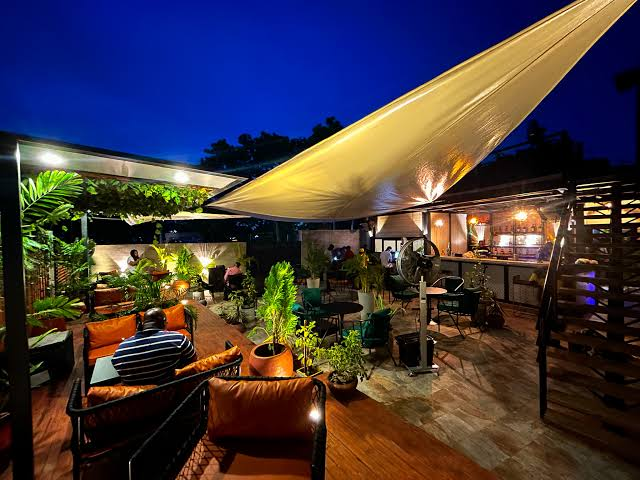
As evening falls over the Greater Accra Region on Friday, September 25, the vibrant energy of the Ghanaian capital will converge at Cello Restaurant and Bar for an extraordinary diplomatic and cultural gathering.
Hosting New York Secretary of State Walter T. Mosley during his official visit to Ghana, this exclusive two-hour reception serves as a vital bridge between West Africa and its dynamic global diaspora.
Organized in close collaboration with the Tau Alpha Lambda Chapter of Alpha Phi Alpha Fraternity Inc. (Ghana Alphas) and the African American Association of Ghana (AAAG)—alongside supporting partners such as the Ghana Tourism Authority, 100 Black Men of Ghana, and Since 1957 Apparel—the event highlights Ghana’s central role as the cultural gateway for the African diaspora.
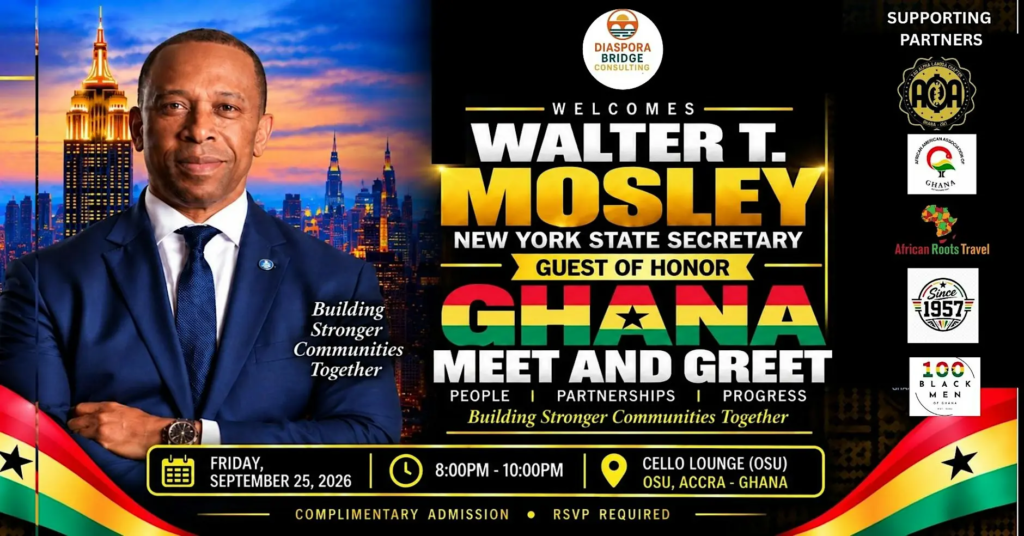
It offers a rare space where civic responsibility, economic development, and shared identity align seamlessly.
An Evening of Connection and Culture
Guests stepping into the refined, intimate atmosphere of Cello Restaurant will experience Ghanaian hospitality at its finest.
Against a backdrop of contemporary Afro-beats and smooth jazz, attendees will engage directly with Secretary Mosley, civic leaders, and prominent entrepreneurs.
Beyond high-level political dialogue, the gathering celebrates historical ties through fashion, art, and culinary excellence, offering curated Ghanaian fusion bites and refreshing signature cocktails.
For international visitors and returnees, the gathering provides an authentic entry point into Ghana’s influential professional networks.
For residents, it offers a frontline view of how transatlantic partnerships drive real-world investment and cultural exchange.
This special meet-and-greet is more than a social mixer—it is a celebration of unity, leadership, and the enduring bond between Ghana and the United States.
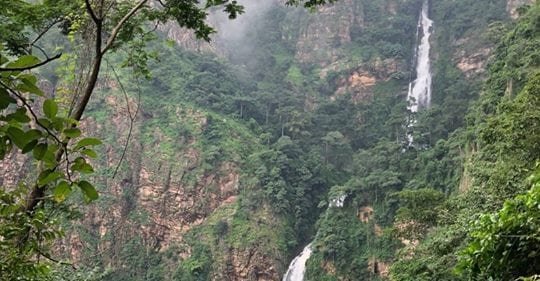
The rhythmic thud of fontomfrom drums reverberates through the lush, emerald canopy of the Agumatsa Wildlife Sanctuary as a gentle mist settles over the gathering crowd.
Every September or October, the quiet township of Wli in Ghana’s Volta Region erupts into a sea of brilliant kente, rich velvet, and triumphant song.
Here, beneath the towering precipice of West Africa’s tallest waterfall, the community gathers for the Wli Falls Festival—a grand spectacle celebrating nature, ancestral lineage, and communal unity.
For the local Ewe people, the cascading waters are more than a natural wonder; they are a sacred gift that has sustained life, agriculture, and spiritual harmony for generations.
The festival originated as a thanksgiving ritual, offering gratitude to the river deities and ancestors for safe sanctuary, fertile land, and continuous flowing water.
Sacred Rituals and Community Spirit
Festivities open with traditional pouring of libations by paramount chiefs and fetish priests, invoking blessings for peace and prosperity.
Durbar grounds fill with majestic processions as palanquins carry traditional rulers draped in gold regalia, accompanied by energetic Borborbor dancers whose swaying rhythms invite international travelers and locals alike to join the circle.
Beyond its spiritual roots, the festival plays a crucial social role today by fostering eco-tourism, environmental conservation, and local development. It serves as a vital bridge connecting younger generations with their ancestral roots.
Experiencing the Wli Falls Festival offers an unforgettable immersion into Ghanaian hospitality—where the thunderous roar of the waterfall harmonizes with the vibrant pulse of human celebration.
It belongs on the bucket list of every traveler seeking the true heart of West Africa.
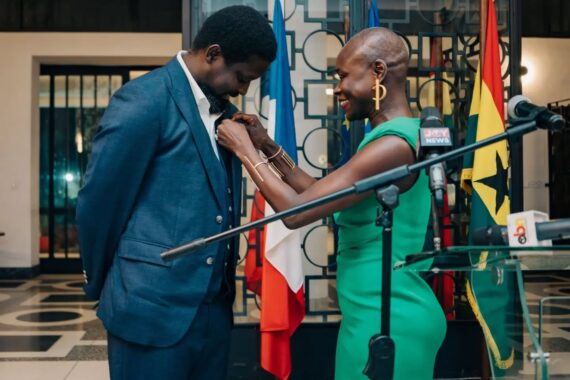
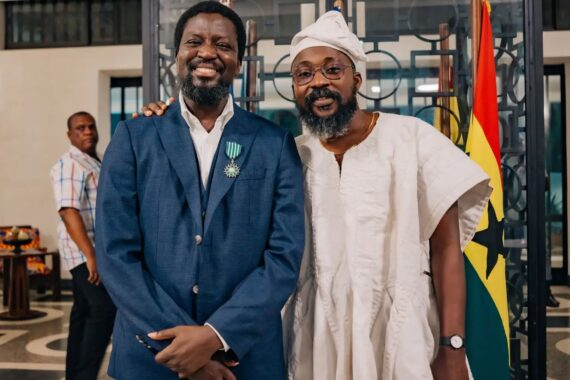
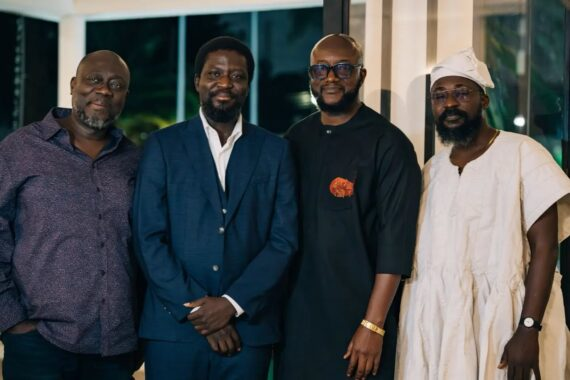
Internationally acclaimed Ghanaian artist Ibrahim Mahama was awarded the insignia of Chevalier de l’Ordre des Arts et des Lettres, one of France’s highest cultural distinctions, last week in recognition of his significant contribution to contemporary art and culture.
The decoration was presented last week by H.E. Mrs. Diarra Dimé Labille, France’s Ambassador to Ghana, ahead of Mahama’s first major exhibition in Paris, The Harvest Season, which opens at the Fondation Cartier pour l’art contemporain on October 22, 2026, and runs through February 28, 2027.
It represents official French recognition of an artist whose practice has increasingly shaped conversations about labor, trade, migration, colonial histories, and the global circulation of goods and people.
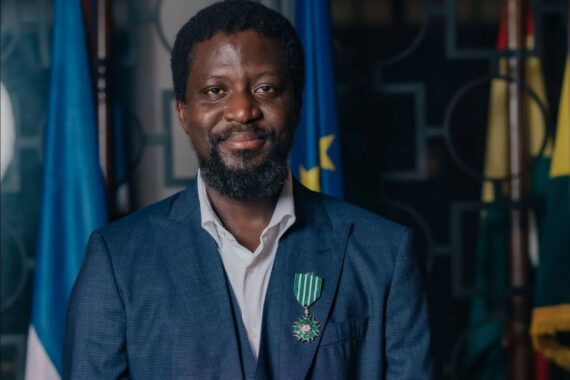
Mahama is widely regarded as one of the most influential voices in contemporary African art. He also became the first African artist to top ArtReview’s Power 100 and win the city of Kassel’s 2026 Arnold Bode Prize, further underscoring his growing influence in the international art world.
Indeed, earlier this year, he was honored as a Laureate by the Asantehene Otumfuo Osei Tutu II Art Awards, in recognition of his outstanding contributions to contemporary visual arts in Ghana and internationally.
His monumental, site-specific installations frequently transform materials associated with labor and commerce—including jute sacks, timber, discarded textiles, and industrial remnants—into expansive sculptural environments.
Through these materials, Mahama interrogates the economic systems and historical forces that have shaped societies, particularly the legacies of colonialism, extraction, and exploitation.
Over the past decade, he has become particularly known for his use of jute sacks and remnant textiles. In some of his most striking works, teams of workers stitch together materials connected to Ghana’s trading and agricultural economies, including leftover cloth from the cocoa industry, into enormous quilts that envelop buildings and other architectural structures.
Yet Mahama’s engagement with labor extends beyond the subject matter of his art. He has used his position in the global art world to create platforms for education, artistic production, and community development, establishing institutions and collaborative initiatives that seek to expand opportunities for artists and audiences in Ghana.
His exhibition history is extensive. Recent institutional presentations include Kunsthalle Bern (2025), Fruitmarket, Edinburgh, and Barbican Center, London (2024), Kunsthalle Osnabrück (2023), Frac des Pays de la Loire, Nantes (2022), and the University of Michigan Museum of Art (2020).
Earlier exhibitions include shows at The Whitworth, University of Manchester, and Norval Foundation, Cape Town (2019), Tel Aviv Museum of Art (2016), and the K.N.U.S.T. Museum, Kumasi (2013).
Mahama served as Artistic Director of the 35th Ljubljana Biennale of Graphic Arts in 2023 and received the inaugural Sam Gilliam Award from the Dia Art Foundation.
His work has also been featured prominently in major international exhibitions, including Sharjah Biennial 15, the 18th Biennale Architettura in Venice, and the 35th Bienal de São Paulo (all 2023); the Museum of Fine Arts, Houston (2021); the Centre Pompidou, Paris, and the 22nd Biennale of Sydney (2020); the 58th and 56th Biennale Arte in Venice (2019 and 2015); and Documenta 14 in Athens and Kassel (2017).
Based in Accra, Kumasi, and Tamale, Mahama has also invested significantly in building cultural infrastructure in northern Ghana. His artist-led initiatives include the Savannah Center for Contemporary Art (SCCA), established in 2019; Red Clay, founded in 2020; and, most recently, Nkrumah Volini, all in Tamale. Together, these spaces have helped broaden the geography of contemporary art in Ghana and created new platforms for exhibitions, research, education, and public engagement.
Established in 1957, France’s Ordre des Arts et des Lettres holds a distinguished place in the country’s cultural policy. The order recognizes individuals who have made exceptional contributions to enriching and promoting the arts and culture in France and internationally.
For Mahama, the French honor arrives at a significant moment in an already remarkable career.
As The Harvest Season prepares to bring his expansive artistic vision to Paris, the distinction underscores an artist whose work continues to connect Ghana’s histories of labor, trade, and extraction with the wider structures of the contemporary world.



-

 Ghana News1 day ago
“It Slipped Through”: Ghana Customs Boss Admits Airport Security Failure After 3.9-Ton Drug Bust
-

 Opinion1 day ago
African Blood for Other People’s War?
-
 Festivals & Events2 days ago
Accra Welcomes New York Leadership for a Historic Night of Community
-

 Homes & Real Estate1 day ago
How Mechanical, Electrical, and Plumbing Audits Protect Your Real Estate Investment
-

 Global Update1 day ago
White House Launches ‘Trump TV’ on YouTube After Banning Three News Outlets: Here’s What It’s Showing
-
 Taste GH2 days ago
The Timeless Appeal of Koose and Spiced Millet Koko
-
 Ghana News6 hours ago
Ghana Parliament Faces Emergency Recall Over Heightening Narcotics Crisis
-
 Fashion & Style1 day ago
When Aesthetics Backfire: What the Converse Imagery Controversy Teaches the Global Style Industry