
Africa Watch
AES Unveils New Regional ID and Passport System as Bloc Deepens Its Split From ECOWAS

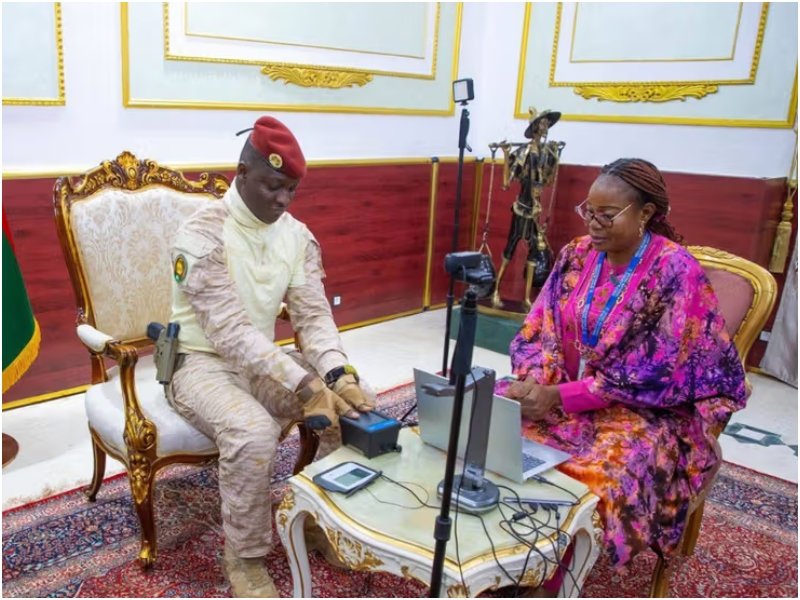
Burkina Faso has taken a decisive step in cementing the sovereignty of the Alliance of Sahel States (AES), with President Ibrahim Traoré becoming the first leader in the bloc to receive a new AES biometric identity card.
The symbolic handover on Monday, December 1, 2025, conducted by Security Minister Mahamoudou Sana, marks the beginning of a major regional shift: a unified identification and travel-document regime designed to define the AES as an independent political structure, no longer tethered to ECOWAS systems or symbols.
For a bloc that has spent the past two years rewriting its place in West Africa, this moment is more than administrative housekeeping. It is an assertion of political identity.
Traoré’s ID card is the first issued under a sweeping AES-wide program to create a uniform biometric identity system and a shared AES passport — a document that was first unveiled earlier this year and immediately signaled the confederation’s ambition to build parallel institutions rivaling those of ECOWAS.
Burkina Faso’s Council of Ministers approved the new identity card system on November 6, 2025, clearing the way for a 10-year biometric card that meets international standards and embeds sophisticated security features.
The card will be available to all Burkinabè from age five and will serve as the country’s primary legal identification tool. Old ID cards will remain valid for a five-year transitional period before being fully phased out across Burkina Faso, Mali, and Niger.
Crucially, ECOWAS logos have already been stripped from Burkina Faso’s passports — a quiet but telling break from decades of regional alignment.
The new AES ID and passport system is designed to operate with its own rules, its own architecture, and its own political messaging. Both documents carry encrypted biometric chips compliant with International Civil Aviation Organization (ICAO) standards, reflecting a deliberate move toward global interoperability without ECOWAS oversight.
Supporters of the reform say the AES identification overhaul will enhance national security, streamline access to public services, and give the bloc full control over its data infrastructure — a strategic win in a region long dependent on external systems and political frameworks.
For the AES leadership, these documents are more than travel papers or ID cards. They are nation-building tools — the administrative backbone needed to support future plans for cross-border trade, joint infrastructure projects, and a fully integrated regional market.
As Burkina Faso leads the rollout, Mali and Niger are expected to follow in the coming months. For observers across West Africa, the quiet efficiency of the new system signals a bloc steadily laying down the institutions it believes it needs to stand on its own.
The AES Confederation is a confederation formed between Mali, Niger, and Burkina Faso, all located in the Sahel region of Africa. It originated as a mutual defense pact created on September 16, 2023 following the 2023 Nigerien crisis, in which the West African political bloc ECOWAS threatened to intervene militarily following a successful coup d’état in Niger earlier that year. All three member states are former members of ECOWAS and currently under the control of juntas following a string of successful coups, the 2021 Malian coup d’état, the September 2022 Burkina Faso coup d’état, and the 2023 Niger coup d’état. The confederation was established on July 6, 2024.
Whether the AES can translate these administrative milestones into long-term regional stability remains to be seen.
But this week’s issuance of the first AES ID card makes one thing clear: the trio of Sahel states is building a new political identity — document by document, system by system.






Africa Watch
Shame on Him! Ramaphosa Attempts a Guilt-Ridden Diplomatic Offensive as he Seeks to Mend Strained Ghana Ties After Xenophobic Attacks

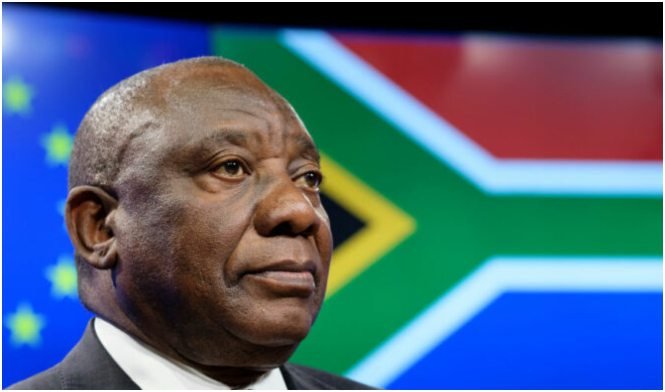
South African President Cyril Ramaphosa has launched a diplomatic offensive to repair strained ties with Ghana, dispatching his International Relations Minister as a special envoy to Accra following weeks of tensions over deadly xenophobic attacks against African nationals.
President John Dramani Mahama received South Africa’s Minister of International Relations and Cooperation, Ronald Lamola, in Accra on Wednesday, July 22, in what both sides described as a constructive engagement aimed at restoring confidence between two of Africa’s largest economies.
“I made Ghana’s position clear. We do not harbour ill will toward South Africa,” Mahama said following the meeting. “However, we remain deeply concerned about the attacks and the significant capital losses suffered by people from various countries on the continent.”
A Nation’s Grief, A Continent’s Concern
The diplomatic push comes after weeks of anti-immigrant violence in South Africa that has claimed at least one Ghanaian life, disrupted the livelihoods of thousands of African migrants, and forced Ghana to undertake costly evacuation operations. Nigeria has also evacuated 1,490 of its nationals from South Africa.
The attacks, which have gone unpunished under Ramaphosa’s disappointing administration, intensified in early July, and have prompted a wave of diplomatic fallout.
Ghana believes the South African government could have done more to protect African immigrants, even if they were in the country illegally, and earlier postponed a planned state visit by President Ramaphosa, as tensions escalated following the circulation of images showing Ghanaian nationals being assaulted and ordered to leave South Africa.
Ghana’s AU Gambit
Mahama has taken the issue to the highest continental body, formally petitioning the African Union Commission to place xenophobic attacks in South Africa on the agenda of the next AU Summit. The proposal, signed by Foreign Minister Samuel Okudzeto Ablakwa, argues that the attacks have resulted in “loss of lives, destruction of businesses and investments, and growing insecurity for African nationals living and working in South Africa.”
Ghana’s call has gained significant regional momentum, with the Economic Community of West African States (ECOWAS) endorsing the proposal. Nigeria has also joined Ghana in pushing ECOWAS to take a decisive position against what it terms “Afrophobic” attacks.
“Sweeping this matter under the carpet will not resolve its root causes,” Mahama said, adding that Ghana’s proposal was not intended to single out South Africa but to create an institutional mechanism for continental dialogue.
South Africa’s Response
Lamola, who met with both President Mahama and AU Commission Chairperson Mahmoud Ali Youssouf, reiterated South Africa’s rejection of xenophobia “in all forms” and emphasized the government’s commitment to the rule of law. He insisted that criminal acts are being investigated through the country’s law enforcement and judicial systems.
President Ramaphosa has publicly condemned the attacks, directed security agencies to pursue those responsible, and intensified enforcement against immigration-related offences. His decision to dispatch special envoys to several African capitals, including Accra, forms part of a broader diplomatic outreach aimed at reaffirming South Africa’s commitment to Pan-African solidarity.
A Threat to African Integration
Mahama warned that recurring xenophobic violence threatens the African Union’s vision of continental integration by undermining the free movement of people, cross-border investment, and the principles of Pan-Africanism.
“Placing this on the AU agenda gives South Africa a formal, constructive platform to share its perspective, and together, as a continent, work toward a lasting solution,” the President said.
His remarks came as two Ghanaians petitioned the International Criminal Court to investigate “repeated xenophobic attacks” in South Africa—a move Pretoria has dismissed as “opportunistic”.
What Happens Next
With ECOWAS backing Ghana’s proposal, the matter is now set for consideration at the continental level. President Mahama expressed optimism that the AU would take concrete action, urging leaders to ensure the issue becomes a practical roadmap for protecting African nationals across the continent.
“The success of this effort will be measured by the safety of Africans wherever they choose to live and work on this continent,” he said, speaking to reporters in Accra.
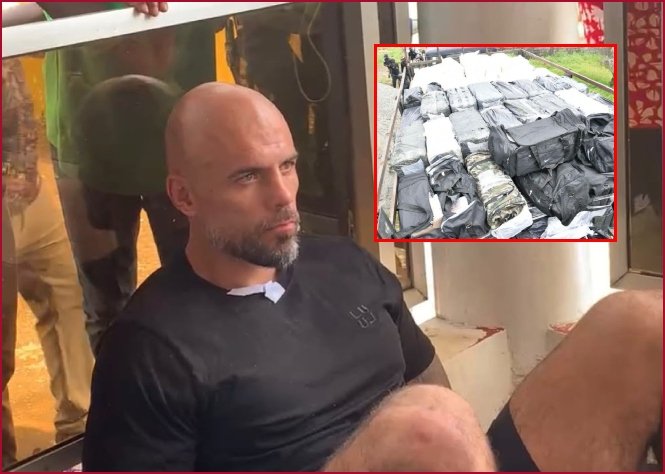
Liberian security forces have seized nearly four metric tons of cocaine valued at an estimated $318 million from a warehouse on the outskirts of Monrovia, in what officials are calling the largest drug bust in the country’s history.
The raid, carried out by a joint security team acting on a court-issued search-and-seizure warrant, uncovered 3,971 kilograms of cocaine at a private property in the VOA Community in Paynesville. Two foreign nationals, one holding dual Colombian and Spanish passports and a Serbian citizen, were taken into custody at the scene.
The seizure comes just weeks after authorities intercepted 237.6 kilograms of cocaine at Roberts International Airport in June, and is nearly 17 times the weight of that earlier bust and roughly 40 times its value. At close to four metric tons, it ranks among the most significant drug hauls ever reported in West Africa.
The Arrests and Investigation
The two men arrested at the scene were identified as Johann David Garces Grajales, who holds both Colombian and Spanish passports, and Srdan Seles, a Serbian national. Investigators, however, are not convinced the names are genuine.
“One of the things we’re going to establish is whether the names in their passports are indeed their real names,” a member of the joint security team told The Liberian Investigator. “It is a common practice for transnational drug dealers to conceal their real identities.”
The operation grew out of a sustained intelligence effort to track the cartel, the officer said, but the scale of what the team found still caught it off guard.
“We have been doing everything possible to track down the cartel. This was made possible through the intelligence we gathered,” he said. The team expected to recover some quantity of drugs at the site, he added, but not this. “What we saw really blew my mind.”
Who owns the warehouse remains an open question. “So far, we have not been able to identify the owner of the property,” the officer said. “We cannot also say whether the owner is linked to the cartel or not. But that’s one of the areas the investigation would also focus on.”
A Widening Reckoning with Trafficking
The arrests land in the middle of a widening reckoning with Liberia’s role on the transatlantic cocaine route. The case that opened that reckoning began June 8 at Roberts International Airport, when customs and security officers intercepted 198 compressed plates of cocaine weighing about 237.6 kilograms and valued at roughly $19.2 million, concealed in six cargo boxes falsely declared as Maggi seasoning cubes and lappas and bound for Europe.
That case has since exposed a network reaching into the institutions meant to stop it. Prosecutors charged five people:
- Paul J. King, an executive at Global Logistics Services, whose company handled cargo at the airport’s GLS-Menzies terminal—the only suspect to appear in a Liberian courtroom in person
- Michael U.S. Browne, also known as Rahim or Raheem Bah, who remained in Monrovia for weeks after the seizure before slipping across the border into Sierra Leone—charged in absentia
- Oscar J. Browne, chief of intelligence for RIA Security
- Emmanuel Kpah, whom police say delivered the shipment and the cash tied to the transaction
- Usman Ali, the United Kingdom-based consignee whose name was stamped on one of the boxes
All five face trafficking and conspiracy charges, with criminal solicitation added in at least one instance. Four of the five were charged in absentia.
A Pattern of Impunity
Senators, including Amara Konneh, Darius Dillon, and Edwin Snowe, have called for a broader inquiry to question how seizures of that size resulted in no arrests before suspects left the country. The concern is genuine: in 2022, a jury acquitted all four defendants in the $100 million Freeport cocaine case, which was then the country’s largest, and the court ordered the seized cash to be returned.
The lesson traffickers seem to have drawn is that Liberia’s borders might sometimes catch a shipment, but its courts rarely catch a trafficker.
Announcing the charges in the June case, Inspector General of Police Col. Gregory O. W. Coleman said the seizure was no accident or clerical error but the work of an organized criminal enterprise exploiting the country’s air cargo system. He added that fugitive suspects were being pursued through arrest warrants, international cooperation, extradition requests, and mutual legal assistance.
What Happens Next
Authorities say investigators will work to trace how the latest shipment entered Liberia and to establish the true identities of the two men in custody. The investigation will also focus on determining the ownership of the warehouse where the drugs were stored.
For a country with a long history of serving as a transit point for Latin American cocaine bound for Europe, the record-breaking seizure—and the questions it raises about institutional integrity—may mark a turning point in Liberia’s fight against transnational organized crime.
Africa Watch
‘We Must Never Permit Intolerance’: Mahama Wins ECOWAS Backing to Take Xenophobia to AU Summit
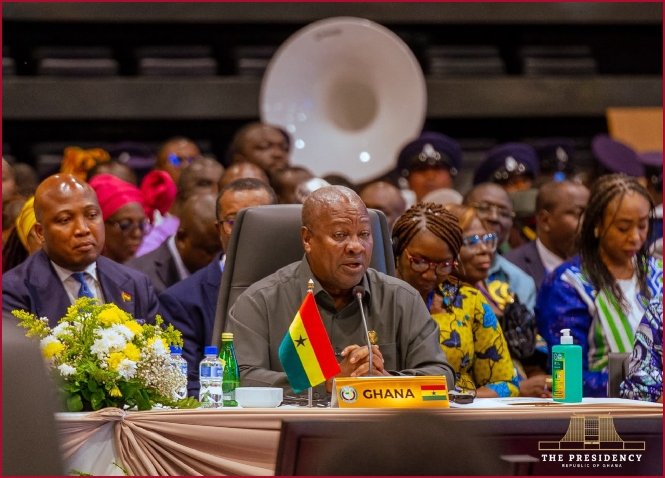
President John Dramani Mahama has secured a major diplomatic victory, winning the endorsement of West African leaders to bring the issue of xenophobic attacks in South Africa before the African Union (AU), a move he says is essential to preserving the continent’s legacy of liberation and unity.
“African liberation was achieved through solidarity across our borders. We must never permit that proud legacy to be weakened by intolerance by a small group of people,” President Mahama declared.
The endorsement came during the 69th Ordinary Session of the ECOWAS Authority of Heads of State and Government, held on July 19, 2026, in the coastal town of Lungi, Sierra Leone. The regional bloc’s collective backing marks the first time ECOWAS heads of state have formally united behind Ghana’s petition since the government first requested AU intervention earlier this year.
‘Deeply Concerned’ by Loss of Life
President Mahama expressed grave concern over the recent wave of violence targeting African nationals in South Africa, which has claimed multiple lives and left countless others living in fear.
“Ghana is deeply concerned about the recent incidents of xenophobic attacks against our citizens in South Africa, during which some Africans, including Ghanaians and Nigerian citizens, have lost their lives, while many other African nationals have experienced fear, intimidation and uncertainty,” he said.
The attacks have triggered a humanitarian crisis. More than 53,000 foreigners have fled South Africa in recent weeks. Close to 1,500 Nigerians and nearly 1,000 Ghanaians have been repatriated after anti-immigrant groups issued a so-called deadline of June 30 for undocumented migrants to leave the country. Nigeria has already evacuated 1,490 citizens across seven separate flights.
ECOWAS Unity and the Road to the AU
The ECOWAS Council of Ministers had earlier declared full support for Ghana’s petition, also granting unconditional endorsement to the Accra Next Steps Commitments on Reparatory Justice. Foreign Affairs Minister Samuel Okudzeto Ablakwa described the unanimous decision as a “significant show of solidarity” from the region’s foreign ministers.
President Mahama welcomed the endorsement, stating: “Ghana welcomes the decision of the Authority of Heads of State of ECOWAS to fully endorse and support Ghana’s petition at the African Union for the matter to be addressed at the next AU Mid-Year Summit”.
Nigeria Joins the Call
Nigeria has also taken a firm stand. President Bola Ahmed Tinubu, represented by Vice President Kashim Shettima at the summit, demanded that West African leaders unite to drag Pretoria before the African Union.
“Nigeria condemns in strong terms the recent Afrophobic attack on its citizens and other fellow Africans in the Republic of South Africa,” Shettima stated. He delivered a sharp historical reminder: “South Africa should be reminded that the freedom the country currently enjoys is due to the liberation efforts of African countries such as Nigeria”.
Ghana and Nigeria have agreed to deepen their partnership against all forms of xenophobia, Afrophobia, intolerance and violence against fellow Africans, emphasizing that such acts are “contrary to the shared values of Pan-Africanism and the collective progress of the continent”.
A Threat to Continental Progress
Diplomatic leaders have warned that such attacks jeopardize the African Continental Free Trade Area (AfCFTA) and undermine the broader spirit of Pan-Africanism. Ghana’s petition to the AU highlights that these persistent attacks violate the African Charter on Human and Peoples’ Rights.
President Mahama also called on ECOWAS member states to place greater attention on implementing existing decisions to strengthen regional integration.
“Over the past five decades, ECOWAS has adopted important treaties, protocols and decisions that have advanced regional integration. There is, therefore, the need for the effective implementation of all our decisions,” he said.
A Defining Moment for African Unity
The coordinated push by Nigeria and Ghana marks a major escalation in regional diplomacy. With the National Assembly in Nigeria opening an official inquiry into the safety of citizens abroad, West Africa is signaling that the era of quiet diplomacy on xenophobia is officially over.
As President Mahama emphasized, the future of ECOWAS will be measured by the effect of its decisions on ordinary people. The question now is whether the African Union will deliver a decisive response — or allow xenophobia to continue unchecked.


How One Father’s Decision Helped Ama Ata Aidoo Become a Global Literary Icon

Meet the Two Ghanaians Who Have Hauled South Africa to the ICC Over Xenophobic Violence

From London to Vancouver to Toronto: The Growing Trend of Asylum Claims at Global Sporting Events
-
 Ghana News22 hours ago
In Photos: Ghana’s Military-led Flood Mitigation Task Force Clears Waterways Building by Building
-
 Ghana News21 hours ago
Meet the Two Ghanaians Who Have Hauled South Africa to the ICC Over Xenophobic Violence
-
 Africa Watch2 days ago
Shame on Him! Ramaphosa Attempts a Guilt-Ridden Diplomatic Offensive as he Seeks to Mend Strained Ghana Ties After Xenophobic Attacks
-

 Ghana News2 days ago
Top 10 Headlines from Ghanaian Newspapers: Friday, July 24, 2026
-
 Ghana News2 days ago
Waiting in Long Queues: Mahama Recalls Pandemic Trauma as He Pushes for Vaccine Self-Sufficiency Across Africa
-

 News2 days ago
British Woman Jailed Six Years After Hong Kong Court Rejects Rape Allegation
-
 Festivals & Events2 days ago
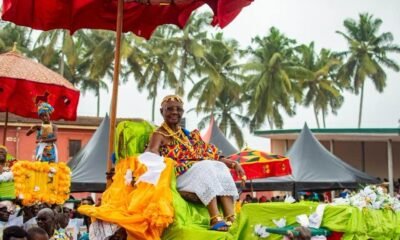
Where History Walks Again: Inside Saltpond’s Colourful Odambea Festival
-

 Health & Wellness2 days ago
The Fitness Milestones That Matter More Than the Number on the Scale