
Arts and GH Heritage
In Ghana, The Coffins Show Death Is a Final Celebration of Life


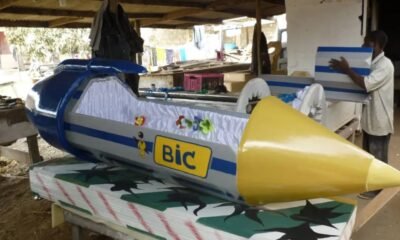
Walk past the Kane Kwei Carpentry Shop in Teshie and you’ll think you’ve stumbled into a surreal sculpture garden.
A giant red cockerel. A gleaming silver Mercedes. A proud lion mid-roar. An airplane ready for take-off. Only when you get closer do you realise: every masterpiece is a coffin.
For over sixty years, families here have turned the saddest moment into the loudest celebration of a life well lived.
Twenty-two-year-old Lawrence Anang wipes sawdust from his brow and smiles.
He is sanding the mane of a lion coffin ordered for a departed chief.
“This is not just wood,” he says quietly. “This is the story of a king going home as a king.”
His family workshop, started by his grandfather, is one of the last remaining strongholds of Ghana’s world-famous fantasy coffin tradition. Pilots are buried in airplanes. Cocoa farmers rest inside giant cocoa pods. Musicians sleep forever inside oversized microphones.
Even a fisherman might choose a brightly painted tilapia or a leaping swordfish.
“It’s the last suit you will ever wear,” Lawrence explains. “So it has to fit perfectly — not just the body, but the soul.”
Felicia Okai stands nearby, eyes shining as she chooses between a cocoa-pod and palm-fruit design for her late uncle, a farmer.
“This coffin will make the whole village talk for years,” she laughs. “When they see it, they won’t cry for long. They will remember how he danced at harvest, how he shared every cedi. Death will look like a party.”

The work is slow and sacred.
Each coffin takes up to two weeks. Measurements must leave “breathing room” around the body. The wood — soft poplar or rich mahogany — is sanded until it feels like silk. Then comes the paint, layer after layer, until a fish coffin shimmers like it could still swim.
These coffins don’t stay in Ghana.
They fly to museums in Paris and London, to diaspora funerals in Atlanta and Amsterdam. Lawrence’s brother now runs a workshop in Wisconsin. A single coffin can cost up to $1,000 — more than many earn in a year — yet families save for decades to give their loved ones this final honour.
And when the dancing pallbearers arrive in their flamboyant suits, lifting a giant bible or a bottle of Schnapps high above their heads, swaying to brass-band highlife, even strangers on the roadside start clapping instead of crying.
Lawrence already knows what he wants when his own time comes: a simple carpenter’s hammer, bright yellow, handle polished smooth.
“Because,” he says, touching the lion’s freshly painted eye, “if you want to have fun in the land of the dead, you need to get your coffin right here.”
Editor’s note: Story adapted from a publication by The World. Read original article here.





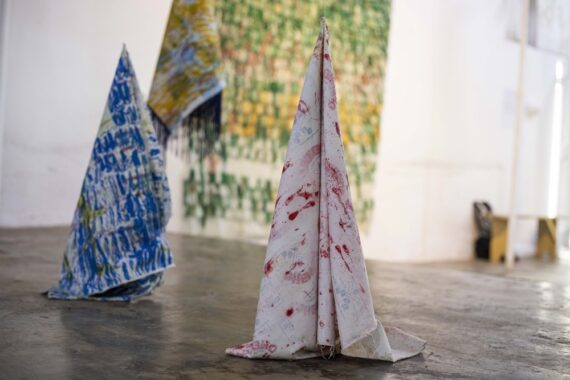
At KNUST, an everyday water filter became a powerful symbol of work, memory, and the marks that shape human lives.
A clean white filter is designed to disappear. Hidden inside a water system, its success is measured by what it captures and what it keeps out of sight.
Yet Ghanaian artist Gideon Kobbla Hanyame asks a disarming question: what if the stains we try hardest to avoid are the very things that give an object—and perhaps a person—its meaning?
That quiet challenge sat at the centre of I call upon these persons here present to witness that…, an exhibition presented at the Sculpture Auditorium of the Kwame Nkrumah University of Science and Technology (KNUST) in Kumasi. Rather than treating cleanliness as an untouched ideal, Hanyame explored purity as something earned through contact, labour and change.
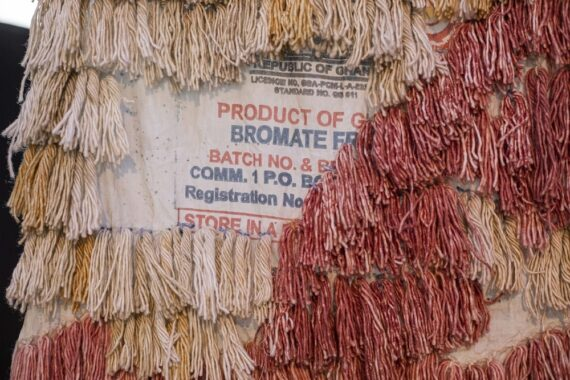
His starting point was the humble string-wound water filter. Bright white when new, it gradually darkens as it removes impurities. Instead of viewing that transformation as deterioration, Hanyame turned it into a metaphor for the invisible work carried out every day—by people, communities and even cultures that absorb pressure while creating something life-giving for others.
Craft Traditions Meet Contemporary Thought
The exhibition drew deeply from Ghana’s material traditions. Dyed filter yarns, flour sacks, stitched textiles and handcrafted mirror frames merged into works that resisted simple labels. They shifted between sculpture, painting and woven installation, reflecting the artist’s belief that identity is never fixed.
Equally significant was the collaborative process. Local dyers and artisans became part of the creative journey, reinforcing the idea that contemporary art does not exist apart from community knowledge but grows through it.
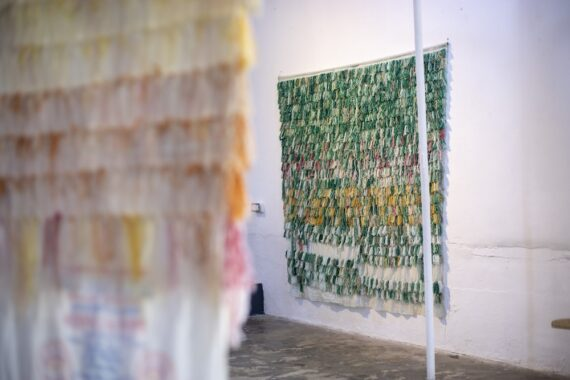
Visitors were encouraged to wander freely rather than follow a prescribed route. Every path produced a different conversation with the works, mirroring the unpredictable ways people accumulate memories, experiences and scars throughout life.
A Different Definition of Purity
At a time when polished perfection dominates social media and consumer culture, Hanyame offers a striking alternative. His exhibition argues that transformation is rarely spotless. Growth leaves marks. Service demands sacrifice. Objects—and people—carry evidence of every encounter.
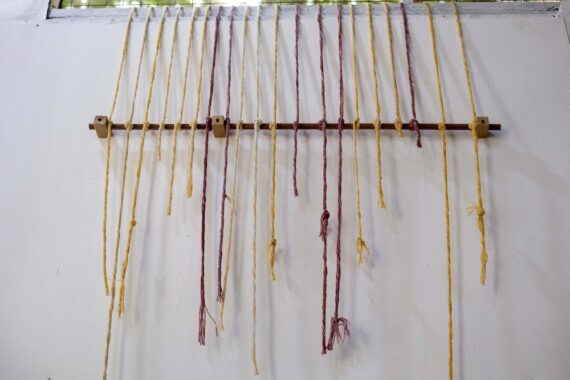
In Ghana, where handmade traditions continue to evolve alongside contemporary artistic practice, that message feels especially timely. The exhibition reminds audiences that heritage is not preserved by remaining untouched. It survives by adapting, absorbing and changing with each generation.
Perhaps that is the exhibition’s most enduring idea: the marks we often hide may be the clearest proof that we have lived, worked and become something new.
Every conversation about galamsey seems to begin with the same image: a miner waist-deep in muddy water, an excavator tearing through a once-green landscape, or a river turned the colour of clay.
Ghanaian artist Ebenezer Christian wants us to look somewhere else entirely. His question is not who digs the pit, but who profits while remaining unseen.
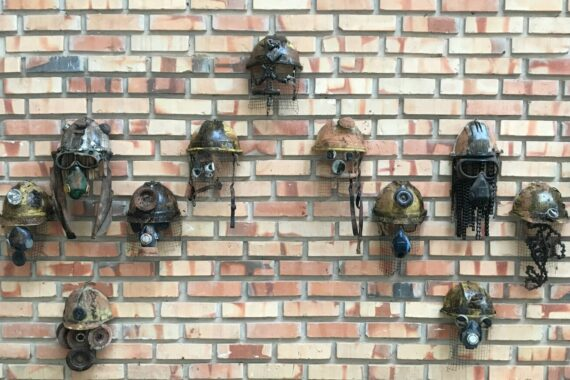
In his 13-piece sculptural series, The Ambiguity of Mask, Christian transforms abandoned mining equipment, broken protective gear, and industrial debris into haunting faces that appear both familiar and anonymous.
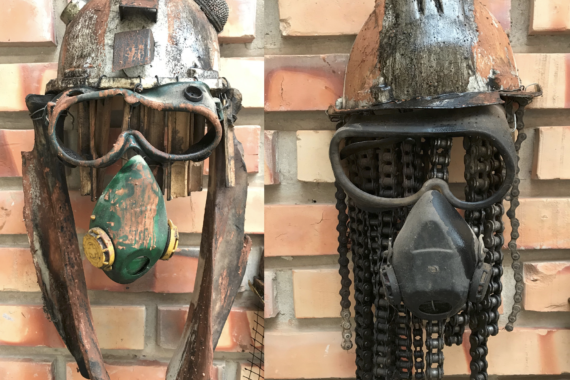
They stare back at viewers with an unsettling silence, carrying the physical scars of extraction while refusing to identify the people behind them.
The masks are not portraits of miners alone. They are symbols of concealment, pointing to the financiers, traditional authorities, landowners, political actors, and other influential figures whose roles in Ghana’s illegal mining economy are often discussed in whispers rather than public debate.
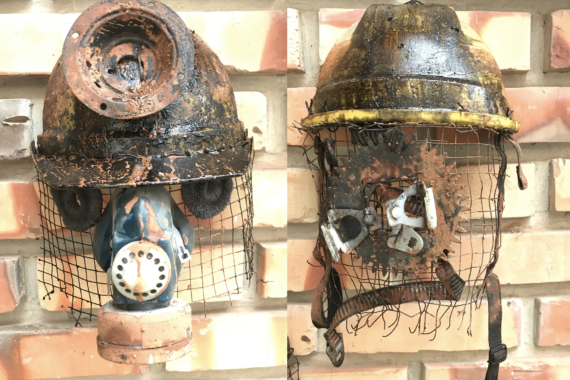
One of the exhibition’s most thought-provoking works, We Know Within, suggests that the truth about galamsey has never been entirely hidden. Instead, it reflects a collective awareness that responsibility extends far beyond those operating machines at mining sites. The title itself hints at an uncomfortable reality: many know where accountability lies, yet meaningful action remains elusive.
Christian’s choice of recycled materials gives the sculptures unusual authority. Every rusted metal fragment and damaged helmet once belonged to the machinery of extraction. Rather than merely representing environmental destruction, the objects embody it. Their transformation into art becomes an act of reclamation, rescuing discarded remnants of exploitation and giving them a new purpose as witnesses.
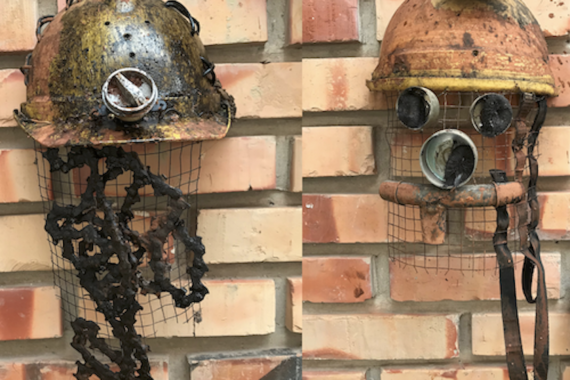
This approach also places Christian within a growing movement of contemporary African artists who use found materials to address urgent public concerns. Across the continent, artists increasingly see waste not simply as refuse but as historical evidence—objects capable of preserving stories that official records sometimes overlook.
In Ghana, where polluted rivers, degraded forests, and disappearing farmlands have become defining consequences of illegal mining, The Ambiguity of Mask arrives with remarkable urgency.
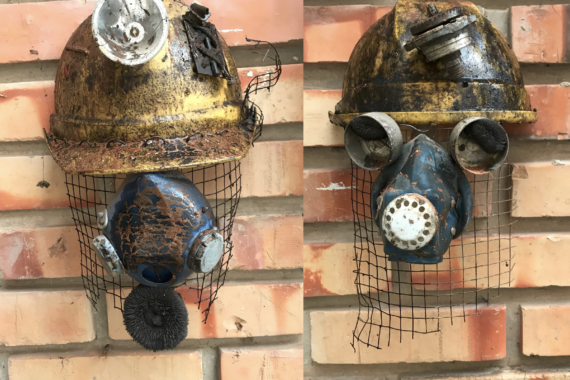
Yet its greatest strength lies in resisting easy answers. Instead of assigning blame to those most visible, Christian asks audiences to examine the structures that make environmental destruction profitable in the first place.
His sculptures ultimately suggest that the greatest disguise in the galamsey crisis is not worn by the miner standing in plain sight. It belongs to the powerful figures who remain comfortably behind the mask, untouched by the devastation unfolding in the open.
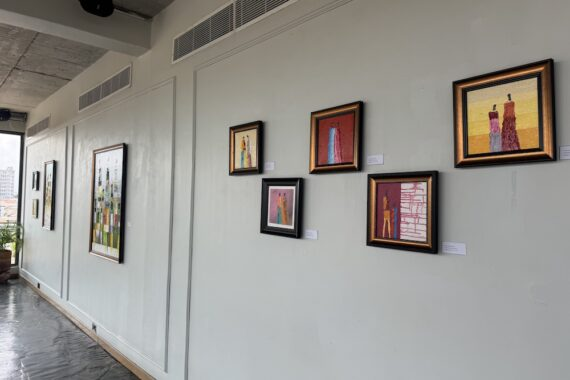
Adam Tata Gasakor’s latest exhibition explores the invisible traces that shape identity long after moments have faded.
A painting can sometimes remember what people forget.
That quiet proposition sits at the heart of Echoes of Presence, the latest solo exhibition by Ghanaian contemporary artist Adam Tata Gasakor, where canvases become less about what is seen than what is felt.
Instead of offering recognizable faces or familiar landscapes, Gasakor asks viewers to search for fragments of themselves inside layers of colour, texture, and movement.
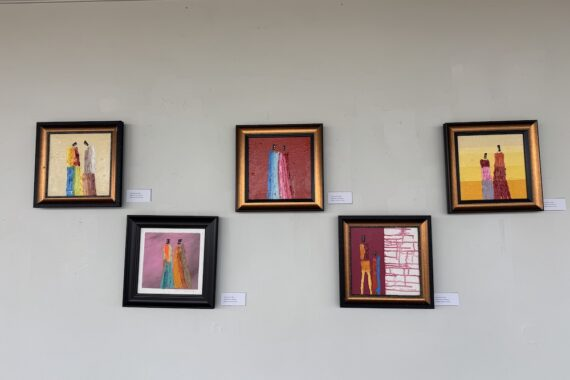
The approach reflects a growing shift within Ghana’s contemporary art scene. Increasingly, artists are moving beyond documenting everyday life to exploring the emotional terrain beneath it—memory, belonging, grief, resilience, and the relationships that continue to influence people long after encounters have ended.
For Ghanaian audiences, this idea resonates with cultural traditions that honour remembrance. Whether through storytelling, family lineage, festivals celebrating ancestors, or communal rituals that preserve collective history, memory has long been understood as something shared rather than private.
Gasakor translates that philosophy into abstraction, allowing emotion to carry the narrative instead of literal imagery.
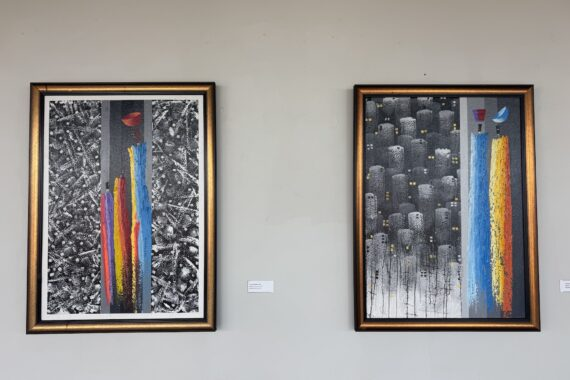
His paintings reward patience. Thick applications of pigment and expressive brushstrokes create surfaces that appear to shift depending on where the viewer stands. No single interpretation dominates.
One visitor may recognise hope where another finds loss, proving that the artwork is completed as much by the audience as by the artist.
Presented at The Mix Design Gallery in Accra, the exhibition also reflects the confidence of a new generation of Ghanaian painters whose work speaks across borders without abandoning local sensibilities.
Their language is deeply personal, yet their themes—identity, memory and human connection—are universal.
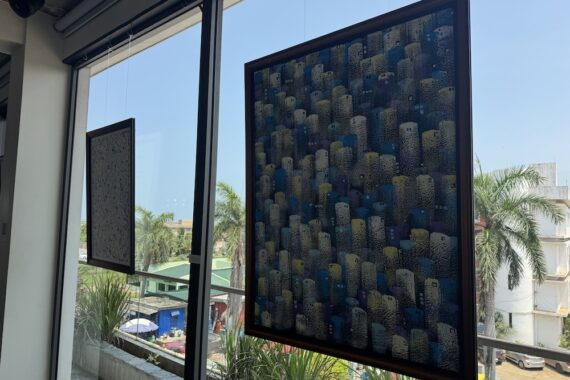
In an era when visual culture often competes for attention through spectacle and speed, Echoes of Presence embraces silence instead. It suggests that some of life’s most enduring experiences cannot be photographed or fully explained.
They linger in memory, shaping choices, relationships and identity in ways that remain invisible but unmistakably real.
As the exhibition continues until August 4, 2026, Gasakor offers more than a collection of paintings. He creates a space where visitors can slow down, confront their own recollections, and discover that the most lasting presence is often the one that cannot be seen.


How One Father’s Decision Helped Ama Ata Aidoo Become a Global Literary Icon

Meet the Two Ghanaians Who Have Hauled South Africa to the ICC Over Xenophobic Violence

From London to Vancouver to Toronto: The Growing Trend of Asylum Claims at Global Sporting Events
-
 Ghana News14 hours ago
In Photos: Ghana’s Military-led Flood Mitigation Task Force Clears Waterways Building by Building
-
 Ghana News13 hours ago
Meet the Two Ghanaians Who Have Hauled South Africa to the ICC Over Xenophobic Violence
-

 Africa Watch1 day ago
Shame on Him! Ramaphosa Attempts a Guilt-Ridden Diplomatic Offensive as he Seeks to Mend Strained Ghana Ties After Xenophobic Attacks
-

 Ghana News1 day ago
Waiting in Long Queues: Mahama Recalls Pandemic Trauma as He Pushes for Vaccine Self-Sufficiency Across Africa
-

 Ghana News2 days ago
Top 10 Headlines from Ghanaian Newspapers: Friday, July 24, 2026
-

 Health & Wellness2 days ago
Why That Lower Belly Isn’t a Problem Most Women Need to Fix
-
 News1 day ago
British Woman Jailed Six Years After Hong Kong Court Rejects Rape Allegation
-
 Festivals & Events1 day ago
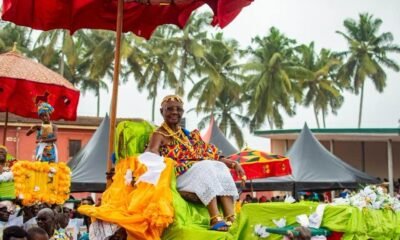
Where History Walks Again: Inside Saltpond’s Colourful Odambea Festival