
Tourism
Emirates Targets Full Network Recovery in ‘Coming Days’ as Gulf Airspace Slowly Reopens

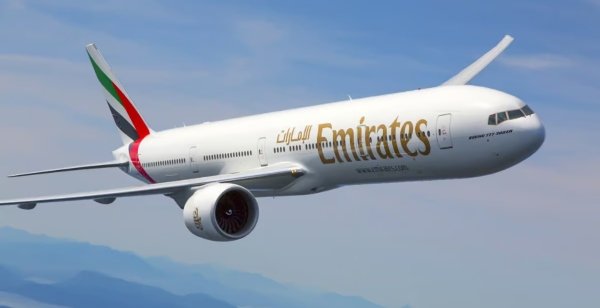
Dubai / Accra – March 6, 2026 – Emirates has announced plans to return to 100% of its pre-crisis flight network “in the coming days,” becoming one of the first major carriers to signal a full recovery after six days of near-total airspace shutdowns across the Gulf caused by the US-Israel-Iran conflict.
The Dubai-based airline stated it carried approximately 30,000 passengers out of Dubai on Thursday and expects to operate 106 daily return flights to 83 destinations by Saturday—roughly 60% of its normal route map.
“Safety remains paramount,” the carrier stressed, adding that passengers with earlier bookings are being prioritized and should only head to the airport if contacted directly.
Etihad Airways is also restarting a limited flight schedule from Abu Dhabi, while Qatar Airways plans to operate a small number of repatriation flights from Doha on Saturday to London, Paris, Madrid, Rome, and Frankfurt, giving priority to families, elderly passengers, and those with urgent medical or compassionate needs.
Click here for full flight schedules.
Other airlines have begun partial operations or special relief flights:
- British Airways is operating additional flights from Muscat (Oman) to London Heathrow on March 9–12 for customers stranded in Oman or the UAE.
- Finnair plans special flights from Muscat to Helsinki starting March 10 to bring back ~1,200 customers from Dubai.
- Virgin Atlantic resumed services from Dubai and Riyadh to London Heathrow on Wednesday.
- Air Arabia is operating limited flights to Austria, Egypt, Ethiopia, Greece, India, Italy, Pakistan, Saudi Arabia, and Turkey.
However, several carriers continue to suspend or heavily restrict services:
- Gulf Air, Saudia, Wizz Air, Turkish Airlines, Air France, KLM, Lufthansa Group, Delta, American Airlines, Air Canada, and Garuda Indonesia all maintain suspensions or cancellations to/from multiple Gulf and Middle East destinations until at least March 8–11, with some routes (e.g., to Tehran) halted until late April.
Dubai Airports reported facilitating more than 1,140 flights and 105,000 outbound seats to over 80 countries between March 2 and 5, but full recovery remains dependent on airspace availability and safety clearances.
The conflict has caused widespread disruption, with 40% of scheduled Middle East flights cancelled since late February. For Ghanaian nationals, diaspora communities, and businesses reliant on Gulf routes, the gradual reopening offers cautious hope, though major carriers have not yet committed to full schedules.








Some meals demand a table, a fork, and a certain amount of ceremony. Then there is Kofi Broke Man.
No plate. No cutlery. No pretence. Just a man—or a woman—with a wooden bowl, a coal pot, and an understanding that the best things in life require nothing more than your hands and a moment of patience.
The name itself tells you everything. Kofi Broke Man is the meal for the days when your pockets are light, but your spirit refuses to go hungry.
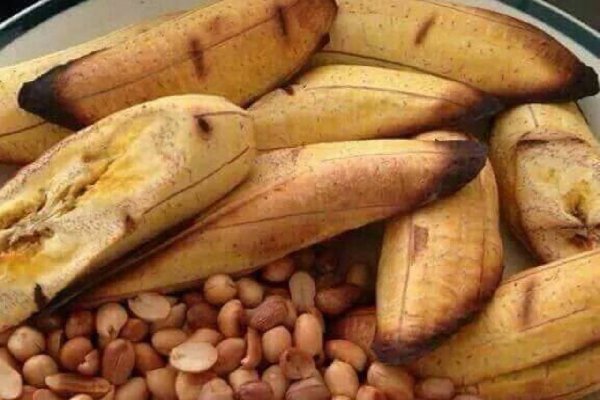
It is roasted plantain served alongside a generous handful of roasted groundnuts. That is it. No fish. No stew. No embellishment. And yet, it is one of the most satisfying things you will ever taste.
Read Also: Experience the Rare Texture of Apapransa the Celebratory Roasted Corn Delicacy
The plantain arrives hot, its skin blistered black from the coals, the flesh inside transformed into something soft and almost honey-sweet. The groundnuts are warm, salted, each kernel offering a buttery crunch. You pull off a piece of the plantain, press a few groundnuts into it, and let the combination do its work. Sweet meets savoury. Soft meets crisp. Heat meets salt.
You eat it standing by the roadside, balancing the paper cone in one palm, using the other to peel back the charred skin. There is no conversation for the first few minutes. Just the quiet focus of someone who knows they have stumbled upon something perfect.
Kofi Broke Man does not try to impress you. It does not need to. It is the taste of resourcefulness, of joy found in simplicity, of a country that knows how to turn two humble ingredients into a moment worth crossing town for.
Sights and Sounds
The Night They Banned the Song: How a Highlife Guitar Felled a General and Renamed an Airport


Let me tell you about the most dangerous pop song in West African history. It wasn’t a protest anthem. It wasn’t a political rallying cry.
It was a gentle, hypnotic tune about a boy and his guitar, a melody so sweet it supposedly drifted into the mind of its creator from a spirit on a lonely Lagos beach.
And yet, for a brief and violent moment in 1967, the government of Ghana treated that song like an enemy battalion. They banned it from the airwaves. They hunted its echoes in dance halls. They tried to scrub it from the national memory.
Why? Because they believed a guitar riff had the power to bring down a regime.
This week, Ghana did something that sounds, on paper, like the most boring bureaucratic exercise imaginable.
They changed the name of the country’s main airport. Out goes Kotoka International Airport. In comes Accra International Airport. Just a new sign, right? A new letterhead for the immigration officers?
To understand why this name change matters—why it carries the weight of a country’s unresolved argument with itself—you have to go back to that banned song.
You have to understand the man whose name is being scrubbed from the arrivals hall, and the strange, musical conspiracy that ended his life.
The Hero, The Villain, and the Man on the Beach
General Emmanuel Kwasi Kotoka is a ghost who haunts modern Ghana. You can ask ten people about him and get ten different answers. In 1966, he was the soldier who led the coup that toppled Kwame Nkrumah, the country’s founding father and the great hope of African liberation.
To some, Kotoka was a liberator who saved Ghana from a dictator. To others, he was the man who broke the dream, who handed the country over to a future of instability.
Either way, he was the man in charge. And a year later, a group of junior officers decided he had to go.
They planned their attack. They chose a codename for their mission. In military history, you expect codenames to be things like “Desert Storm” or “Operation Thunderbolt.” Things that sound tough. Things that sound like victory.
@wearevinylplus Ghana’s airport name change has roots in something unexpected: music. A highlife hit became the soundtrack to one of the biggest political incidents in Ghana’s history Decades later, that musical ripple is still echoing. #ForTheNow #africanpolitics ♬ original sound – wearevinylplus
These young soldiers, likely with the radio crackling in their barracks, picked something else. They named their plot Operation Guitar Boy.
They named it after a song.
The Soundtrack of the Barracks
In 1966, a Nigerian highlife legend named Sir Victor Uwaifo released a track that would define an era. Guitar Boy was pure magic. It wasn’t just a hit; it was the sound of West Africa letting its hair down. That guitar line was everywhere.
It spilled out of the taxis crawling through Accra’s traffic. It floated from the palm-wine bars. It whistled from the lips of street vendors.
Uwaifo himself claimed the melody wasn’t entirely his own. He said a mermaid—a Mammy Wata figure—appeared to him on a beach in Lagos and gifted him the tune.
It was folklore set to music. It had nothing to do with politics. It had everything to do with the spirit of the moment.
And that spirit had seeped into the army barracks. When those young lieutenants dreamed of overthrowing a general, the song in their heads wasn’t a military march. It was Guitar Boy. They weren’t being poetic. They were just men of their time, using the language of their time to describe their ambition.
The plot failed. Kotoka was killed during the attempt at the Flamingo Nightclub in Accra. But when the government pieced together the conspiracy, they didn’t just see the guns and the plans. They saw the name. They saw the cultural infection.
Their response was to declare war on a song.
The Weapon Was a Melody
Guitar Boy was banned in Ghana.
Think about that for a second. Not a subversive text. Not a radical pamphlet. A highlife record. The state decided that this piece of art was so intertwined with the rebellion that it had to be silenced. They treated a melody like a weapon.
They understood, perhaps better than we do today, that culture isn’t separate from politics. It is the soil in which politics grows.
For decades after, the airport bore Kotoka’s name. To some, it was a fitting tribute to a soldier. To others, it was a daily reminder of a wound, a forced acceptance of a man they saw as a traitor to the Nkrumah dream.
Every tourist who landed there, every citizen who returned home, walked through a gateway named for a coup.
Now, that gateway is simply Accra International. It is an attempt to let the airport be a place of arrival and departure, not a monument to a contested past. It is an attempt to step out of the shadow of 1966.
But the ghost of that story remains. And at its center is not a politician or a general, but a boy with a guitar.
It’s wild to think that a song, born from a mermaid’s whisper on a beach, ended up tangled in a coup, a ban, and the very name of a nation’s front door. It’s a reminder that history is rarely made by presidents and parliaments alone.
Sometimes, it’s made by a young man humming a tune, a soldier with a radio, and a melody that refuses to be silenced.
Sir Victor Uwaifo never meant to start a revolution. He just wanted to play his guitar. But in Ghana, sixty years later, his riff is still echoing through the corridors of power.
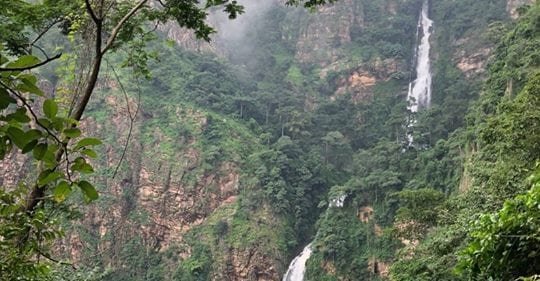
Let me tell you about the moment my breath actually stopped. It wasn’t the four-hour drive from Accra, the nine river crossings, or even the sight of the water that did it.
It was standing at the base of the falls, soaking wet and shivering, when the sun broke through the clouds.
The mist caught the light, and suddenly, a rainbow materialized right in front of me—so close I could almost reach out and touch it.
That is the magic of Wli. It doesn’t just show you something beautiful; it pulls you into the frame.
Tucked away in the Volta Region, near the quiet border town of Wli that shares a boundary with Togo, you will find the highest waterfall in all of West Africa. The locals call it Agumatsa—”Allow Me to Flow”. And flow it does, cascading roughly 80 meters down the cliffs of the Agumatsa Range into a chilly, inviting pool below.
Read Also: The African Dream in Stone: Stepping Into the Footsteps of Osagyefo Dr Kwame Nkrumah
There are two ways to experience this place. The first is the walk to the lower falls. It is an easy, flat stroll through the lush Agumatsa Wildlife Sanctuary. You will cross sturdy little bridges, listen to the call of hornbills overhead, and watch butterflies dance through the shafts of sunlight.
But look up. High on the cliffs, thousands of fruit bats cling to the rocks. If you time your visit for late afternoon, you will witness them take flight en masse—a dark, swirling cloud against the golden sky that feels like something out of a nature documentary.
For those with a bit more fire in their legs, the upper falls are a different beast entirely. It is a steep, sweaty climb that takes a few hours, but the reward is a view from the top that makes you feel like you are standing on the roof of West Africa.
But here is why you should really come.
Wli is not just a hike; it is a sanctuary. For the Ewe people, the falls and the bats are sacred messengers between worlds. Whether you are there for the swim, the photos, or the peace, the place gets under your skin. One visitor described stepping out of the pool feeling completely empty, not in a bad way, but as if the water had washed the stress right out of him.
You can stay overnight in a simple guesthouse with views of the mountains, grab a bowl of spicy banku and tilapia at a local spot, or even camp under the stars.
In a world that moves too fast, Wli Waterfalls is a place that simply says, “slow down, and listen.” Come for the tallest waterfall in West Africa. Stay for the rainbows you can almost touch.


The Taste of the Sidewalk: Chasing Ghana’s Perfect Bite of Ghana’s Kofi Broke Man

The Night They Banned the Song: How a Highlife Guitar Felled a General and Renamed an Airport

5 Realistic Guide to Weight Loss on Ghanaian Foods
-

 Ghana News2 days ago
Newspaper Headlines Today: Wednesday, March 18, 2026
-

 Ghana News2 days ago
UK Engages Ghana on Counterterrorism and Maritime Security
-
Ghana News23 hours ago
Newspaper Headlines Today: Thursday, March 19, 2026
-

 Ghana News2 days ago
Two Scrap Dealers Lynched, Video of Mahama’s Reaction After Atta Mills’ Death Resurfaces and Other Trending Issues Today (March 18, 2026)
-

 Ghana News23 hours ago
New Video Captures Victims Piloting Microlight Before Fatal Crash, Dormaahene Breaks Down in Tears and Other Trending Issues Today (March 19, 2026)
-
 Ghana News2 days ago
Germany Hands Over Four Operational Shelters to Ghana Immigration Service at Aflao Border
-
 Ghana News22 hours ago
Ghana to Table Landmark UN Resolution on Slave Trade in September
-

 Ghana News22 hours ago
54 Ghanaian Soldiers Return Home After Successful Hurricane Relief Mission in Jamaica