
Ghana News
Top Headlines in Ghana: December 1, 2025 – Key Developments in Governance, Education, and Security


Ghana’s top headlines today reflect a nation grappling with institutional accountability, educational integrity, and security challenges.
From judicial probes to rising crime concerns, the headlines today show there is a push for transparency and accountability at key sectors.
Here’s a detailed roundup for our global readers, drawing on verified reports from leading local outlets.
Petitions Target Leaders at Key National Institutions amid Calls for Accountability
Ten separate petitions have been filed with President John Dramani Mahama seeking the removal of Electoral Commission (EC) Chairperson Jean Mensa and her two deputies—Dr. Bossman Eric Asare and Samuel Tettey—under Article 70 of the Constitution, citing alleged misbehavior and incompetence.
Three additional petitions demand the ouster of Special Prosecutor Kissi Agyebeng under Section 15 of the Office of the Special Prosecutor Act, 2017, for similar grounds.
The pleas, forwarded to Chief Justice Paul Baffoe-Bonnie for prima facie review, highlight growing public frustration with the electoral and anti-corruption bodies ahead of future polls. No official response from the Presidency yet, but the move signals deepening scrutiny on state actors.
WASSCE 2025 Performance Plunge Sparks Demand for School-Level Probes
The 2025 West African Senior School Certificate Examination (WASSCE) results revealed a stark decline, with over half of 461,736 candidates failing Core Mathematics—the worst in seven years. This has prompted calls for investigations.
Dr. Peter Anti, education expert and Executive Director of the Institute of Education Studies, has urged a school-by-school analysis rather than national averages, attributing the drop to lapses in teaching quality, supervision, and resources.
“We must identify specific institutions and ask what happened,” Anti stated.
He has warned that broad statistics mask policy failures affecting student futures.
Doubts Cloud IGP Yohuno’s Alleged Post-Retirement Contract
Skepticism surrounds a leaked letter dated November 25, 2025, purporting to extend Inspector General of Police (IGP) Christian Tetteh Yohuno’s tenure on a two-year contract post-retirement, amid anomalies like spelling errors (“Polce” for Police) and a mismatched Ghana Coat of Arms.
Presidential Secretary Dr. Callistus Mahama denied issuing it, as Yohuno nears his 60th birthday on December 27.
The controversy, linked to rising crime stats (628 armed robberies and 340 murders by July), has sparked emergency meetings at the Presidency and reports of media lobbying, with President Mahama reportedly opposing such extensions.
Two Police Officers Jailed 13 Years for Narcotics Trafficking
A Tema Circuit Court sentenced Assistant Superintendent of Police Nasiru Amadu to 10 years and Corporal Emmanuel Mintah to 5 years (concurrent) for conspiracy and possession of narcotics, following their 2023 arrest with 541 parcels of suspected Indian hemp en route from Ho to Accra.
Each faces a GH¢120,000 fine or three additional years; the case, after a four-year trial, underscores internal corruption in law enforcement, with the officers contracted by a dealer known as “Oluman”.
Wesley Girls High School Prayer Row Escalates to Supreme Court
The controversy at Wesley Girls Senior High School—where Muslim students allege bans on fasting, hijab, daily prayers, and forced Christian participation—has reached a boiling point, with the Supreme Court ordering the school’s board to respond within 14 days to lawyer Shafic Osman’s December 2024 suit.
Interior Minister Muntaka Mubarak warned of societal fractures, alleging the school tasks Christian students with spying on Muslims. The Ghana Catholic Bishops’ Conference and Christian Council defend the Methodist-founded institution’s right to preserve its ethos, while scholars like Sheikh Yusuf Umar Jallo and Inusah Fuseini decry it as unconstitutional discrimination rooted in colonial legacies.
Education Minister Haruna Iddrisu affirmed, “No right is divisible,” urging tolerance amid calls for national guidelines on religious accommodation in mission schools (MyJoyOnline, CitiNewsroom, JURIST, December 1, 2025).

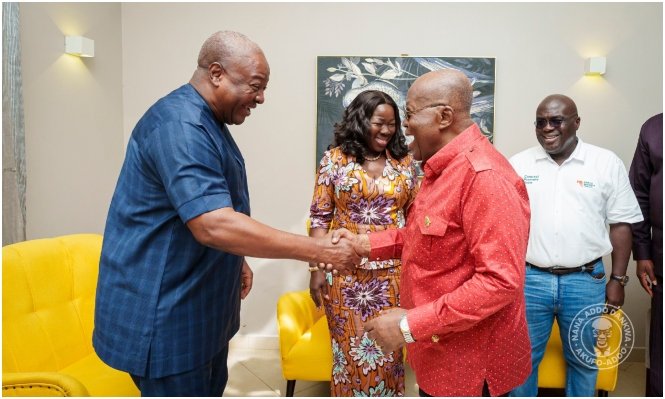
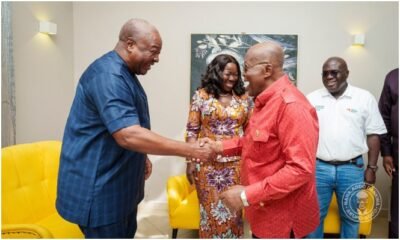
Kwahu, Ghana – Former President Nana Akufo-Addo paid a courtesy call on President John Dramani Mahama on Holy Saturday, April 4, 2026, while both leaders were in the Kwahu enclave for the annual Easter celebrations.
The meeting took place as President Mahama participated in activities linked to the Kwahu Business Forum, a major event held alongside the Easter festivities.
Akufo-Addo, who has maintained a nearly two-decade tradition of spending Easter in Kwahu, described the visit as a cordial engagement during the sacred period.
In a Facebook post, the former president wrote: “On the Holy Saturday of Easter, while in Kwahu where for almost two decades I have consecutively visited during the sacred period of Easter, I called on the President of the Republic, H. E. John Dramani Mahama who is also in Kwahu.”
The encounter highlights a moment of peaceful political civility between the current and immediate past leaders of Ghana amid the festive season. No further details about the substance of their discussion were made public.
The visit comes at a time when both leaders are actively involved in national and regional development conversations, with Mahama using the Kwahu platform to engage stakeholders on economic matters.
Ghana News
Mahama Calls Christ’s Birthplace an ‘Epicentre of War’, New Airport Concourse Planned and Other Big Stories in Ghana Today

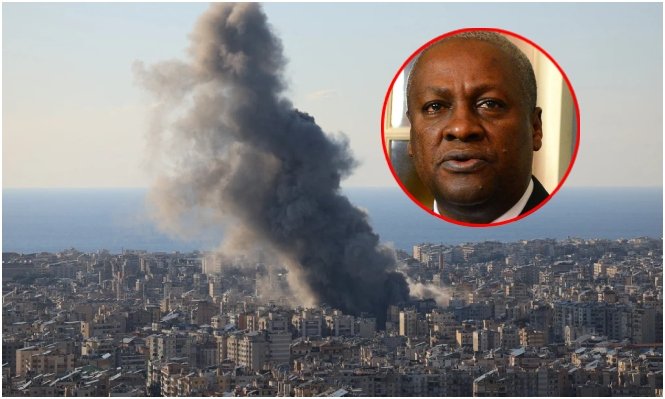
We have curated the most relevant and impactful stories from Ghana to keep you informed.
‘It’s Painful Christ’s Birthplace Now an Epicentre of War’ – President Mahama
President John Dramani Mahama has described the ongoing violence in the Middle East as a “painful irony,” noting that the birthplace of Christianity and the land where Christ preached love, forgiveness, and peace has become a major centre of conflict. In his Easter message delivered at Black Star Square on April 3, 2026, Mahama said the suffering in the Holy Land cannot be ignored during the season of Easter. He extended Ghana’s thoughts and prayers to the people of Israel, the United Arab Emirates, Qatar, Iran, and the wider Middle East region, urging world leaders to embrace restraint, dialogue, and respect for human dignity.
Read the full story here
Gov’t to Construct New Concourse at Accra International Airport to Ease Congestion
The Ghana Airports Company Limited will begin construction this month on an ultra-modern concourse linking Terminal 2 and Terminal 3 at Kotoka International Airport. The project aims to eliminate current operational bottlenecks, enable seamless passenger transfers, and significantly improve hub efficiency. Key features include five additional passenger boarding bridges, five passenger holding areas, bi-directional travelators, new escalators and elevators, a VIP lounge, four business lounges, and four retail and duty-free pods. The expansion forms part of a broader modernisation drive to provide world-class facilities and strengthen Ghana’s position as a competitive aviation hub in West Africa.
Read the full story here
Gov’t Procures Over 24,000 Medical Equipment to Support Free Primary Healthcare Rollout
The Ghanaian government has acquired 24,534 pieces of medical equipment to strengthen health facilities ahead of the nationwide rollout of its free primary healthcare policy. The consignment, inspected by Health Minister Kwabena Mintah Akandoh, includes baby incubators, radiant warmers, oxygen concentrators, X-ray machines, ultrasound devices, laboratory analysers, vital signs monitors, glucometers, patient monitors, infusion devices, delivery beds, and hospital beds. The equipment will be distributed across government hospitals to improve diagnostics, newborn care, and overall service delivery at the primary level.
Read the full story here
Ghana to Manufacture First Vaccine with Support from Indonesia
Ghana is set to begin local production of its first vaccine with technical and partnership support from the Indonesian government. Honorary Consul of Indonesia to Ghana, Paskal A B Rois, confirmed that a high-level delegation from Ghana’s National Vaccine Institute, Food and Drugs Authority, and GIZ visited Indonesia late last year to finalise arrangements. Once operational, Ghana will become the third African country — after Senegal and South Africa — to manufacture vaccines domestically. The initiative is expected to enhance the country’s health security and reduce dependence on imported vaccines.
Read the full story here
No Business Thrives Without Trust in Justice System — Chief Justice
Chief Justice Paul Baffoe-Bonnie has emphasised that trust in the judicial system is essential for business growth and investor confidence in Ghana. Speaking at the Kwahu Business Forum on April 4, 2026, he stated that contracts must be honoured, property protected, and disputes resolved fairly and predictably for any economy to flourish. The Chief Justice announced that the judiciary is repositioning itself to become an active partner in creating a business-friendly environment anchored in the rule of law. He warned that delays and uncertainty in the justice system carry real economic costs by discouraging investment.
Read the full story here
Ghana News
Ghana President Convenes Emergency Cabinet Meeting to Cushion Ghanaians from Soaring Fuel Prices
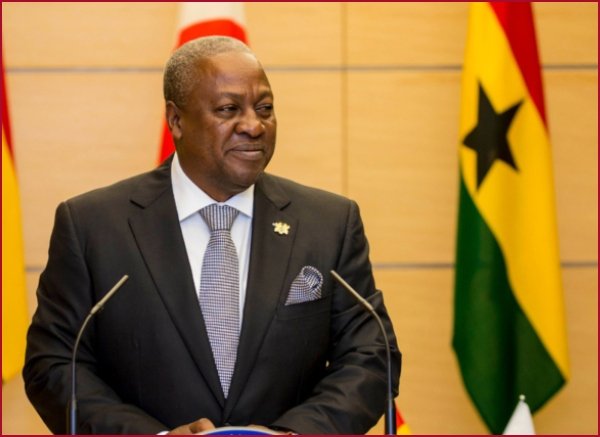
President John Dramani Mahama has convened an emergency cabinet meeting to address the sharp rise in fuel prices caused by the ongoing conflict in the Middle East, particularly the escalation involving Iran.
Speaking on Saturday, April 4, 2026, during the second day of the Kwahu Business Forum, President Mahama stated that the meeting will focus on practical interventions to ease the burden on citizens.
He specifically mentioned the possibility of adjustments in fuel margins and other components of the price build-up to help keep prices relatively stable while hoping for de-escalation of the conflict.
“I have called for this emergency cabinet meeting to decide on specific measures we can take to cushion petroleum prices,” Mahama said. “There are adjustments we can make, particularly in the margins, to help maintain relatively stable prices as we pray for the war to cease.”
The President assured Ghanaians that the government remains committed to protecting the economy from external shocks and has taken steps to build resilience.
“I can confidently tell you that the economy will not collapse because of the war in Iran,” he stated.
Mahama also commended transport unions for showing restraint by not immediately increasing lorry fares despite the fuel price surge.
He urged them to continue exercising patience as the government works on relief measures. Fuel prices rose significantly effective April 1, 2026, with petrol increasing to approximately GH¢13.30 per liter (a 15% hike) and diesel to GH¢17.10 per liter (a 19% hike) for the first half of April.
The government is reviewing options including reductions in margins and levies to provide relief to consumers.
This latest development highlights the direct link between global geopolitical tensions and domestic living costs in Ghana, as the government balances immediate relief with longer-term economic stability.


Renowned Global Bodies Warn Middle East War Will Scuttle Africa’s 2026 Growth

Ex-President Akufo-Addo and President Mahama Exchange Pleasantries on Easter

Mahama Calls Christ’s Birthplace an ‘Epicentre of War’, New Airport Concourse Planned and Other Big Stories in Ghana Today
-
 Ghana News1 day ago
Ghana President Convenes Emergency Cabinet Meeting to Cushion Ghanaians from Soaring Fuel Prices
-
 Ghana News1 day ago
Mahama Calls Christ’s Birthplace an ‘Epicentre of War’, New Airport Concourse Planned and Other Big Stories in Ghana Today
-
 Ghana News24 hours ago
Ex-President Akufo-Addo and President Mahama Exchange Pleasantries on Easter
-
 Business23 hours ago
Renowned Global Bodies Warn Middle East War Will Scuttle Africa’s 2026 Growth