
Arts and GH Heritage
Lost Grooves of the 1970s: New Compilation Celebrates Ghana’s Highlife Revolution

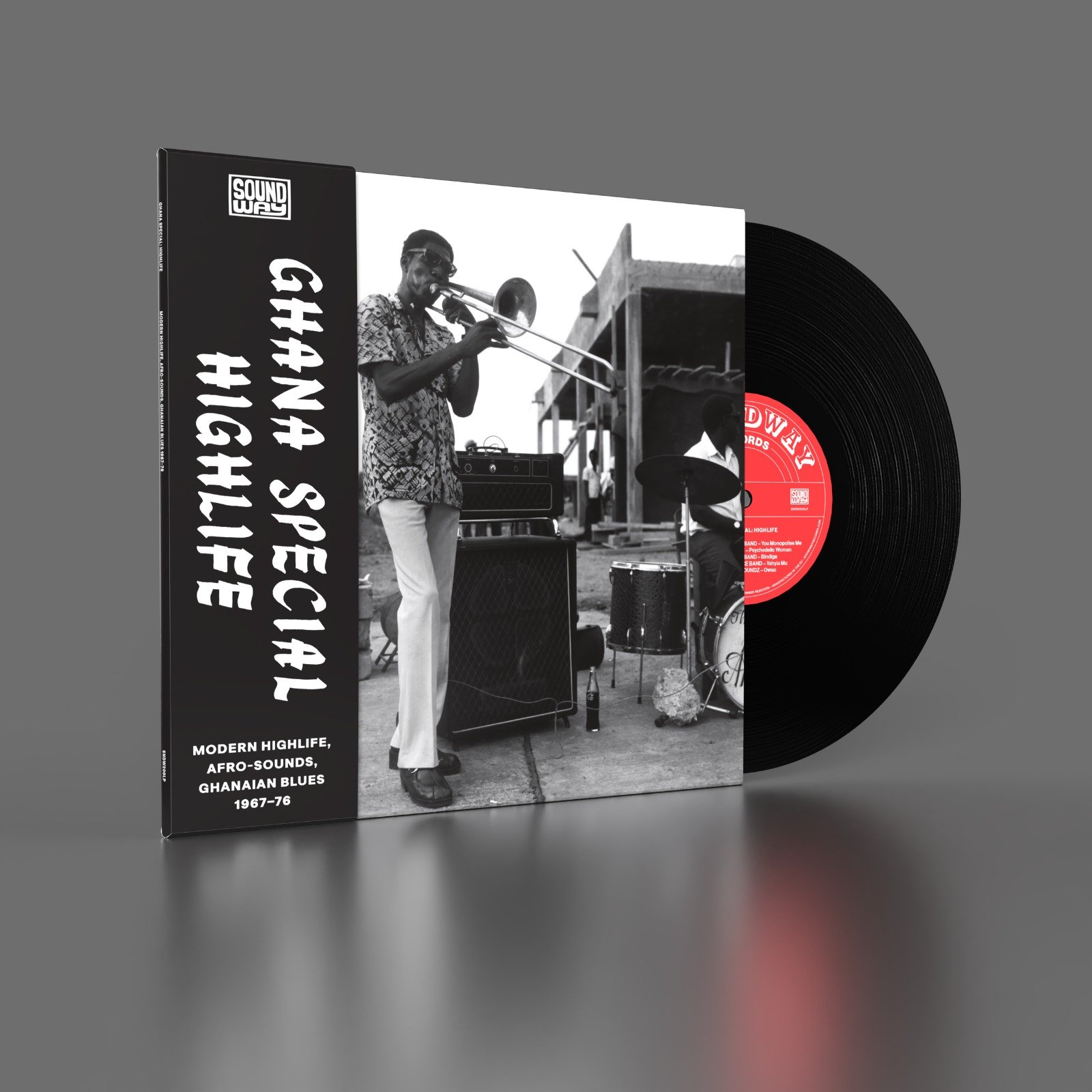
A new compilation album is bringing one of the most dynamic periods of Ghanaian music back into the spotlight, offering global audiences another chance to experience the experimental sound that defined the country’s highlife scene in the late 1960s and 1970s.
The UK-based label Soundway Records has released Ghana Special: Highlife, a curated single-LP selection highlighting Ghanaian recordings from 1967 to 1976. The release distills music originally featured in Soundway’s acclaimed 2009 five-LP box set Ghana Special, now long out of print and highly sought after by collectors.
The new edition focuses on a decade widely regarded as a creative peak for Ghanaian music, when highlife absorbed elements of rock, soul, and funk while remaining rooted in traditional rhythms and storytelling. The compilation brings together seminal recordings from groups such as The Ogyatanaa Show Band, Hedzoleh Soundz, and the celebrated guitarist and composer Ebo Taylor with his group Honny & the Bees Band.
Among the standout tracks is “You Monopolise Me” by The Ogyatanaa Show Band, produced by Ghanaian studio innovator Kwadwo Donkor. The song captures the playful songwriting and soulful arrangements that defined much of the era’s highlife output.
Another highlight is “Edinya Benya” by Hedzoleh Soundz, a group known for blending traditional Ghanaian rhythms with electric instrumentation and spiritual themes. Their music gained traction in the 1970s under the guidance of promoter and cultural impresario Faisal Helwani, who helped reshape Ghana’s live music scene with showcase events that mixed concerts with fashion shows, competitions and cultural performances.
Helwani was also instrumental in promoting young artists across West Africa and played a role in bringing Nigerian legend Fela Kuti and his early band Koola Lobitos to perform in Ghana.
The compilation also revisits the influential track “Psychedelic Woman” by Honny & the Bees Band, which gained renewed international attention when British producer Bonobo remixed it in 2005, introducing the sound of 1970s Ghanaian highlife to new audiences within the electronic music community.
A standout element of the release is its cover artwork: an unpublished 1976 photograph by renowned Ghanaian photographer James Barnor. The image, taken during a Rothmans factory Christmas party in Accra, captures a musician mid-performance and offers a rare visual glimpse into the country’s social and musical life of the era.
One of the compilation’s most historically rich recordings is “Ohiani Sua Efrir” by Asaase Ase, a project led by Ebo Taylor that returned to traditional folk roots. Inspired by groups such as Hedzoleh Soundz and Wulomei, the project featured musicians from the streets of Cape Coast performing stripped-down folk songs with guitar, percussion and vocals. Taylor described the track as “a real African blues,” telling the story of a hunter whose traps yield only snakes while wealthier hunters return with bush meat.
By condensing a landmark anthology into a more accessible format, Ghana Special: Highlife reintroduces listeners to a period when Ghanaian musicians fused local traditions with global influences, producing a sound that continues to inspire artists around the world.




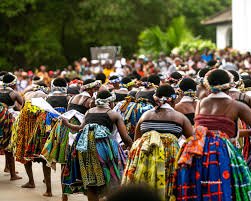
On a warm evening in southeastern Ghana, the first drumbeat cuts through the air like a signal. A circle forms almost instantly. Women adjust their cloth around the waist, men step forward with a confident sway, and the rhythm begins to gather pace. Feet shuffle, shoulders roll, hips tilt to the pulse of drums and rattles. This is Borborbor, one of the most beloved social dances of the Ewe people, and in communities across the Volta Region, its rhythm still brings people together the way it did generations ago.
Borborbor did not begin as a grand cultural performance. Its roots lie in community life during the mid-20th century, when Ewe youth began creating new dance styles that reflected changing times. Oral histories often trace their emergence to the 1950s in the town of Kpando.
At the time, young people were fascinated by the brass band music played at military parades and public events during the late colonial period. The marching rhythms, steady drum patterns, and lively call-and-response singing inspired them to create something of their own.
What emerged was Borborbor—a dance that blended traditional Ewe drumming with the cadence of parade music. The name itself echoes the rolling sound of the drums. Soon, the style spread rapidly across towns and villages. It became especially popular at community gatherings, funerals, festivals, and celebrations where large groups could participate.
Unlike some ceremonial dances reserved for specific occasions, Borborbor is open and social. The drummers sit at the center, surrounded by dancers who move in loose formations. The steps are energetic but playful: knees bending low, feet stamping lightly into the ground, arms swinging in rhythm. Women often lead with graceful hip movements while men respond with confident footwork. Colorful cloth wraps, beads, and headscarves add visual flair as the dancers move.
Music is the lifeblood of the performance. A lead singer calls out verses—sometimes humorous, sometimes reflective—and the crowd answers in chorus. The songs can comment on daily life, celebrate community figures, or simply encourage dancers to move with more spirit. Laughter often breaks out mid-performance as dancers improvise gestures or tease one another through movement.
For the Ewe people today, Borborbor represents far more than entertainment. It carries a sense of belonging. At funerals, the dance becomes a way to honor the life of someone who has passed, celebrating their journey rather than dwelling only on grief. During festivals or family gatherings, it reinforces bonds between generations. Elders clap along proudly while younger dancers bring fresh energy to the circle.
Even beyond the Volta Region, Borborbor has traveled widely. Cultural troupes perform it on international stages, introducing global audiences to the pulse of Ewe music and dance. Yet its heart remains in the community spaces where it began—village squares, open courtyards, and festival grounds where drums echo long into the night.
When the rhythm starts, people rarely stay seated for long. Borborbor invites participation. It asks the body to listen, respond, and celebrate the simple joy of moving together.
Arts and GH Heritage
Global Arts Community Condemns Police Assault on Ghanaian Artist Ibrahim Mahama


Leading international galleries and cultural institutions have issued a joint statement condemning the alleged police brutality against the renowned artist and calling for an immediate, independent investigation.
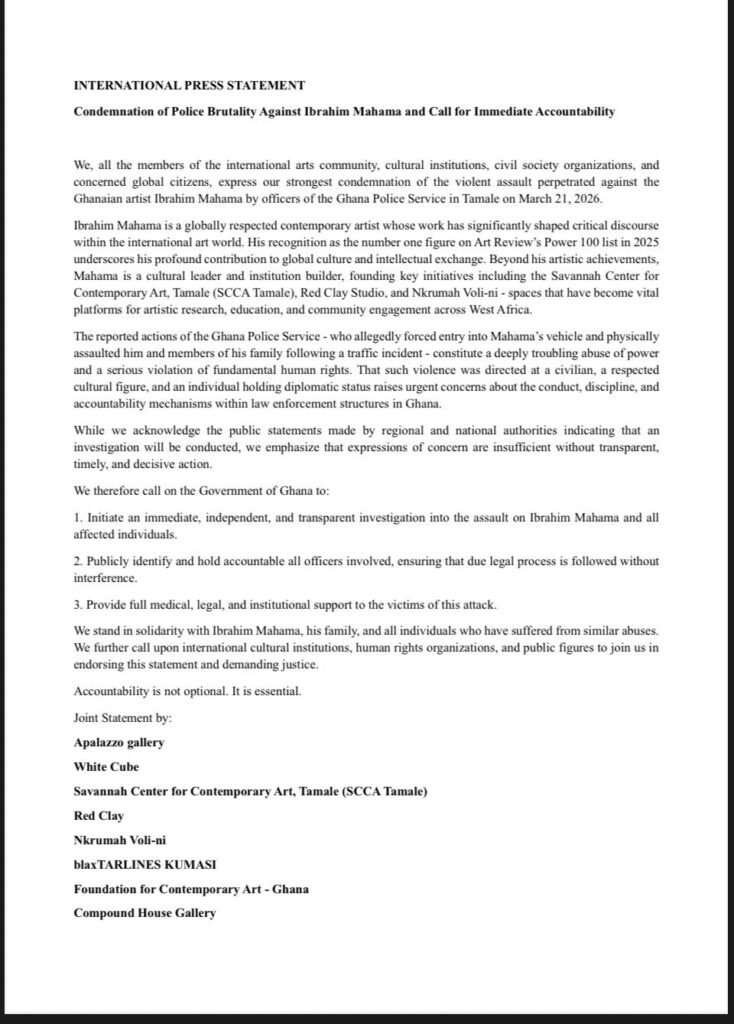
Accra, Ghana / International – A coalition of prominent international arts institutions, galleries, and cultural organizations has issued a powerful joint statement condemning the alleged violent assault of Ghanaian artist Ibrahim Mahama by officers of the Ghana Police Service in Tamale on March 21, 2026, and demanding urgent accountability.
The statement, released on March 23, 2026, brings together some of the most influential names in the global art world, including White Cube, Apalazzo Gallery, the Savannah Center for Contemporary Art (SCCA Tamale), Red Clay, Nkrumah Voli-ni, blaxTARLINES KUMASI, the Foundation for Contemporary Art – Ghana, and Compound House Gallery.
Mahama, a globally respected contemporary artist who was named the number one figure on Art Review’s prestigious Power 100 list in 2025, was reportedly assaulted following a traffic incident in Tamale. According to accounts, police officers allegedly forced entry into his vehicle and physically assaulted him and members of his family. Mahama, who holds diplomatic status, has since cancelled all international lectures and exhibitions due to injuries sustained in the incident.
The joint statement describes the alleged actions as “a deeply troubling abuse of power and a serious violation of fundamental human rights.”
“That such violence was directed at a civilian, a respected cultural figure, and an individual holding diplomatic status raises urgent concerns about the conduct, discipline, and accountability mechanisms within law enforcement structures in Ghana,” the statement read.
While acknowledging that regional and national authorities have indicated that an investigation will be conducted, the signatories emphasized that “expressions of concern are insufficient without transparent, timely, and decisive action.”
The coalition issued three specific demands to the Government of Ghana:
– Initiate an immediate, independent, and transparent investigation into the assault on Ibrahim Mahama and all affected individuals.
– Publicly identify and hold accountable all officers involved, ensuring due legal process without interference.
– Provide full medical, legal, and institutional support to the victims of the attack.
The statement highlighted Mahama’s significance beyond his artistic practice, noting his role as a cultural leader and institution builder. He founded the Savannah Center for Contemporary Art (SCCA Tamale), Red Clay Studio, and Nkrumah Voli-ni — spaces described as “vital platforms for artistic research, education, and community engagement across West Africa.”
The Inspector-General of Police has since directed the Police Professional Standards Bureau (PPB) to investigate the allegations, but the international arts community insists that accountability must follow swiftly.
“We stand in solidarity with Ibrahim Mahama, his family, and all individuals who have suffered from similar abuses,” the statement concluded. “Accountability is not optional. It is essential.”
The signatories also called on international cultural institutions, human rights organizations, and public figures to endorse the statement and join the demand for justice.
The case has drawn global attention to police accountability in Ghana, with cultural leaders framing Mahama’s treatment as a bellwether for broader concerns about law enforcement conduct, the protection of civilians, and the state’s responsibility to safeguard its citizens — regardless of their public stature.
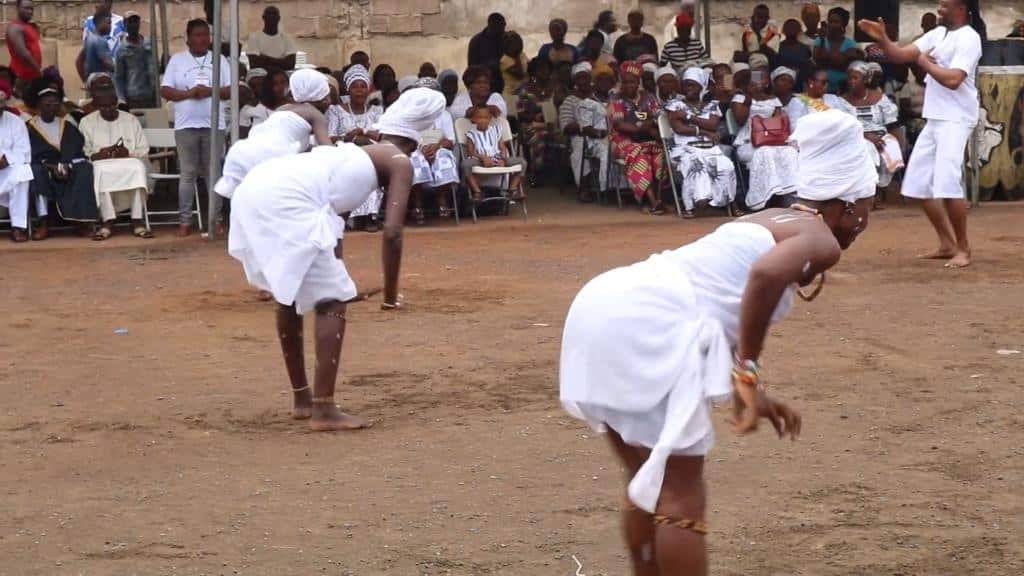
On a warm evening along the coast of Accra, the beat of hand-played drums begins to ripple through the air. Young dancers gather in a loose circle, their shoulders rolling, hips snapping sharply to the rhythm, while friends clap and cheer.
The dance is playful, confident, and unmistakably Ghanaian. This is Kpanlogo, one of the most recognizable cultural expressions of the Ga people, and a dance whose roots lie in youthful rebellion, post-independence optimism, and the vibrant social life of Accra in the 1960s.
Kpanlogo emerged during a transformative period in Ghana’s history. The country had just gained independence from Britain in 1957 under Kwame Nkrumah, and a wave of cultural confidence swept through the nation.
In the working-class neighborhoods of Accra—particularly communities like Jamestown and Teshie—Ga youth began experimenting with new ways to express themselves through music and dance.
At the time, traditional Ga dances were often tied to rituals, festivals, or community ceremonies led by elders. But younger people wanted something different: a dance that reflected their generation’s energy and the rapidly changing social scene in the city.
They began blending older Ga rhythms with new influences from Highlife music, Caribbean sounds, and even elements of American pop culture that had started to reach Ghana’s shores.
Out of this creative ferment came Kpanlogo.
The dance was bold and modern for its time. Its movements—characterized by bent knees, rhythmic hip swings, and expressive arm gestures—broke away from the stricter patterns of older ceremonial dances.
The drumming style was equally distinctive, built around a lively ensemble of hand drums and percussion instruments that drove the dancers forward with infectious energy.
But Kpanlogo was more than entertainment. In its early years, it became a symbol of youthful freedom and social change.
Some elders initially viewed the dance as rebellious or even inappropriate because of its energetic movements and playful interactions between male and female dancers. Yet its popularity spread quickly, turning street corners, beaches, and community gatherings into impromptu dance grounds.
Within a few years, what began as a youth craze had become a cultural phenomenon. The rhythms and choreography were eventually embraced by cultural troupes and national dance ensembles, helping introduce Kpanlogo to audiences across Ghana and beyond.
Today, the dance holds a special place in Ga cultural identity. It is often performed during community celebrations, national events, and cultural festivals across Accra.
Schools and cultural groups teach the dance to younger generations, ensuring that the rhythm continues to echo through the city’s neighborhoods.
For the Ga people, Kpanlogo represents more than movement—it reflects the spirit of Accra itself. The dance captures the city’s coastal vibrancy, its humor, its openness to new ideas, and its ability to transform tradition without losing its roots.
When the drums begin, and dancers step forward, Kpanlogo tells a story that began decades ago with the dreams of young people in a newly independent nation. Today, that story continues each time the rhythm rises, and the crowd gathers to move as one.


How 81 Controversial Road Contracts Are Threatening to Dim Mahama’s Second-Term Goodwill

Church Building Collapse Claims 3 Lives, Sole-Sourced Contracts Dims Mahama’s 2nd Term Goodwill, and Other Big Stories in Ghana Today

Newspaper Headlines Today: Monday, March 30, 2026
-
 Ghana News16 hours ago
Ghana Prepares for Nationwide Biometric SIM Re-Registration: What You Need to Know
-

 Ghana News2 days ago
ECG Metering and Billing Soon to be Handled by Private Concessionaires
-
 Ghana News22 hours ago
Catholic Bishops Back President Mahama on LGBTQ+, Call for Swift Passage of Anti-Gay Bill
-
 Ghana News2 days ago
EU Clarifies Abstention on Ghana’s Slavery Resolution: “It Does’nt Mean Don’t Support the Moral Underpinnings”
-
 Ghana News17 hours ago
Meet Zaina Adamu: Political Communications Strategist Ranked Among 40 Most influential People of African Descent
-
 Ghana News2 days ago
Content Creator Priscilla Ansong Arrested, Otumfuo Urges Timely Completion of KNUST Hospital and Other Big Stories in Ghana Today
-
 Ghana News23 hours ago
Heavy Rains Trigger Flood Alerts Across Ghana and Other Big Stories in Ghana Today
-

 Ghana News22 hours ago
Power Cuts to Hit Several Accra Communities from April 8 to 17