
Sights and Sounds
The Night They Banned the Song: How a Highlife Guitar Felled a General and Renamed an Airport


Let me tell you about the most dangerous pop song in West African history. It wasn’t a protest anthem. It wasn’t a political rallying cry.
It was a gentle, hypnotic tune about a boy and his guitar, a melody so sweet it supposedly drifted into the mind of its creator from a spirit on a lonely Lagos beach.
And yet, for a brief and violent moment in 1967, the government of Ghana treated that song like an enemy battalion. They banned it from the airwaves. They hunted its echoes in dance halls. They tried to scrub it from the national memory.
Why? Because they believed a guitar riff had the power to bring down a regime.
This week, Ghana did something that sounds, on paper, like the most boring bureaucratic exercise imaginable.
They changed the name of the country’s main airport. Out goes Kotoka International Airport. In comes Accra International Airport. Just a new sign, right? A new letterhead for the immigration officers?
To understand why this name change matters—why it carries the weight of a country’s unresolved argument with itself—you have to go back to that banned song.
You have to understand the man whose name is being scrubbed from the arrivals hall, and the strange, musical conspiracy that ended his life.
The Hero, The Villain, and the Man on the Beach
General Emmanuel Kwasi Kotoka is a ghost who haunts modern Ghana. You can ask ten people about him and get ten different answers. In 1966, he was the soldier who led the coup that toppled Kwame Nkrumah, the country’s founding father and the great hope of African liberation.
To some, Kotoka was a liberator who saved Ghana from a dictator. To others, he was the man who broke the dream, who handed the country over to a future of instability.
Either way, he was the man in charge. And a year later, a group of junior officers decided he had to go.
They planned their attack. They chose a codename for their mission. In military history, you expect codenames to be things like “Desert Storm” or “Operation Thunderbolt.” Things that sound tough. Things that sound like victory.
@wearevinylplus Ghana’s airport name change has roots in something unexpected: music. A highlife hit became the soundtrack to one of the biggest political incidents in Ghana’s history Decades later, that musical ripple is still echoing. #ForTheNow #africanpolitics ♬ original sound – wearevinylplus
These young soldiers, likely with the radio crackling in their barracks, picked something else. They named their plot Operation Guitar Boy.
They named it after a song.
The Soundtrack of the Barracks
In 1966, a Nigerian highlife legend named Sir Victor Uwaifo released a track that would define an era. Guitar Boy was pure magic. It wasn’t just a hit; it was the sound of West Africa letting its hair down. That guitar line was everywhere.
It spilled out of the taxis crawling through Accra’s traffic. It floated from the palm-wine bars. It whistled from the lips of street vendors.
Uwaifo himself claimed the melody wasn’t entirely his own. He said a mermaid—a Mammy Wata figure—appeared to him on a beach in Lagos and gifted him the tune.
It was folklore set to music. It had nothing to do with politics. It had everything to do with the spirit of the moment.
And that spirit had seeped into the army barracks. When those young lieutenants dreamed of overthrowing a general, the song in their heads wasn’t a military march. It was Guitar Boy. They weren’t being poetic. They were just men of their time, using the language of their time to describe their ambition.
The plot failed. Kotoka was killed during the attempt at the Flamingo Nightclub in Accra. But when the government pieced together the conspiracy, they didn’t just see the guns and the plans. They saw the name. They saw the cultural infection.
Their response was to declare war on a song.
The Weapon Was a Melody
Guitar Boy was banned in Ghana.
Think about that for a second. Not a subversive text. Not a radical pamphlet. A highlife record. The state decided that this piece of art was so intertwined with the rebellion that it had to be silenced. They treated a melody like a weapon.
They understood, perhaps better than we do today, that culture isn’t separate from politics. It is the soil in which politics grows.
For decades after, the airport bore Kotoka’s name. To some, it was a fitting tribute to a soldier. To others, it was a daily reminder of a wound, a forced acceptance of a man they saw as a traitor to the Nkrumah dream.
Every tourist who landed there, every citizen who returned home, walked through a gateway named for a coup.
Now, that gateway is simply Accra International. It is an attempt to let the airport be a place of arrival and departure, not a monument to a contested past. It is an attempt to step out of the shadow of 1966.
But the ghost of that story remains. And at its center is not a politician or a general, but a boy with a guitar.
It’s wild to think that a song, born from a mermaid’s whisper on a beach, ended up tangled in a coup, a ban, and the very name of a nation’s front door. It’s a reminder that history is rarely made by presidents and parliaments alone.
Sometimes, it’s made by a young man humming a tune, a soldier with a radio, and a melody that refuses to be silenced.
Sir Victor Uwaifo never meant to start a revolution. He just wanted to play his guitar. But in Ghana, sixty years later, his riff is still echoing through the corridors of power.






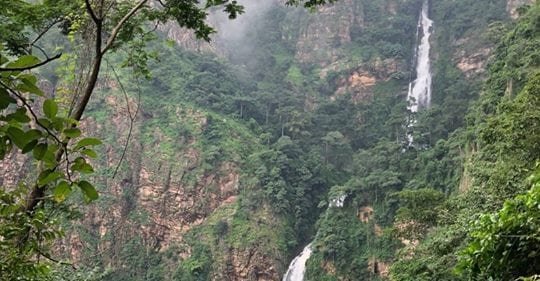
Let me tell you about the moment my breath actually stopped. It wasn’t the four-hour drive from Accra, the nine river crossings, or even the sight of the water that did it.
It was standing at the base of the falls, soaking wet and shivering, when the sun broke through the clouds.
The mist caught the light, and suddenly, a rainbow materialized right in front of me—so close I could almost reach out and touch it.
That is the magic of Wli. It doesn’t just show you something beautiful; it pulls you into the frame.
Tucked away in the Volta Region, near the quiet border town of Wli that shares a boundary with Togo, you will find the highest waterfall in all of West Africa. The locals call it Agumatsa—”Allow Me to Flow”. And flow it does, cascading roughly 80 meters down the cliffs of the Agumatsa Range into a chilly, inviting pool below.
Read Also: The African Dream in Stone: Stepping Into the Footsteps of Osagyefo Dr Kwame Nkrumah
There are two ways to experience this place. The first is the walk to the lower falls. It is an easy, flat stroll through the lush Agumatsa Wildlife Sanctuary. You will cross sturdy little bridges, listen to the call of hornbills overhead, and watch butterflies dance through the shafts of sunlight.
But look up. High on the cliffs, thousands of fruit bats cling to the rocks. If you time your visit for late afternoon, you will witness them take flight en masse—a dark, swirling cloud against the golden sky that feels like something out of a nature documentary.
For those with a bit more fire in their legs, the upper falls are a different beast entirely. It is a steep, sweaty climb that takes a few hours, but the reward is a view from the top that makes you feel like you are standing on the roof of West Africa.
But here is why you should really come.
Wli is not just a hike; it is a sanctuary. For the Ewe people, the falls and the bats are sacred messengers between worlds. Whether you are there for the swim, the photos, or the peace, the place gets under your skin. One visitor described stepping out of the pool feeling completely empty, not in a bad way, but as if the water had washed the stress right out of him.
You can stay overnight in a simple guesthouse with views of the mountains, grab a bowl of spicy banku and tilapia at a local spot, or even camp under the stars.
In a world that moves too fast, Wli Waterfalls is a place that simply says, “slow down, and listen.” Come for the tallest waterfall in West Africa. Stay for the rainbows you can almost touch.
Sights and Sounds
The African Dream in Stone: Stepping Into the Footsteps of Osagyefo Dr Kwame Nkrumah
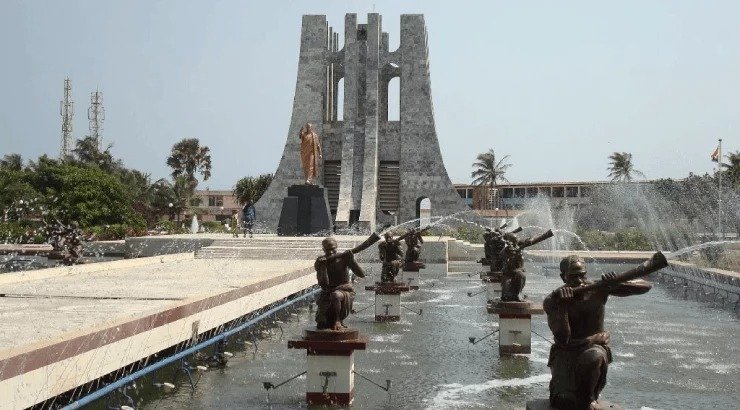
In the heart of Accra, where the humid Atlantic breeze meets the city’s relentless energy, lies a patch of hallowed ground that feels remarkably still.
This is the Kwame Nkrumah Memorial Park, a site that is far more than a burial ground. It is the exact location where, in 1957, Dr. Kwame Nkrumah stood before a sea of hopeful faces and declared that “Ghana, our beloved country, is free forever.”
Today, the park has undergone a stunning $3.5 million transformation, turning it into a world-class destination that balances solemnity with modern interactive storytelling.
Whether you are a history buff or a curious traveler, this is the definitive starting point for understanding the African independence movement.
Why You Can’t Skip It
The centerpiece of the park is the Mausoleum—a striking Italian marble structure designed to resemble an upside-down sword.
In Ghanaian culture, the “sword down” posture is a powerful symbol of peace. Inside, the air is cool and quiet, housing the remains of Dr. Nkrumah and his wife, Fathia.
Read Also: Walking with Giants: Why Mole National Park is Africa’s Best-Kept Safari Secret
But the real magic happens as you explore the new additions:
- The Audio-Visual Tunnel: Walk through a digital passage where the sights and sounds of the independence era come alive, making you feel the weight and wonder of that historic night in 1957.
- The Freedom Wall: A beautifully curated space featuring the “States of Emotion” of the former President, offering a humanizing look at the man behind the political icon.
- The Vintage Cadillac: For a touch of mid-century glamour, you can view the bulletproof 1957 Cadillac used by Nkrumah—a car that saw the birth of a nation from its leather seats.
A Modern Sanctuary
Beyond the history, the park is a literal breath of fresh air. The synchronized musical fountains—reminiscent of global landmarks but with a distinctly Ghanaian rhythm—provide a backdrop for the lush, landscaped gardens.
It’s a place where families, students, and global dignitaries converge, proving that Nkrumah’s dream of a united Africa is still very much a living, breathing concept.
As you leave, walking past the bronze statue of the “Osagyefo” pointing toward the future, you don’t just take away facts; you take away a sense of pride and a deeper connection to the spirit of the continent.
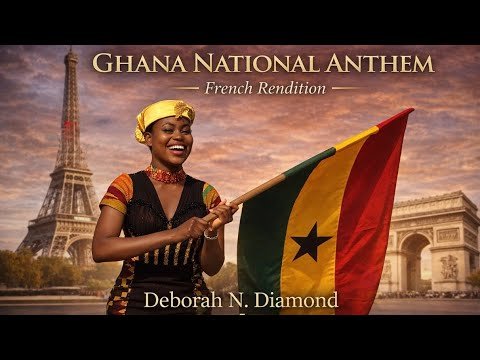
When Ghana marked its 69th Independence Day on March 6, celebrations echoed across the country and among the diaspora. In Paris, one Ghanaian student chose a different way to honour the moment—by giving the national anthem a new linguistic expression.
Deborah Ntiriwaah Diamond, popularly known as Deborah Diamond GH, released a French rendition of God Bless Our Homeland Ghana, offering a version that bridges Ghanaian identity with the language spoken across much of the world.
The performance, shared to commemorate Ghana’s independence anniversary, reflects both personal pride and cultural diplomacy.
“March 6, Ghana chose freedom, and this freedom shall be spoken in a new language to the world,” Deborah said while introducing the project.
Celebrating Ghana far from home
Living and studying in France, Deborah says the idea was born from a desire to celebrate Ghana in a way that resonates with her current environment. Paris, a city where cultures intersect, felt like the perfect place to reinterpret the anthem.
“As a Ghanaian student in France, I did this rendition to celebrate Ghana in Paris,” she explained.
Rather than replace the original, Deborah sees the French version as a translation of spirit rather than just words.
“Ghana’s story can travel across languages without losing its meaning. The anthem carries Ghana’s soul; the language carries the bridge,” she said.
A symbol beyond borders
Composed by Philip Gbeho, Ghana’s national anthem has been a powerful symbol of the nation since independence in 1957. For many Ghanaians abroad, hearing it in a foreign land can evoke strong feelings of belonging and nostalgia.
Deborah’s rendition taps into that emotion while also introducing the anthem to audiences who may not understand English.
By performing it in French—one of the world’s most widely spoken languages and the official language of several West African countries—the singer subtly highlights Ghana’s connection to the broader region and the global community.
Ghana’s story told differently
For Deborah, the performance is not just about music. It is about identity, connection, and the idea that patriotism can take different forms depending on where one stands in the world.
Standing in Paris, singing about a homeland thousands of kilometres away, she reminds us that Ghana’s narrative is not confined to its borders.
“God bless our homeland, Ghana,” she concluded.
As Ghana continues to strengthen ties with its diaspora and expand its cultural footprint abroad, creative gestures like Deborah Diamond’s French rendition show how national pride can travel, carried not only in passports, but also in song.


Ghanaians Evacuated from Israel and Safely Returned to Ghana

Chief Imam’s Message to Ghanaians on Eid-ul-Fitr, Lithium Mining Deal Approved, and Other Trending Issues Today (March 20, 2026)

The Taste of the Sidewalk: Chasing Ghana’s Perfect Bite of Ghana’s Kofi Broke Man
-

 Ghana News1 day ago
Newspaper Headlines Today: Thursday, March 19, 2026
-

 Ghana News1 day ago
New Video Captures Victims Piloting Microlight Before Fatal Crash, Dormaahene Breaks Down in Tears and Other Trending Issues Today (March 19, 2026)
-
 Ghana News24 hours ago
Ghana to Table Landmark UN Resolution on Slave Trade in September
-

 Business2 days ago
Top 20 Profitable Business Ideas in Ghana for 2026 – High-Growth Opportunities for Entrepreneurs
-

 Ghana News24 hours ago
54 Ghanaian Soldiers Return Home After Successful Hurricane Relief Mission in Jamaica
-

 Homes & Real Estate1 day ago
Six Reasons to Start Selling Land and Houses in Ghana
-
 Arts and GH Heritage1 day ago
The Day the Antelope Danced: Uncovering the Soul of Ashanti’s Adowa
-

 Global Update21 hours ago
Federal Judge Orders Full Restoration of Voice of America Operations, Reinstating Over 1,000 Employees After Year-Long Shutdown