
Sights and Sounds
Bigger Than Manhyia: Discover the Grandeur of the Assin Kushea Palace, West Africa’s Largest

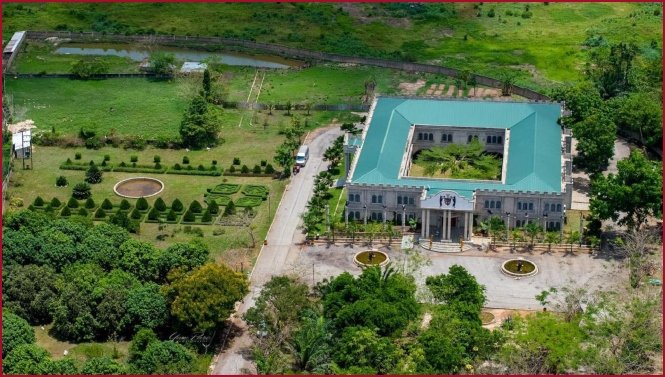
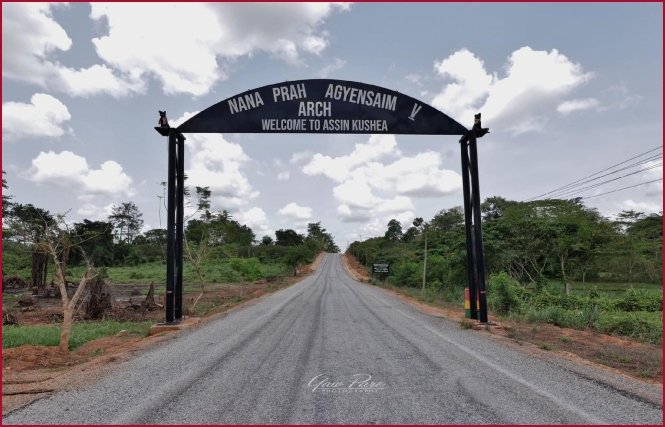
Tucked away in the quiet Central Region town of Assin Kushea lies a masterpiece of traditional architecture that is quietly redefining Ghana’s tourism landscape.
The Assin Kushea Palace, built by Nana Prah Agyensaim VI, Paramount Chief of the Owirenkyi Traditional Area, is believed to be the largest palace in West Africa—surpassing even the renowned Manhyia Palace in Kumasi in physical size and scale.
For travel influencer Gladys Cassandra Bugashie (@iamcassie_gh), the discovery was nothing short of revelation.
“I don’t even know why I am now discovering this gem,” she exclaims in a recent Instagram video that has since gone viral. “They said this is the largest palace in West Africa. Honestly, when I was coming, I just decided not to give myself any expectations. Guys, I absolutely agree this place is the biggest palace in West Africa. I am shocked, like properly shocked.”
A Vision Born from a Wife’s Encouragement
The story of how this magnificent structure came to be is as compelling as the palace itself. Speaking to Etsey Atisu, host of People & Places on GhanaWeb TV, Nana Prah Agyensaim VI revealed that the inspiration came from an unexpected source: his wife.
“I remember one day, I was talking to my wife about Kushea and she said, ‘You should build a palace o, you should build a palace before you go—you should build a palace.’ I said OK, I hear. I will; I will. Little did she know all her ‘chop money’ would go into the palace,” the chief recounted with a chuckle.
Construction began 13 years ago, and on the very same day, the chief planted a tree on the palace grounds.
“So, they have the same birthdays; the tree and the palace,” he noted. Though still not fully completed, the palace already stands as a testament to what the chief calls “inter-generational leadership”—a legacy meant to endure long after he is gone.
Grandeur on a 7.4-Acre Scale
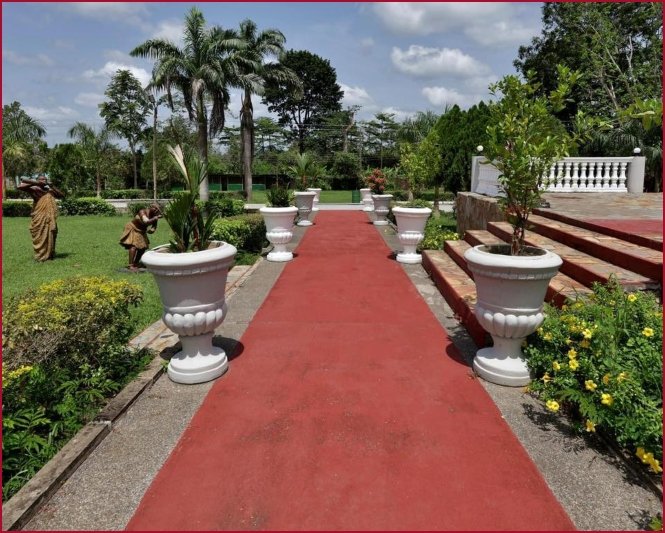
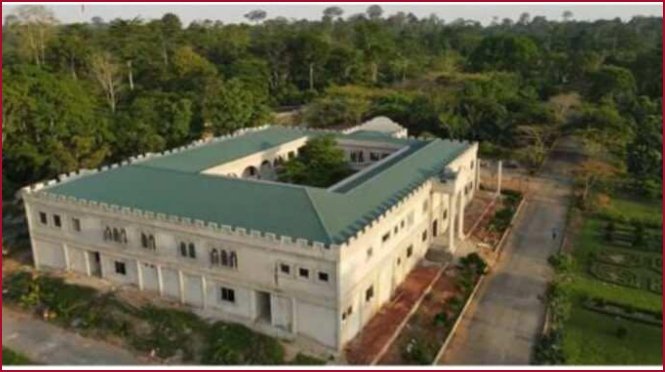
Sitting on approximately 7.4 acres of land, the Assin Kushea Palace is a sprawling complex that defies expectations.
Unlike the more famous Manhyia Palace in the Ashanti Region—primarily a residence and historical museum for the Asantehene—the Assin Kushea Palace was conceived from the outset as a tourism and community asset.
The chief has stated that he does not intend to reside in the palace himself; rather, it is being built to promote tourism and showcase Ghanaian culture to the world.
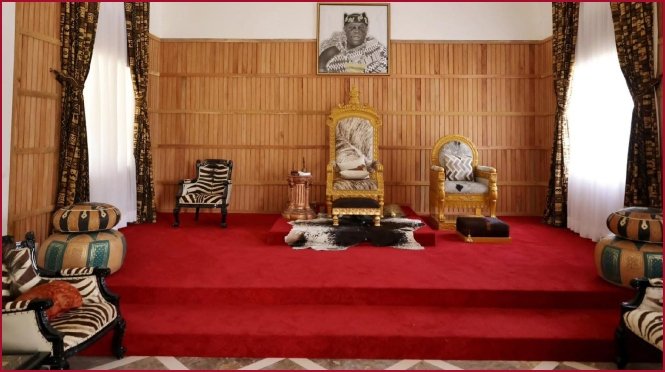
Visitors to the palace are greeted by an imposing entrance flanked by two statues of warriors, spears and shields in hand, standing guard. Beyond lies a massive courtyard suitable for ceremonial gatherings, complete with an elevated platform where the chief presides during functions.
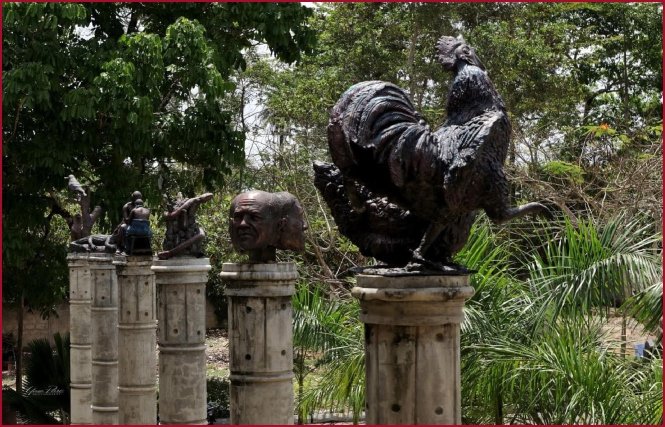
The architectural details tell stories. Throughout the complex, visitors will encounter numerous sculptures of dogs—the totem of the chief’s Aduana Clan. According to legend, a dog guided the clan during their migration, lighting the path with fire from its mouth. The dog represents honesty and industriousness, values that the chief has clearly embedded in his vision for the community.
More Than Just a Palace
What sets the Assin Kushea Palace apart is its multifaceted nature. The complex includes:
- A botanical garden showcasing local flora
- A mini-zoo housing various animals
- A fishpond, created by the chief to address potential future fish shortages resulting from the environmental impact of illegal mining (galamsey) on the Pra River
- Guest rooms for visitors who wish to stay overnight and immerse themselves in the peaceful environment
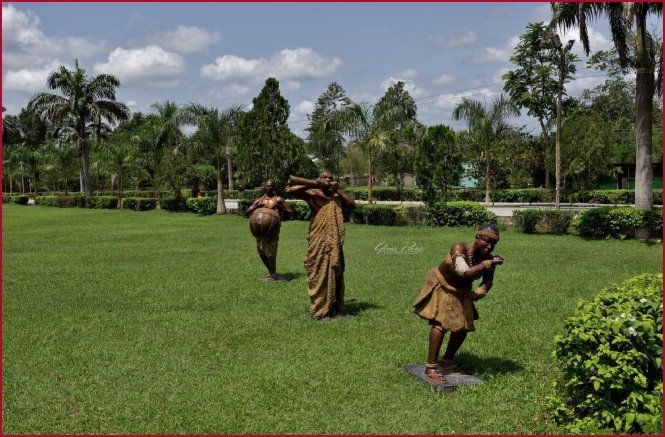
- Walls adorned with African proverbs, traditional artifacts, and depictions of animals and birds
“The place is huge, neat, and very grand,” Bugashie marvels in her video. “You just stand there and you’re like, whoa, so this is actually in my country. The funny thing is, it’s quietly tucked away in the Central Region of Ghana, not even loud about it. Just sitting there like a gem.”
The Cleanest Town in Ghana
The palace is not the only point of pride for Assin Kushea. Under Nana Prah Agyensaim VI’s leadership, the town has earned the distinction of being the cleanest in Ghana . The chief recognized early that he could not compete with larger, wealthier paramountcies, so he chose to be different—focusing on sanitation as a unique selling point .
His approach was rooted in understanding Ghanaian cultural habits.
“We as Ghanaians had the tradition of throwing leaves away, when we used to eat from leaves… after you finish eating, the natural thing to do is throw the leaves away. In those days, it didn’t matter because the leaves would decompose. So, we were not littering, but the habit of throwing had been ingrained in us,” he explained. “So, when this creature called plastic came, we put our food in the plastic. After eating, we throw it away because that is the habit that we had inculcated in us. So, my problem was to stop the throwing away”.
Today, Assin Kushea’s streets are tarred, dustbins are ubiquitous, and the chief personally conducts visits to communities and schools to emphasize the importance of hygiene .
A Call to Domestic Tourism
For Bugashie, the experience carried a deeper message about how Ghanaians view their own country.
“Sometimes, we are just looking outside Ghana to find nice places to visit, but the real beauty is right here at home,” she reflects. “Trust me, you will love it. I loved it, so I’m sure you would.”
Her sentiment echoes a growing movement encouraging Ghanaians to explore their own backyard. While the slave castles of Cape Coast and Elmina draw international visitors, and the Manhyia Palace attracts those interested in Ashanti history, the Assin Kushea Palace offers something different: a living, growing monument to what visionary leadership can achieve.
Practical Information for Visitors
The Assin Kushea Palace is located approximately 12 kilometers off the Assin Fosu highway in the Central Region . Tour operators such as Obed B. offer guided day tours from Accra and surrounding areas, with itineraries that include the palace, the mini-zoo, and opportunities to learn about the history of the Akan people and the surrounding communities .
For those seeking a deeper experience, guest rooms are available on-site, allowing visitors to stay overnight and fully absorb the peaceful atmosphere that characterizes both the palace grounds and the town itself .
As Bugashie concludes in her video: “If you like traveling and exploring or just seeing nice places, please add this to your bucket list. Do not sleep on it. Go and experience it for yourself.”
The Assin Kushea Palace stands as proof that Ghana’s tourism treasures extend far beyond the well-trodden paths—and that sometimes, the most magnificent discoveries are hiding in plain sight.














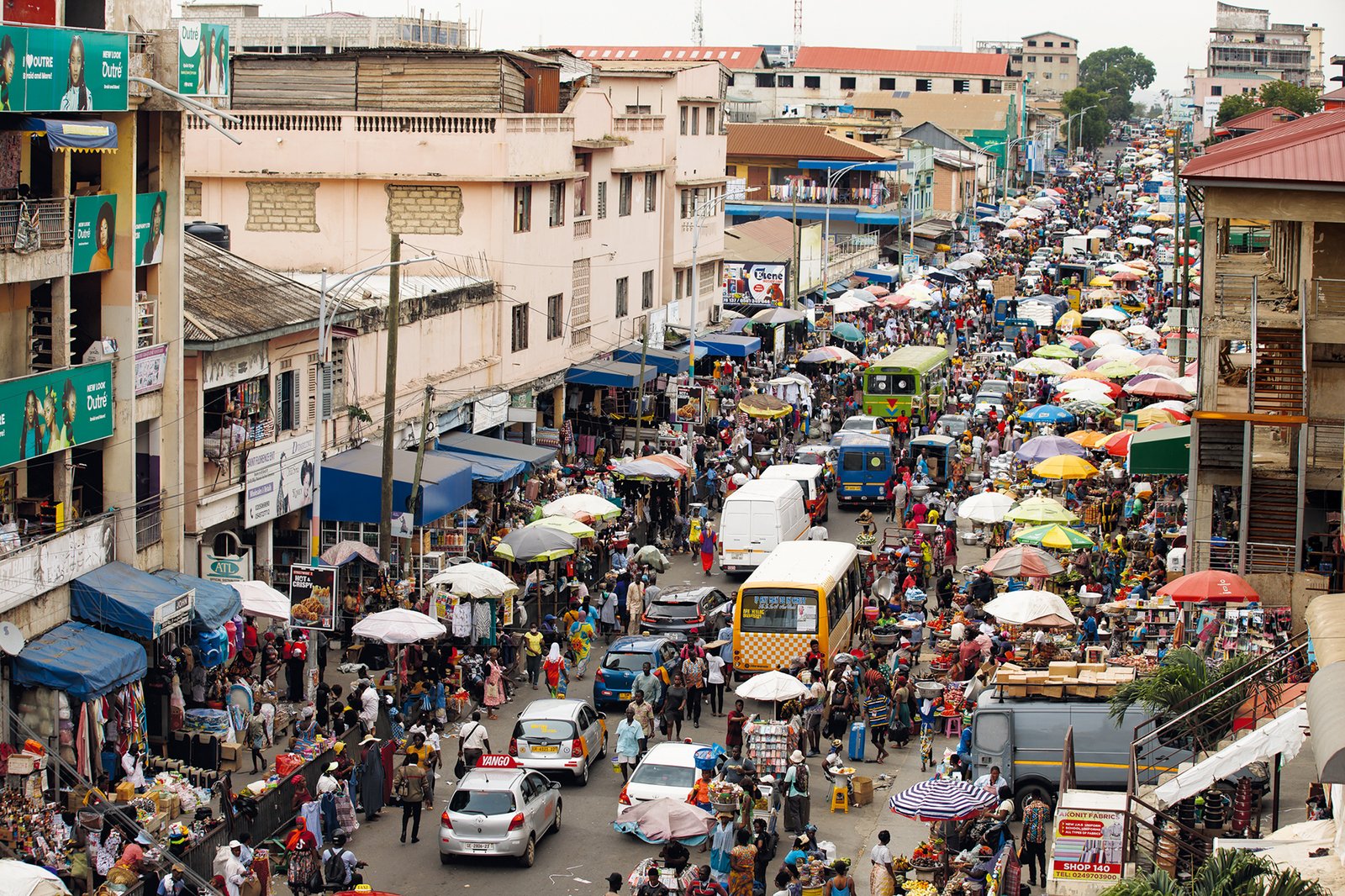
The morning light over Accra falls softly across the stately grounds of the National Museum of Ghana. A few schoolchildren chatter beneath the trees, their voices echoing faintly against the museum’s pale walls.
Inside, quiet halls hold centuries of Ghanaian creativity—wooden sculptures carved with patient skill, bold textiles alive with color, and masks whose expressions seem to carry stories from generations past.
It’s the kind of place where time slows, inviting visitors to look more closely and listen to the country’s cultural heartbeat.
Step through the galleries and Ghana’s artistic journey unfolds. Intricately carved stools, ceremonial regalia, and traditional instruments reveal how art has long been woven into daily life. Sunlight filters through high windows, glancing off brass ornaments and beads once worn by royalty.
Visitors wander from display to display, pausing to study the details—symbols etched into wood, patterns stitched into cloth, fragments of history preserved with care. The museum feels calm and reflective, a welcome pause from the city’s busy rhythm.
But just a short drive away, the tempo changes entirely.
At Makola Market the air vibrates with movement. Traders call out prices over the hum of conversation.
Fabrics ripple in bright cascades of orange, turquoise, and deep indigo. The scent of smoked fish drifts through narrow lanes while baskets overflow with fresh peppers, tomatoes, and ginger. Here, Accra shows its everyday energy.
Visitors quickly realize Makola is more than a place to shop—it’s a living theater of commerce and community.
Women balance bowls of goods with remarkable grace, bargaining unfolds with good-natured laughter, and every stall offers something different: handmade sandals, woven baskets, shimmering jewelry, and neatly folded wax prints waiting to become tomorrow’s outfit. The colors alone can keep you wandering for hours.
Together, the museum and Makola Market capture two sides of Ghana’s story. One preserves heritage in quiet halls; the other keeps culture alive in the open air, vibrant and unscripted.
Experiencing both in a single day gives travelers a fuller sense of the city—its creativity, its resilience, and its warmth.
Leave Makola in the late afternoon and the sounds of the market linger in your ears: laughter, bargaining, music from a passing radio.
It’s a reminder that in Accra, culture isn’t just displayed behind glass—it’s happening all around you.
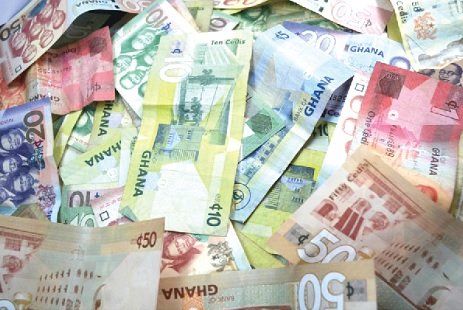
Long before banknotes and coins filled wallets across Ghana, trade in local markets relied on something far simpler: tiny white shells. Known as cowries, these shells once served as one of the most widely used forms of money in the region that later became the Gold Coast. They passed from hand to hand in busy markets, paying for food, cloth, and daily essentials.
But the story of Ghana’s currency is also a story of power, independence, and national identity.
When the British consolidated their colonial rule over the Gold Coast, the traditional system of cowry-based trade gradually gave way to a European monetary framework. The colonial administration introduced pounds, shillings, and pence—currencies managed by the West African Currency Board and circulated across several British territories in West Africa.
For many people, the new system was complicated and unfamiliar, yet it became the official means of exchange throughout the colonial era.
Everything began to change after Ghana became the first sub-Saharan African country to gain independence in 1957 under the leadership of Kwame Nkrumah. A year later, the newly established Bank of Ghana introduced the country’s first national currency: the Ghana pound.
Although the Ghana pound symbolized political independence, it still followed the British-style system of pounds, shillings, and pence. The real break from colonial monetary traditions came in 1965, when the country adopted a decimal system.
That year, Ghana introduced the cedi and pesewa, replacing the old pound-based structure entirely. The new currency was more than a financial reform—it was a powerful symbol of national pride. The notes carried the portrait of President Nkrumah, reflecting the optimism of a young nation shaping its own future.
Even the name “cedi” carried historical meaning. Derived from the Akan word “sɛdeɛ,” meaning cowry shell, it paid tribute to the shells that once fueled commerce across the region centuries earlier.
Political changes soon reshaped the currency again. After Nkrumah was overthrown in 1966, the government introduced a “new cedi” in 1967. This redesign removed Nkrumah’s portrait and replaced it with national symbols such as the Ghana coat of arms, the Independence Arch, and the Adome Bridge—images meant to reflect the country’s broader identity.
Over the decades that followed, inflation steadily pushed prices upward. Everyday purchases often required thousands of cedis, making the currency increasingly cumbersome to use.
In 2007, the Bank of Ghana introduced the modern Ghana cedi, removing four zeros from the old notes. Under the reform, 10,000 old cedis became one new cedi, simplifying transactions and restoring confidence in the currency.
From cowry shells in bustling markets to modern banknotes, Ghana’s monetary history mirrors the nation’s broader journey. It reflects colonial influence, the struggle for independence, political change, and economic adaptation.
In many ways, the story of the cedi is not just about money. It is about how a country continually reshapes its identity while holding onto echoes of its past—even in the name of its currency.

Long before playlists were filled with Afrobeats and dance floors pulsed to Amapiano, a different rhythm captured global attention. It didn’t start in luxury studios or international charts. It started on the streets of Ghana.
Azonto wasn’t just a song. It was a movement.
In the early 2010s, young people in southern Ghana—particularly within Ga communities around Accra—began transforming a traditional dance known as panlogo into something new. Panlogo already carried a strong identity: expressive hand gestures, rhythmic footwork, and movements that told everyday stories.
But a new generation reimagined it.
They sped it up, added humour, and turned everyday activities into dance gestures—mimicking phone calls, driving, washing clothes, or even acting out jokes. The result was Azonto: playful, expressive, and instantly addictive.
Soon the streets became stages.
Ghanaian musicians quickly caught onto the energy. Artists like Sarkodie, E.L, Gasmilla, and Stay Jay began weaving the dance into their music and performances. Tracks built around the dance flooded local airwaves, parties, and clubs.
Azonto was no longer just something you watched. It was something you joined.
Social media and early YouTube dance clips helped push the movement further. Tutorials popped up everywhere, showing fans how to master the signature gestures and rhythmic footwork.
Then the wave crossed borders.
UK-based Ghanaian artist Fuse ODG played a key role in carrying Azonto beyond West Africa. After spending time in Ghana and working with producer Killbeatz, he returned to the United Kingdom with a clearer understanding of the sound and culture surrounding the dance.
What followed helped ignite a global craze.
Songs built around Azonto rhythms began circulating internationally. One of them even broke the dance down step-by-step, making it easy for anyone—anywhere—to learn the moves. Soon, dance floors from London to Paris were filled with people mimicking the playful gestures born on the streets of Accra.
The internet amplified the spread.
Videos of Azonto dancers began appearing from cities across Europe and North America. What had started as a local reinterpretation of a traditional Ga dance was now part of global pop culture.
As often happens when trends explode, imitations followed. Nigerian duo P-Square introduced a dance called Alingo, which many fans saw as heavily inspired by Azonto’s style and rhythm. Debates followed, but for many observers, the origin of the spark was already clear.
Azonto had already written its name into global dance history.
Today, newer sounds like Afrobeats and Amapiano dominate international charts, but Azonto’s influence still lingers in the way African music connects with dance culture worldwide. It proved that a local street movement—driven by creativity and community—could shape global trends.
For Ghana, Azonto was more than a viral moment. It was a cultural statement.
A reminder that sometimes the world’s next big wave doesn’t start in corporate boardrooms or international studios.
Sometimes it starts with a group of friends dancing in the streets of Accra.


Renowned Global Bodies Warn Middle East War Will Scuttle Africa’s 2026 Growth

Ex-President Akufo-Addo and President Mahama Exchange Pleasantries on Easter

Mahama Calls Christ’s Birthplace an ‘Epicentre of War’, New Airport Concourse Planned and Other Big Stories in Ghana Today
-

 Ghana News1 day ago
Ghana President Convenes Emergency Cabinet Meeting to Cushion Ghanaians from Soaring Fuel Prices
-
 Ghana News1 day ago
Mahama Calls Christ’s Birthplace an ‘Epicentre of War’, New Airport Concourse Planned and Other Big Stories in Ghana Today
-
 Ghana News1 day ago
Ex-President Akufo-Addo and President Mahama Exchange Pleasantries on Easter
-
 Business1 day ago
Renowned Global Bodies Warn Middle East War Will Scuttle Africa’s 2026 Growth