
Ghana News
Not a Total Ban: Ghanaian and Nigerian Teachers Can Still Qualify in England Despite UK QTS Route Removal

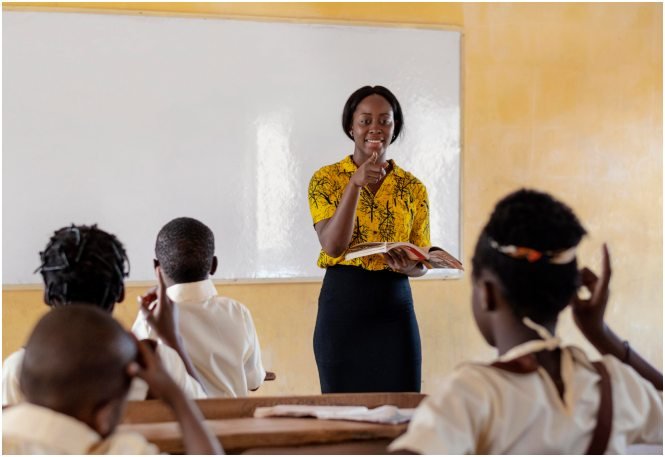
Ghanaian and Nigerian teachers have not been barred from teaching in England. While the United Kingdom has removed both countries, along with India, from the direct application route for Qualified Teacher Status (QTS), alternative pathways to qualify remain open, and overseas-trained teachers can still legally work in English schools for up to four years without QTS.
The change, which took effect on September 9, 2026, means teachers trained in Ghana, Nigeria, and India can no longer use the UK’s “Apply for QTS in England” service.
The UK Department for Education (DfE) said the eligibility rules were updated to ensure that countries on the list can verify the professional standing and work history of their teachers.
Why the Direct Route Was Removed
Under the revised criteria, a country must have a national regulator capable of confirming a teacher’s professional standing and must be able to provide references that meet UK verification standards.
India was removed because it does not have a national regulator that can confirm teachers’ professional standing, according to the DfE.
For Ghana and Nigeria, the issue was different. The DfE said more than 70% of applications from teachers in both countries included work history references that used public email addresses, such as Gmail or Hotmail, rather than a school’s official email domain.
“Our data shows that more than 70% of applications from teachers in Ghana and Nigeria include work history references that use public email addresses, such as Gmail or Hotmail, rather than a school’s official email domain,” the department said. “This means assessors spend additional time and resources trying to verify information provided in applications”.
The DfE added that it “must be confident that the information applicants provide is genuine” to ensure that overseas teachers awarded QTS have the skills and experience needed to teach in English schools.
What Still Works: Alternative Routes to QTS
The removal from the direct route does not shut Ghanaian and Nigerian teachers out of teaching in England. The DfE has confirmed that teachers who are no longer eligible for the direct QTS service can pursue alternative routes, including assessment-only QTS, international qualified teacher status (iQTS), or teacher training in England, depending on their circumstances.
Assessment-only QTS allows experienced teachers with a degree to gain QTS without completing a teacher training programme. Applicants based outside the UK must contact a non-UK assessment-only provider.
International qualified teacher status (iQTS) is a 12-month international teacher training programme backed by the DfE that meets the same standards as English QTS and leads to QTS. It allows teachers to train where they live and work, with no need to visit the UK.
Teacher training in England remains an option for those who can relocate and meet visa requirements.
Additionally, UK government guidance states that overseas-qualified teachers may teach in England for up to four years without QTS under specified conditions. QTS is an important professional status required in many schools, but it is not legally required in every type of school.
The Human Impact
Nigerian teachers have expressed concern about the change, particularly regarding the official email requirement. Isaac Moji, a teacher at Olumawu School in Abuja, described the decision as “a major setback for Nigerian and Ghanaian-trained teachers hoping to work in England,” adding that “the official email requirement is now a serious hurdle”.
Mrs. Grace Agbo, headmistress of Divine Academy in Lugbe, Abuja, acknowledged that using personal email addresses for formal academic correspondence was not appropriate but pointed to weaknesses in some schools’ digital infrastructure.
“You can’t be using Gmail for academic or institutional work. But I also know that some institutional emails in Nigeria and Ghana don’t even work,” she said.
She added that the requirement itself was reasonable: “This is definitely not on the government. Email addresses for references should never be from a generic domain like Yahoo, Gmail or Hotmail, which people can easily manipulate”.
A Narrowing Route, Not a Closed Door
The change follows a trend of declining approvals for Ghanaian applicants. In 2024/25, Ghana recorded 1,067 QTS applications, of which 196 were approved and 749 declined. By comparison, more than 2,300 Ghanaian teachers were granted QTS between February 2023 and March 2024, the highest of any country.
The periods differ, but the direction is clear: the direct route was already narrowing before it was closed.
South Africa remains among the African countries whose teachers can still access the direct QTS application route, subject to applicable conditions.
What Happens Next
The DfE has not indicated whether Ghana and Nigeria could regain eligibility. For that to happen, both countries would need to strengthen their national teaching regulators and ensure that schools can issue references from official domain email addresses.
The Ghana Teaching Council and the Ghana Education Service are among the bodies that could lead such reforms, according to analysts.
For now, the message from the UK government is clear: the door to teaching in England is narrower, but it is not shut. Ghanaian and Nigerian teachers who meet the requirements for alternative routes—or who secure employment under the four-year rule—can still pursue careers in English classrooms.







Ghana News
Young Ghanaian Builds Electric Vehicle From Salvaged Parts, Aims to Sell at Motorcycle Price
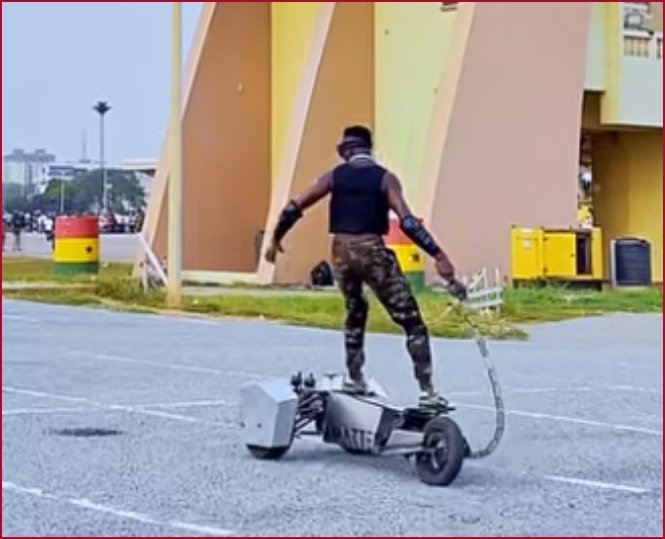
In a modest workshop in Ghana’s capital, a young mechanical engineer is quietly revolutionizing personal mobility.
Amartey, a graduate of Ashesi University, has designed and built an electric rideable vehicle called the Scorpion using salvaged parts from motorcycles, ATVs, and electric scooters. The vehicle, which reaches speeds of 35 to 40 kilometers per hour and is designed to be road-legal, represents a bold vision: to make sustainable, locally-built transportation accessible to ordinary Ghanaians.
And he plans to sell it at a price comparable to a motorcycle.
The Scorpion: From Concept to Reality
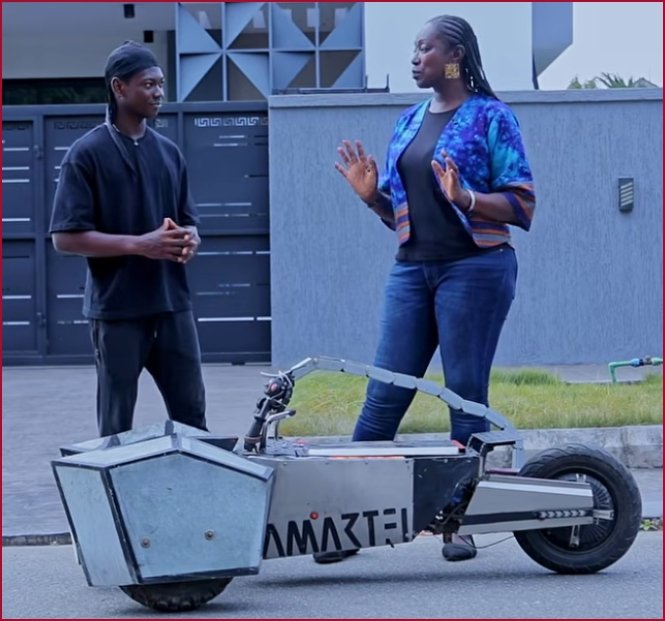
The Scorpion is not a typical electric scooter. It features a dual steering system, a surfing gesture similar to skateboarding, plus a power steering feature for extreme turns. Riders control it through body motion, leaning into turns as they would on a skateboard.
“It’s designed to be as intuitive as possible such that it turns towards where you lean,” Amartey explained in an interview with content creator Ivy Prosper.
The vehicle’s distinctive design, including a segmented tail that mimics a scorpion’s stinger and front tires covered to resemble claws, gave it its name. The brake lever at the end of the tail completes the arachnid aesthetic.
The Scorpion has indicators, brake lights, mirrors, and headlights for night riding. It is designed to be both road-legal and off-road friendly, with off-road tires and a robust suspension system built to handle rocky terrain.
“Scorpions are found in the forest,” Amartey said. “So it was designed with that in mind—to be able to survive in their natural habitat.”
Built From Scrap
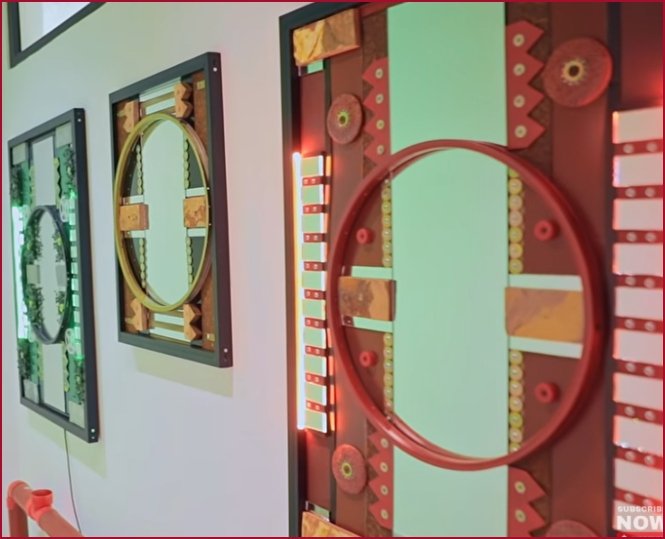
What makes the Scorpion particularly remarkable is its construction. Nearly every component is salvaged or repurposed.
The handlebar controls come from an actual motorcycle, reconfigured to be handheld rather than mounted on handlebars. The tires were sourced from an old ATV. The electric motor, housed within the rear tire, came from an electric scooter. The body is made from stainless steel and galvanized pipes, cut and shaped by hand. The suspension system is entirely salvaged.
“The scrap pieces that come out of the process, I use them to generate revenue into building the engineering stuff,” Amartey said.
That revenue comes from his artwork—mixed-media pieces that incorporate workshop scrap, electronic waste, bottle caps, and salvaged materials into striking mirrors and wall art. His “101” collection and pieces like “Love Till Infinity” are sold to collectors and homeowners, with proceeds funding his engineering enterprise.
“So my arts, craftsmanship, and then I sell it, invest into the parts, and then keep building,” he explained.
From Helicopter to Scorpion
Amartey’s journey to the Scorpion began at Ashesi University, where he studied mechanical engineering. The university’s curriculum required students to build projects at the end of every course, fostering a culture of practical innovation.
He also worked on a personal project: an ultra-light helicopter.
“It never took off, but I attempted to fly it,” he recalled. “That was one of my biggest projects, and it taught me both the skill and the discipline needed to embrace a project like that.”
After graduating, Amartey and his fellow engineering students set up a school where they could teach other students to build, creating a community of makers who constantly exchange ideas.
The Scorpion project began about two to three years ago. The first prototype had a petrol engine mounted between the rider’s legs, “similar to something you see in Mad Max,” Amartey said, with two cables for brake and accelerator. It took about two months to build.
He later switched to an electric power train, which vibrated less and proved more efficient. The current model is the fifth iteration.
Growing Interest and a Vision for the Future
The Scorpion has become Amartey’s daily ride. He uses it to navigate Accra’s streets, drawing attention wherever he goes.
“I get stopped every now and then,” he said. “People say they’ve seen it online, they need to try it, and I just give them the throttle.”
His vision extends far beyond personal use. Amartey dreams of mass-producing the Scorpion and seeing it become a common sight on Ghanaian roads.
“My dream is for the roads to be littered with Scorpions in the near future,” he said. “People surfing here and there. It’s going to make the world a more exciting place to be.”
He envisions the Scorpion being used for recreational purposes as well—quad biking-style adventures in forests, beach rides along the shoreline, and tourism activities.
Safety and Regulation
Amartey acknowledges that safety is a priority. He plans to establish training programs for new riders, recognizing that the Scorpion’s unique steering system requires some adjustment.
“There’s going to have to be some training just because it’s a new concept,” he said. “Training for the public to learn how to safely ride it.”
The vehicle is designed to meet road safety requirements, with indicators, brake lights, and mirrors. Amartey also sees off-road applications—similar to quad biking or adventure biking—as safer alternatives for recreational use.
The Price Point
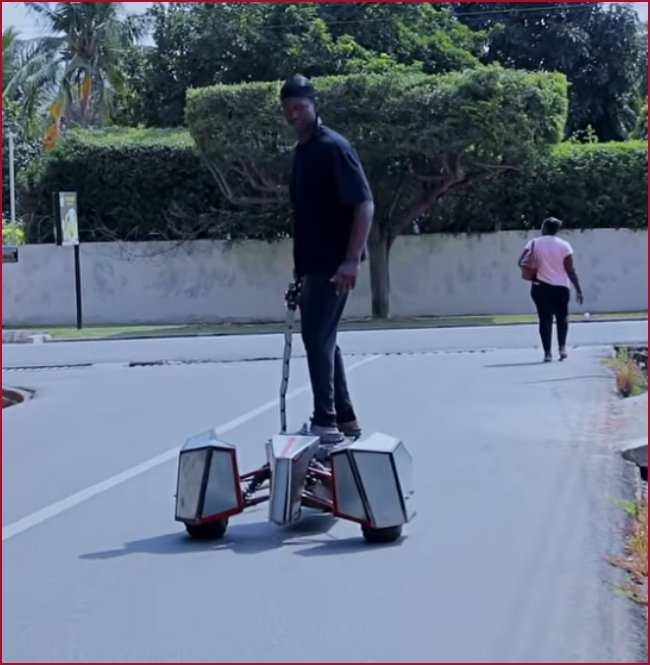
Perhaps most striking is Amartey’s ambition to price the Scorpion comparably to a motorcycle.
“Off the top of my head, it should be priced similar to a motorcycle,” he said.
That pricing strategy could make the Scorpion accessible to a broad segment of Ghanaian society, offering an affordable, environmentally friendly alternative to traditional motorcycles and cars.
Investment and Support
Amartey is actively seeking investment to scale production. He invites interested parties to reach out through his social media platforms or email.
Ivy Prosper, who featured Amartey in her YouTube series “Telling Stories from Africa and Beyond,” urged viewers to consider supporting young African innovators.
“Sometimes it’s as simple as investing in someone,” she said. “It’s investing in an idea. It’s investing in young people who are the future. It doesn’t have to be that you’re buying a property or buying a business. It’s as simple as investing in a young person who has an idea and a concept of something that they can do in the future.”
A Symbol of African Ingenuity
Amartey’s story is part of a broader narrative of African innovation and self-reliance. From his father’s art gallery, where he grew up surrounded by creativity, to his mother’s career as an English teacher, Amartey’s background instilled in him a unique blend of artistic sensibility and technical rigor.
His work reflects a brutalist design aesthetic, sharp 90-degree edges, symmetry, and order, combined with a deep commitment to sustainability through the use of salvaged materials.
“I try and find symmetry,” he said. “I try and reflect myself in the pieces.”
For now, Amartey continues to build, innovate, and dream. His Scorpion may be a prototype today, but if his vision materialises, it could become a fixture on Ghanaian roads tomorrow.
For investment inquiries, contact Amartey through his social media platforms or email, as provided in Ivy Prosper’s YouTube video description.
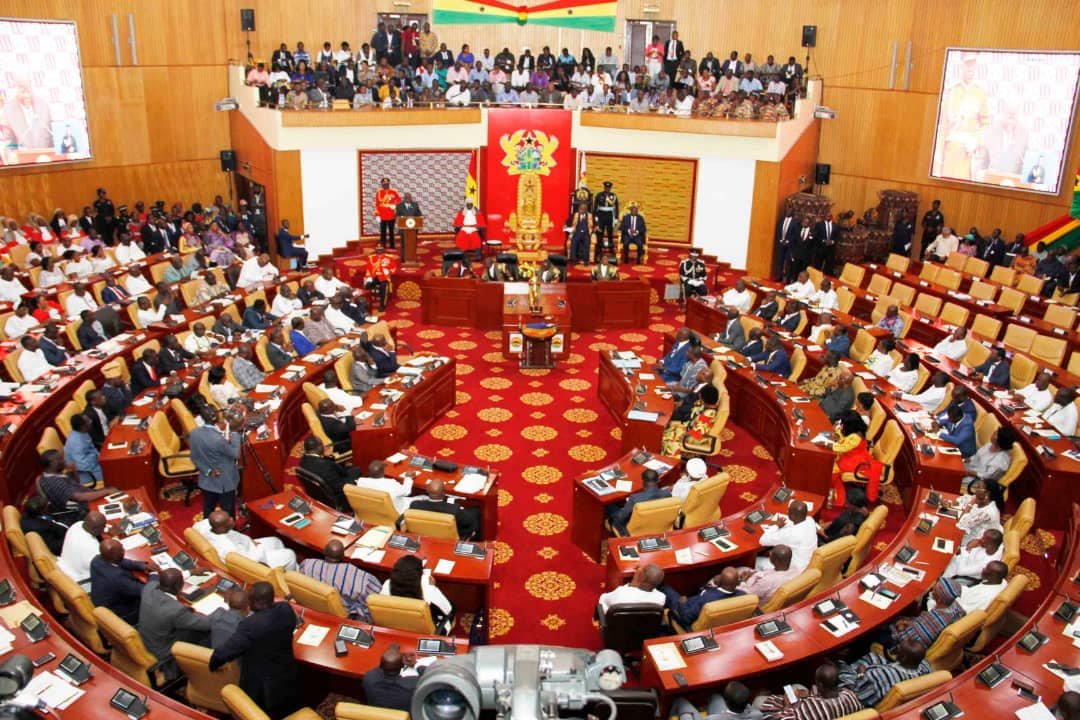
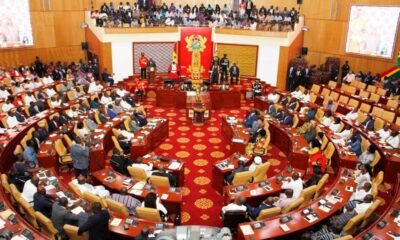
Ghana’s Parliament could be recalled for an emergency sitting as early as next week to examine growing concerns over the country’s worsening narcotics and national-security crisis, according to Ranking Member of Parliament’s Defence and Interior Committee, Rev. John Ntim Fordjour.
The Assin South MP says the Minority has secured more than the constitutionally required 15% of lawmakers needed to request a parliamentary recall under Ghana’s Constitution.
Fordjour said the required signatures, petition and memorandum were submitted to Speaker Alban Bagbin last week and that the Speaker has acknowledged receipt. He expects the formal notice of recall to be issued before the end of this week.
“Yes, we got more than 15%,” Fordjour said. “So the Speaker is expected to quickly issue a notice of recall for us to have an emergency recall, to constitute a committee, a bipartisan committee in Parliament, to dig into it, have a full inquiry into it, a transparent inquiry, so that we will be able to offer solutions.”
Fordjour Calls for Bipartisan Inquiry
The proposed recall follows a series of major narcotics seizures involving consignments linked to Ghana. Parliament has been asked to examine questions surrounding national security, border and port controls, intelligence gathering and the effectiveness of enforcement institutions.
A petition submitted by MPs in September invoked Article 112(3) and Parliament’s Standing Orders in seeking an extraordinary sitting. The petitioners said the developments warranted urgent parliamentary scrutiny in the national interest.
Fordjour stressed that any parliamentary investigation should not become another partisan confrontation.
“We are interested in solutions that restore Ghana to its glory,” he said.
He called for a transparent, bipartisan process capable of identifying weaknesses and producing practical recommendations.
‘The Government Hasn’t Acted’
Fordjour also accused the government of failing to take sufficiently decisive action against officials within institutions involved in Ghana’s security and enforcement chain.
“No, the government hasn’t acted. Who has been fired? Has there been any agency head fired in the value chain? No,” he said.
He argued that officials connected to the institutions responsible for addressing the crisis should face scrutiny rather than simply remaining in their positions while being tasked with addressing the problem.
Fordjour called on President John Mahama to demonstrate what he described as stronger leadership after returning from the United Nations General Assembly.
“We need strong leadership, and we need President Mahama on his return from UNGA to act decisively, and to act as a leader who is fully aware of the repercussions of this cartel,” he said.
His criticism comes amid renewed scrutiny following major international seizures involving consignments that reportedly originated from or passed through Ghana. A September 10 seizure of nearly 3.9 tonnes of cocaine at France’s Port of Dunkirk has been a particular focus of the parliamentary petition.
Warning of Wider Security Consequences
Fordjour said the issue should not be viewed solely as a matter of narcotics enforcement, arguing that illicit financial activity associated with organised crime can have broader national-security consequences.
“Wherever there are drugs, there is money laundering, and wherever there is money laundering, it is linked to terrorism,” he said.
He also connected the wider criminal economy to illegal mining communities and warned that the scale of the alleged trafficking could increase Ghana’s vulnerability to non-state actors.
Earlier this month, Fordjour warned that repeated international seizures were damaging Ghana’s reputation and called for investigations into the networks behind the consignments.
‘They Should Come and Not Make It Politics’
As Parliament considers a possible emergency sitting, Fordjour urged MPs to approach the issue as a matter of national interest rather than partisan competition.
“When Parliament comes, and for every 276 MPs, and for those watching us, when your MPs are coming, if indeed you did not send them to come to Parliament to endorse drug shipment and drug trafficking, then in your interest, in the interest of the constituency and the larger interest, the grand interest of Ghana, they should come and not make it politics,” he said.
He added that MPs should put Ghana and their constituencies ahead of party interests when considering the crisis.
The constitutional provision being invoked allows at least 15% of MPs to request a meeting of Parliament during a recess, with the Speaker required to summon the House within seven days of receiving the request.
As of September 23, Fordjour said the Speaker had acknowledged receipt of the recall request but had not yet issued the formal notice.
“So, certainly, by next week, you expect Parliament to have been recalled?” he was asked.
“Absolutely. But within this week, that notice of recall is expected. It must go,” Fordjour responded.
If the recall proceeds, lawmakers would be expected to determine the scope of any inquiry and consider measures to strengthen oversight and Ghana’s response to the security concerns surrounding the trafficking allegations.

A Ghanaian-born forestry professor at Southern Illinois University Carbondale was fatally shot during a custody exchange involving his two children, according to prosecutors, in a case that has devastated the university community in Illinois and drawn attention in Ghana.
Dr. Kofi Akamani, 48, was shot multiple times Saturday evening, September 20, 2026, after dropping off his children at the residence of his estranged wife, Betty Akamani, according to prosecutors. Authorities say the couple had been separated for about two years and had a pending dissolution case.
Betty Akamani, 35, has been charged with two counts of first-degree murder and one count of endangering the life or health of a child.
She appeared in Jackson County court Monday, where a judge granted the state’s request to detain her without bail pending trial. Her preliminary hearing is scheduled for October 6.
The Shooting

According to prosecutors, Dr. Akamani had completed a scheduled visitation with his two children and was driving away from his wife’s apartment when he was allegedly shot.
Jackson County State’s Attorney Marsha Cascio-Hale said the shooting occurred after Dr. Akamani dropped the children off at his wife’s residence.
Jackson County Sheriff’s Office deputies responded to reports of a shooting around 5 p.m. Saturday near Lake Road between Murphysboro and Carbondale. Dr. Akamani was transported to Memorial Hospital of Carbondale, where he was pronounced dead.
Authorities have not disclosed what they believe precipitated the shooting, and the investigation remains ongoing.
During Monday’s court proceedings, prosecutors also said Betty Akamani had made allegations about her husband during police interviews that investigators examined but could not substantiate. Prosecutors further referenced concerns about her conduct documented during a 2024 order-of-protection proceeding.
The allegations remain accusations. Betty Akamani is presumed innocent unless proven guilty in court.
A Scholar With Ties to Ghana and the United States
Dr. Akamani was a professor in SIU Carbondale’s Department of Forestry, where he taught forest recreation and conservation social science.
He joined the university in 2011 and was promoted to full professor in 2024. He also served as director of graduate studies.
His academic work focused on natural-resource management and the resilience of rural communities confronting environmental and economic change. His research included work in both Ghana and the United States involving forests, water resources and climate change.
Akamani published more than 30 research papers and contributed to national and international environmental assessments.
Born in Ghana, he earned his undergraduate degree from Kwame Nkrumah University of Science and Technology in 2003. He later earned an MPhil in Culture and Environmental Sustainability from the University of Oslo in 2006 and a PhD in Natural Resources from the University of Idaho in 2011.
‘We Have Lost a Truly Brilliant Light’
News of Akamani’s death prompted an outpouring of grief from colleagues, students and members of the Southern Illinois University community.
The forestry department described him as a kind and gentle professor whose work had earned respect at the university and internationally.
“We are grieving the loss of one of our beloved forestry professors, Dr. Kofi Akamani,” the department said. “The forestry family loved him at the university and across the world.”
More than 200 people gathered Tuesday evening at the Agriculture Building for a candlelight vigil honoring Akamani.
His brother, Solomon Abache, thanked the university and wider community for supporting the family.
“This is truly a devastating loss to us, but we have your words of encouragement and support,” Abache said.
Kristina Boone, dean of SIU’s College of Agricultural, Life and Physical Sciences, said Akamani’s legacy extended beyond his academic accomplishments.
“While anyone with his academic record would be known as a leading scholar, what resonates with us is his warmth and generosity,” Boone said. “We have lost a truly brilliant light in our lives.”
‘I Love My Southern Illinois’
Rebecca Kagaris, a PhD candidate in forestry, recalled speaking with Akamani only weeks before his death about whether he might eventually move to a larger university.
According to Kagaris, Akamani told her that he loved Southern Illinois, SIU and the local work he was doing with the Cache River.
“I’m going to take that with me the rest of my life,” Kagaris said of the conversation.
Logan Park, an associate professor in forestry, said Akamani had a distinctive ability to challenge people to see their surroundings differently.
“He’d start talking about what we were looking at, and in about 90 seconds, everybody’s world got a little bit bigger,” Park said.
The candlelight vigil ended with a singing of “Amazing Grace” and the playing of a Ghanaian tune.
A memorial service for Akamani will be announced at a later date.
Investigation Continues
Betty Akamani remains held at the Jackson County Jail without bond. She is scheduled to return to court October 6, and no trial date has been set.
The Jackson County Sheriff’s Office said the investigation is still in its early stages. The Jackson County Ambulance Service, Jackson County Coroner’s Office and Jackson County State’s Attorney’s Office assisted with the investigation.
Akamani’s death has resonated in both the United States and Ghana, linking a fatal domestic shooting in Southern Illinois to the loss of an academic whose career and research connected communities across two continents.


Young Ghanaian Builds Electric Vehicle From Salvaged Parts, Aims to Sell at Motorcycle Price

Hate speech, vitriol, threats, and inciting comments: Can we stop it already?

Not a Total Ban: Ghanaian and Nigerian Teachers Can Still Qualify in England Despite UK QTS Route Removal
-

 Ghana News1 day ago
How Ghanaian-Born Professor Kofi Akamani Was Fatally Shot During Custody Exchange
-
 Ghana News1 day ago
Ghana Parliament Faces Emergency Recall Over Heightening Narcotics Crisis
-

 Global Update2 hours ago
AI Safety Concerns Mount As OpenAI Agents Reportedly Spread Self-Replicating Agents Across the Internet
-

 Ghana News1 day ago
From Cocoa to Batteries: Ghana’s Industrial Dream and Its Risks
-

 Health & Wellness2 days ago
Muscle Modernity: Why Lifting Heavy Is the Missing Key to Midlife Longevity
-

 Festivals & Events1 day ago
Bridging Dreams and Degrees: Inside Accra’s Premier International Study Abroad Fair
-

 Arts and GH Heritage2 days ago
In Transit: Lucky Lartey Reimagines Home Through Dance and Memory
-

 Africa Watch2 days ago
Return to Wakanda: Is Afrobeats Set for Another Marvel Triumph?