
Ghana News
Ghana Unveils New Cedi Notes Featuring Nkrumah, Kofi Annan and Trailblazing Women


Ghana has introduced upgraded banknotes under a new currency design initiative known as the Ghana Heritage Series, placing some of the country’s most influential historical, cultural, educational and political figures at the center of its national currency while strengthening measures against counterfeiting.
The new banknotes, unveiled by the Bank of Ghana, feature prominent personalities including the country’s founding president, Dr Kwame Nkrumah; former United Nations Secretary-General Kofi Annan; pioneering judge Justice Annie Jiagge; flag designer Theodosia Okoh; and renowned composer Dr Ephraim Amu.
Other figures honored include Agnes Oforiwa Tagoe-Quarcoopome, a celebrated market woman who supported Ghana’s independence movement; Cardinal Peter Porekuu Dery, a prominent Catholic leader; and Dr James Emman Kwegyir Aggrey, the pioneering educator and Pan-Africanist.
Beyond the portraits, the redesigned currency incorporates historic buildings, important national sites, market scenes and Adinkra symbols, bringing aspects of Ghana’s history and cultural identity into everyday financial transactions.
The Bank of Ghana says the upgraded notes are intended to improve security, increase durability and make the currency more convenient to handle, while reinforcing public confidence and national pride in the cedi.
Bank of Ghana explains the purpose of the new currency

Speaking at the launch, Bank of Ghana Governor Dr Johnson Pandit Asiama said a national currency represented much more than a means of payment.
He described it as an expression of a country’s ability to manage its monetary affairs through its own institutions and as a foundation for economic activity.
“This launch is more than the introduction of upgraded notes. It is an opportunity for us to reaffirm our responsibility to protect the cedi, to celebrate the heritage that defines us and prepare our currency for the demands of a changing world,” he said.
Dr Asiama stated that the credibility of a currency depended on sound economic policies, effective institutions and the confidence of the people who used it.
He said the Ghana Heritage Series formed part of the central bank’s continuing efforts to modernize currency management and preserve confidence in the country’s national currency.
The redesign also addresses practical concerns associated with the use of physical money. The notes have been made smaller to improve portability and handling, while their construction is intended to withstand Ghana’s climatic conditions and the frequent handling associated with everyday cash transactions.
Enhanced security features have also been incorporated to make genuine banknotes easier to identify and more difficult to counterfeit. The Bank of Ghana says the improvements are expected to extend the notes’ useful lifespan.
The stories behind the new Ghana cedi denominations
One of the most distinctive aspects of the Ghana Heritage Series is the selection of personalities whose contributions represent different dimensions of the country’s development.
Rather than focusing exclusively on political leaders, the new designs recognize people associated with commerce, religion, education, the judiciary, music, diplomacy and the struggle for independence.
The denominations and their featured personalities include:
GH¢1 — Agnes Oforiwa Tagoe-Quarcoopome: Celebrating Ghana’s market women
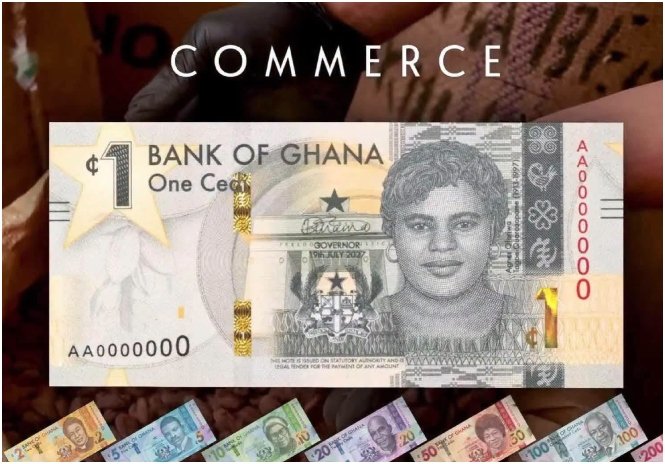
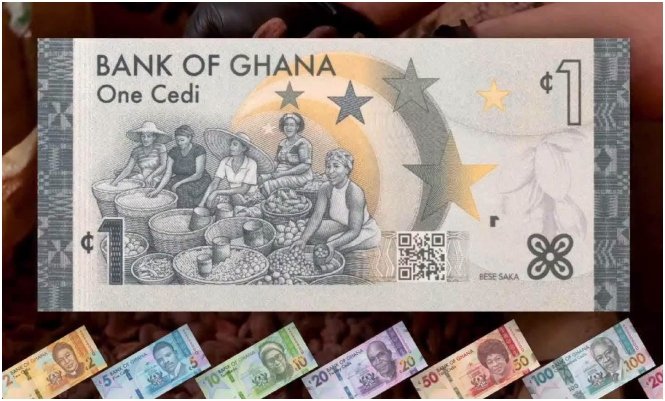
The GH¢1 note features Agnes Oforiwa Tagoe-Quarcoopome (1913–1997), affectionately known as Auntie Oforiwa, a prominent market woman and textile trader remembered for supporting Ghana’s independence struggle.
She began trading between 1921 and 1929 and had become one of the country’s respected businesswomen by the 1940s, operating shops at Makola and Okaishie markets in Accra.
She is credited with being the first woman at Makola Market to open a bank account with Standard Bank of West Africa, now Standard Chartered Bank Ghana, at a time when many traders kept their savings at home.
Her example reportedly encouraged other market women to develop confidence in formal banking.
Beyond her commercial activities, she mobilized women traders at Makola to provide financial and other support for the campaign for independence.
The reverse of the GH¢1 note features Makola Market, reflecting the importance of women’s trading networks and traditional markets in Ghana’s economic and social history.
GH¢2 — Cardinal Peter Porekuu Dery: Recognizing religious and cultural leadership
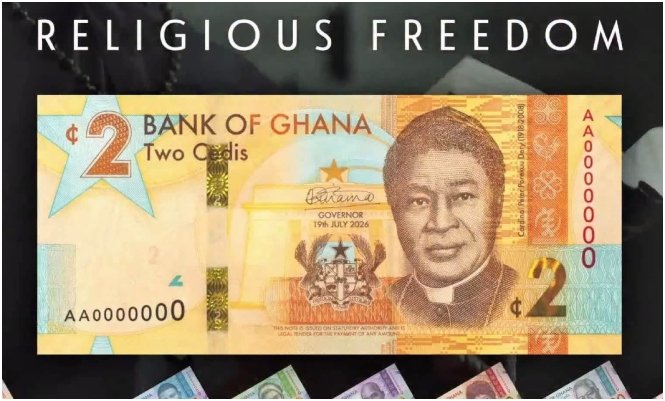

The GH¢2 note honors Cardinal Peter Porekuu Dery (1918–2008), a prominent Ghanaian Catholic prelate who served as Archbishop of Tamale from 1974 to 1994.
Elevated to the rank of cardinal by Pope Benedict XVI in 2006, Dery was widely recognized for promoting the incorporation of Ghanaian languages and cultural expressions into Catholic worship.
His contribution to the relationship between Christianity and local cultural identity is an important part of his legacy.
He holds the title Servant of God as his cause for sainthood progresses.
The reverse of the note features the Larabanga Mosque in the Savannah Region, one of Ghana’s most historically significant religious structures. Widely regarded as the country’s oldest mosque, it is an important center of Islamic heritage and pilgrimage.
GH¢5 — Dr James Emman Kwegyir Aggrey: Honoring education and intellectual development
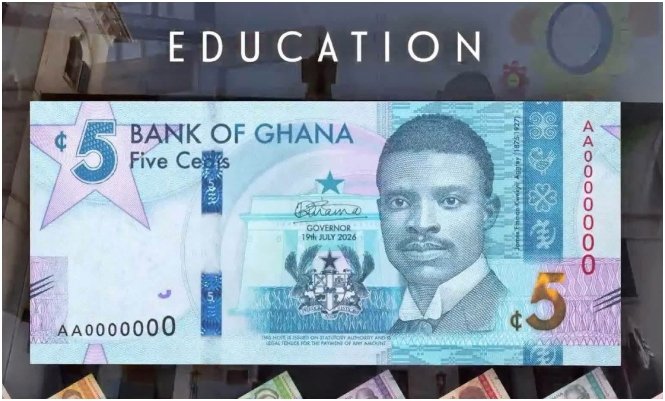
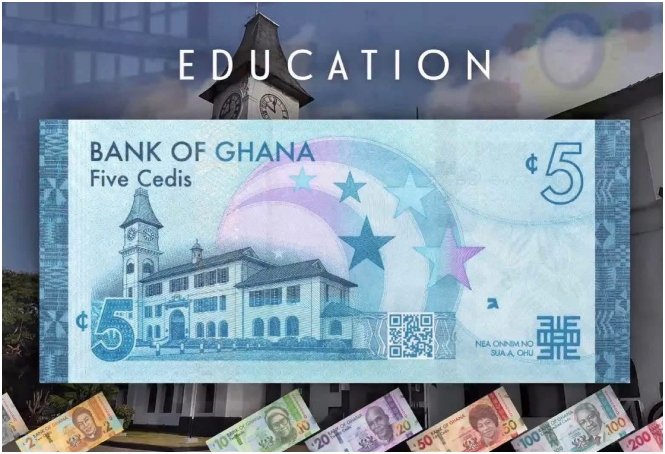
The GH¢5 note features Dr James Emman Kwegyir Aggrey (1875–1927), a pioneering Ghanaian intellectual, educator, missionary and Pan-Africanist widely known as the Father of African Education.
Aggrey advocated education as an essential instrument for individual advancement and the development of African societies.
His inclusion highlights the importance of education in Ghana’s national development and the contribution of early African intellectuals to debates about equality, opportunity and self-determination.
The reverse of the note features Achimota School, an institution associated with the country’s educational history, alongside a symbol representing education, innovation and creativity.
GH¢10 — Justice Annie Jiagge: Recognizing women’s contribution to the judiciary
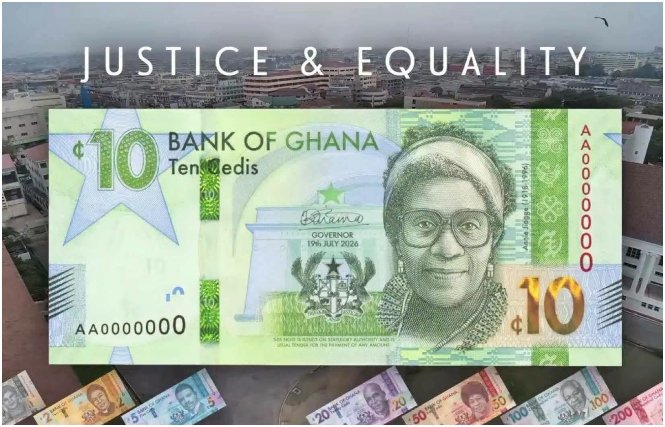
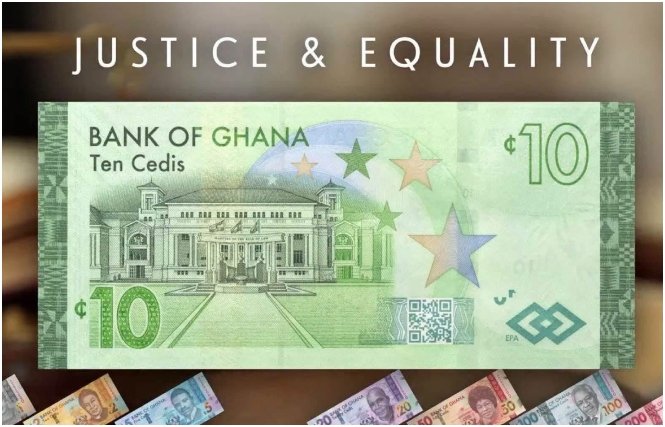
The GH¢10 note celebrates Justice Annie Jiagge (1918–1996), one of the most influential women in Ghana’s legal history.
She broke significant gender barriers, becoming Ghana’s first female judge and the second woman in the British Commonwealth to hold a judicial position.
Her career included serving as President of Ghana’s Court of Appeal from 1980 to 1983.
She also became the first African President of the World YWCA, serving from 1975 to 1983, and was involved in international efforts to advance women’s rights and social development.
Her appearance on the new banknote recognizes the contribution of women to Ghana’s legal institutions and public life.
GH¢20 — Dr Ephraim Amu: Celebrating Ghanaian music and cultural identity
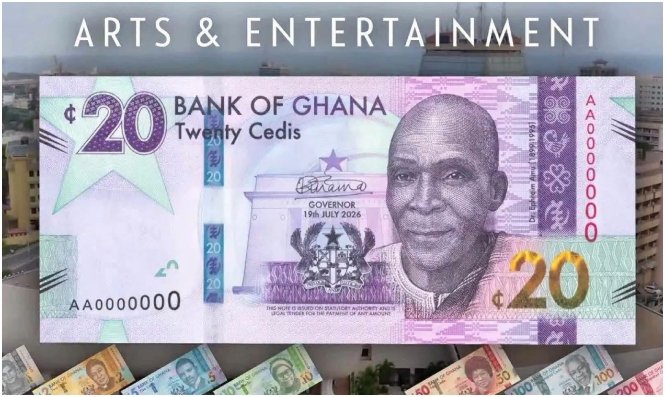
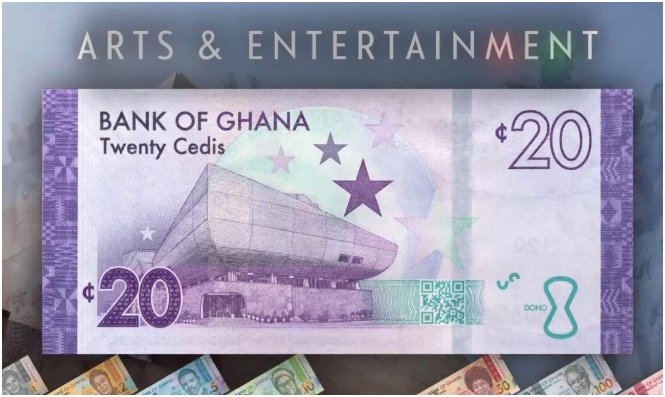
The GH¢20 note features Dr Ephraim Amu (1899–1995), the celebrated composer, musicologist and educator best known for writing the patriotic song Yɛn Ara Asaase Ni.
The song, whose title translates as “This Is Our Own Land”, has become an enduring expression of Ghanaian national identity and patriotism.
Amu’s work helped shape Ghanaian choral music by incorporating African musical traditions and cultural elements into formal musical compositions.
His appearance on the new GH¢20 also marks a return to the country’s currency after he previously featured on the old ¢20,000 banknote between 2002 and 2007.
The reverse of the new note features the National Theatre building in Accra, another prominent symbol of Ghana’s cultural and artistic life.
GH¢50 — Theodosia Okoh: Honoring the designer of Ghana’s national flag
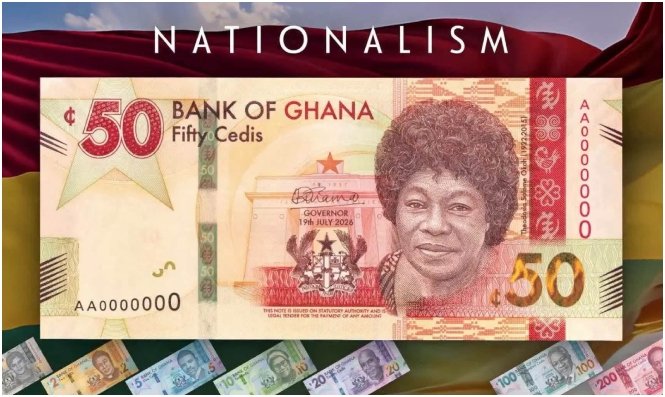
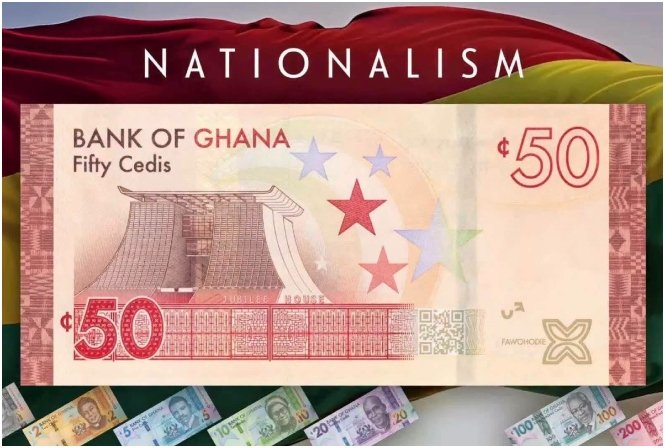
The GH¢50 note features Theodosia Salome Okoh (1922–2015), the Ghanaian artist and designer who created the country’s national flag.
Her design, adopted at independence in 1957, incorporated the red, gold and green colors associated with Ghana’s national identity, alongside the black star.
The red represents the blood shed in the struggle for independence, gold reflects the country’s mineral wealth, green symbolizes its natural resources and vegetation, and the black star represents African freedom and unity.
Her inclusion on the banknote recognizes the role of art and national symbolism in shaping Ghana’s identity.
GH¢100 — Kofi Annan: Celebrating Ghana’s contribution to global diplomacy
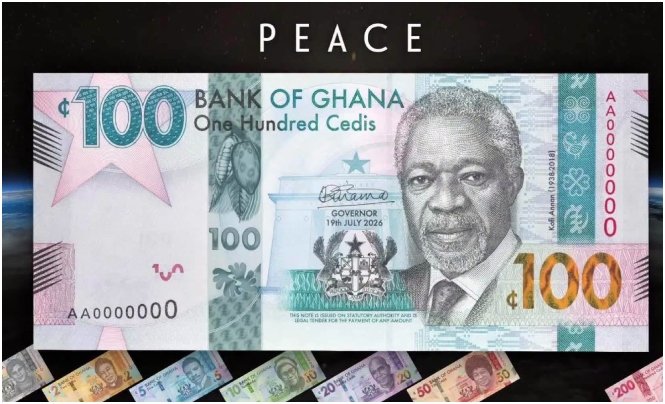

The GH¢100 note honors Kofi Atta Annan (1938–2018), the Ghanaian diplomat who served as the seventh Secretary-General of the United Nations from 1997 to 2006.
Annan made history as the first Black African to lead the United Nations and the first career UN staff member to rise through the organization’s ranks to become Secretary-General.
During his tenure, he became a prominent international voice on peace, security, development, human rights and multilateral cooperation.
His appearance on the new currency highlights Ghana’s contribution to international diplomacy and the country’s representation in global institutions.
GH¢200 — Dr Kwame Nkrumah: Honoring the leader of Ghana’s independence
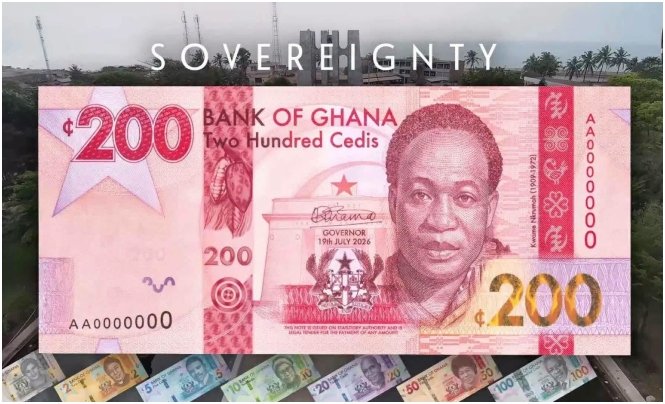
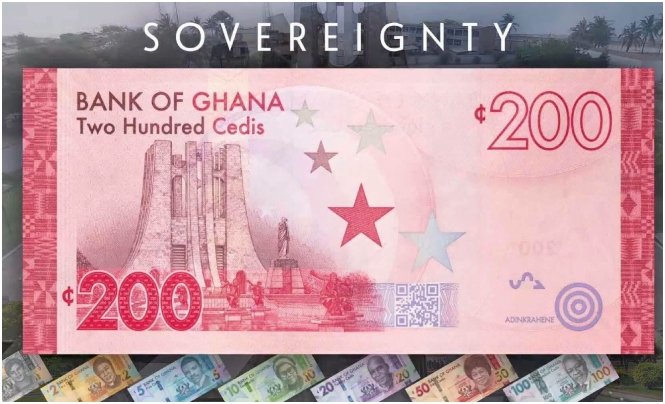
The GH¢200 note features Dr Kwame Nkrumah (1909–1972), Ghana’s founding leader and one of the most influential figures in the history of African independence movements.
Nkrumah led the Gold Coast to independence from British colonial rule on March 6, 1957, making Ghana the first country in sub-Saharan Africa to gain independence from colonial rule.
He became the country’s first Prime Minister and subsequently its first President.
A leading advocate of Pan-Africanism, Nkrumah promoted African political unity and sought to position Ghana as an influential voice in the continent’s struggle for self-determination.
His appearance on the highest denomination in the new series gives prominence to the political struggle that established modern Ghana.
A currency design that tells Ghana’s story
The Ghana Heritage Series represents an attempt to use the national currency as more than a practical instrument for exchanging goods and services.
The selection of personalities across the denominations creates a visual account of the country’s development, from the independence movement and the growth of commerce to education, religion, cultural expression, the judiciary and international diplomacy.
The inclusion of Agnes Oforiwa Tagoe-Quarcoopome is particularly significant because it brings the contributions of women in informal commerce and the independence struggle into a space traditionally dominated by prominent political and institutional figures.
Similarly, the recognition of Justice Annie Jiagge and Theodosia Okoh highlights women’s contributions to public institutions, law and national identity.
The designs also connect different periods of Ghanaian history through images of places such as Makola Market, Larabanga Mosque, Achimota School and the National Theatre.
The incorporation of Adinkra symbols for the first time further strengthens the cultural dimension of the redesigned notes, bringing traditional Ghanaian visual expressions into the country’s modern monetary system.
Security, durability and confidence in the cedi
While the heritage features have attracted attention, the Bank of Ghana has explained that the redesign also serves important monetary and practical purposes.
Counterfeit currency remains a concern for monetary authorities worldwide, making the incorporation of improved security features an important part of maintaining confidence in physical money.
The upgraded notes are designed to make it easier for the public to distinguish genuine currency from counterfeits.
Their improved durability is also intended to reduce the frequency with which damaged banknotes need to be replaced, while their smaller dimensions are expected to make cash transactions more convenient.
The Bank’s emphasis on durability is particularly relevant in Ghana, where physical cash remains an important part of everyday commerce, including transactions in markets, shops, transport services and other informal economic activities.
However, confidence in a currency cannot be secured through banknote design alone. As Governor Asiama indicated, it also depends on the strength of monetary policy, the credibility of institutions and public trust in the economy.
The Heritage Series therefore combines a practical currency modernization exercise with a broader effort to strengthen the symbolic relationship between Ghanaians and their national money.










Ghana News
Javits Frimpong’s Murder: One Suspect Arrested, Two Still Wanted as Bullying Questions Remain Unanswered

The arrest of a 17-year-old boy in connection with the fatal shooting of 15-year-old Ghanaian immigrant Javits Frimpong has marked a significant breakthrough in the investigation, but two other suspects remain wanted as police continue examining the circumstances surrounding the teenager’s killing in New York.
Frimpong was shot on October 29, 2026, while walking to school in the Bronx. The teenager was attacked near the intersection of East 171st Street and Third Avenue, in an incident that left his family devastated and raised questions about the safety of young people travelling to school.
The New York Police Department (NYPD) announced the arrest on Wednesday, November 11, identifying the development as the result of an investigation by its Violent Crimes Task Force.
The suspect, identified by law enforcement sources as Thierno Jalloh, was charged with second-degree murder, manslaughter and criminal possession of a weapon. He was remanded without bail following his arraignment at Bronx Criminal Court.
However, the arrest has not resolved some of the most troubling questions surrounding the killing, particularly allegations that Frimpong had experienced bullying shortly before his death.
Investigators are also continuing their search for two additional suspects believed to have been involved in the shooting.
Three suspects reportedly fled after the shooting
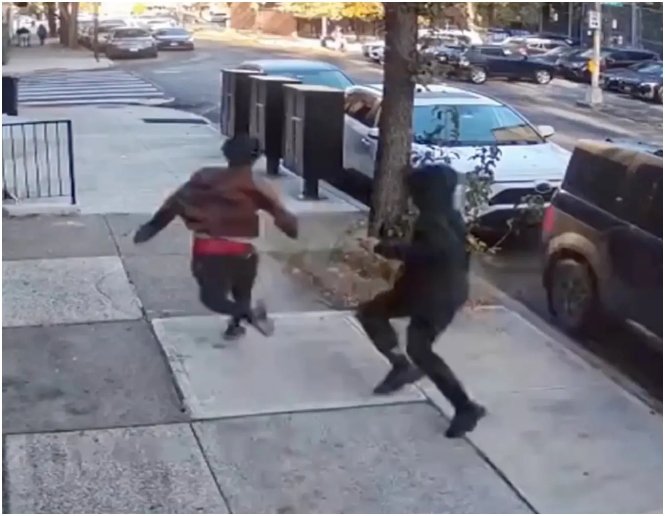
According to police information previously released in the case, three males dressed entirely in black were seen fleeing the scene after the gunfire. They were believed to be between 16 and 18 years old.
Harrowing surveillance footage reportedly showed Frimpong, gravely wounded, running for his life before collapsing. He later died from his injuries.
The arrest of Jalloh represents the first major breakthrough in identifying a suspect, but authorities have not publicly explained the precise roles allegedly played by the three individuals or disclosed what led to the confrontation.
Law enforcement sources told the New York Post that Jalloh was not a student at the same school as Frimpong.
The identities of the two remaining suspects have not been publicly disclosed, and police have not announced further arrests.
For the victim’s family, the investigation cannot end with one suspect in custody.
“One in the bag, two to go,” Frimpong’s uncle, Mohamed Doumouaian, told the New York Post after the arrest was announced.
“Everybody involved in the murder of my nephew, I want them to be held accountable. All three of them should be charged with murder,” he said.
Father says school reported bullying two days before the murder
One of the most significant unresolved aspects of the case concerns allegations that Frimpong had been bullied at 329 The DreamYard Preparatory School in the Bronx.
His father, Thomas Frimpong, 60, said his son had experienced bullying at the school and believes it may have been connected to his death.
According to his account, the school’s principal contacted him just two days before the fatal shooting to inform him that two boys had been fighting with his son.
Thomas Frimpong said the two students were suspended following the incident.
The timing of that reported school intervention has raised questions about whether the shooting could have been connected to an earlier dispute and whether the teenager’s family or school officials had reason to anticipate further trouble.
However, the alleged bullying has not been established as the motive for the murder.
NYPD Chief of Detectives Joseph Kenny previously confirmed that investigators were examining the issue alongside other possible explanations.
Kenny described the reported bullying as “one aspect that we’re looking at, as well as some others.”
The distinction is important. While the father’s account provides a significant line of inquiry, investigators have not publicly established that the alleged bullying led to the shooting.
There is also the question of how the arrested teenager, who reportedly did not attend the same school, may have been connected to Frimpong or the events preceding his death.
Police have not publicly provided an explanation.
Police say teenager was focused on education, not gang activity
As investigators worked to establish a motive, Chief of Detectives Kenny described Frimpong as a student who appeared committed to his education and was trying to build a future in the United States.
He said the teenager would return home, complete his homework and occasionally use his phone.
Kenny also said investigators had found nothing indicating that Frimpong was involved in gang activity.
“All indications are that he was trying to live the American dream. He was trying to get ahead by going to school,” the detective chief said.
“Seems like he was just a very good kid,” he added.
The police assessment has become an important part of the public understanding of the case, particularly because the motive remains unknown.
Frimpong’s sister, Millicent Frimpong, said her younger brother dreamed of becoming a doctor and hoped to join the United States military after graduating from high school.
She revealed that three of his siblings had served in the US Army, with one still serving. She is also a military veteran.
His family described him as a quiet, studious teenager whose ambitions centred on education and service.
Mother travels from Ghana to demand justice
The case has also drawn attention to the difficulties faced by families separated across international borders when tragedy strikes.
Frimpong’s mother, Doris Adu Gyamfi, had been in Ghana when her son was killed. She was subsequently able to travel to New York after Mayor Zohran Mamdani appealed to US President Donald Trump to expedite her visa.
Trump agreed to grant the visa, allowing her to reach the United States to mourn her son and be with her family.
On Wednesday, hours before the arrest was announced, she spoke publicly about the killing for the first time at a press conference in Harlem.
Standing alongside civil rights activist Rev. Al Sharpton and family attorney Ben Crump, she made an emotional appeal for accountability.
“I need justice for my child,” she said through tears. “I have only one child. I have only one child.”
Her appearance brought renewed attention to the family’s grief and its determination to see everyone responsible brought before the courts.
Arrest marks progress, but legal process is just beginning
Jalloh was arraigned in Bronx Criminal Court on Wednesday evening and charged with second-degree murder, manslaughter and criminal possession of a weapon.
He was remanded without bail. He was scheduled to appear before Family Youth Court on Thursday, reflecting the fact that he is being prosecuted as a juvenile.
His attorney, Thomas Klein of the Bronx Defenders, declined to comment after the arraignment.
The NYPD Detectives Endowment Association praised the investigators responsible for the arrest.
Its president, Scott Munro, described the development as the product of detectives’ sustained investigative efforts, while acknowledging the devastating loss suffered by Frimpong’s loved ones.
The arrest is an important step in the investigation, but a criminal charge is not a conviction. The suspect remains entitled to the presumption of innocence as the case proceeds through the justice system.
Questions that remain unanswered
With one suspect in custody and two others still being sought, several central questions remain unresolved.
Police have not disclosed what motivated the shooting, whether the alleged school bullying was connected to it, how the three individuals allegedly became involved or what roles each may have played.
It also remains unclear whether investigators have established any connection between the reported school dispute and the circumstances of the fatal attack.
For the Frimpong family, the arrest provides some movement towards accountability but does not yet deliver the answers they are seeking.
Their demand is that everyone responsible for the teenager’s death be identified and prosecuted.
As the investigation continues, the case also raises wider concerns about violence affecting young people and the importance of taking reports of bullying seriously before disputes escalate.
For now, the search for the two outstanding suspects continues, while the circumstances that led to the death of a 15-year-old boy walking to school remain the subject of an active police investigation.
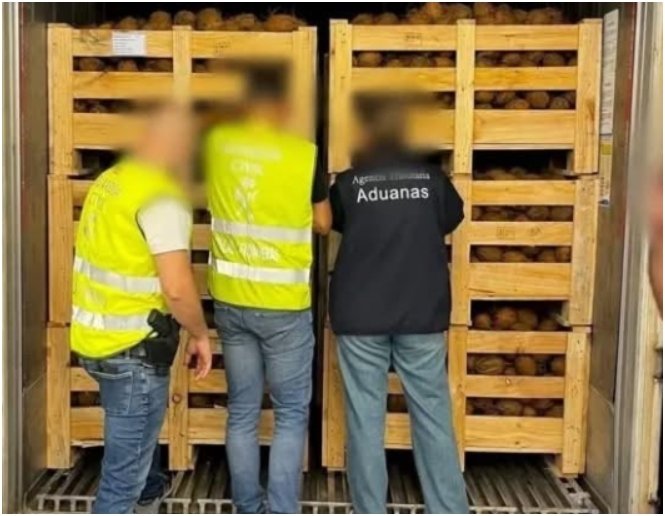
Spanish authorities have seized 2,600 kilograms of cocaine concealed in a shipment of coconuts originating from Ghana, uncovering an elaborate concealment system in two shipping containers that travelled from the Port of Tema to Spain.
The seizure, announced on November 11, 2026, by Spain’s Tax Agency and the Civil Guard, resulted in the arrest of two men in the municipality of Viator, in the province of Almería.
The suspects were identified by authorities as the importer of the goods and the person responsible for unloading the shipment.
The cocaine was discovered at the Port of Valencia after customs officials selected the two containers for inspection, having identified them as presenting a high-risk profile during routine controls on international trade.
According to the Spanish authorities, the containers were loaded at Tema Port on August 2, 2026, and arrived in Valencia on August 22 aboard a container vessel.
Cocaine hidden beneath false bottoms in coconut crates
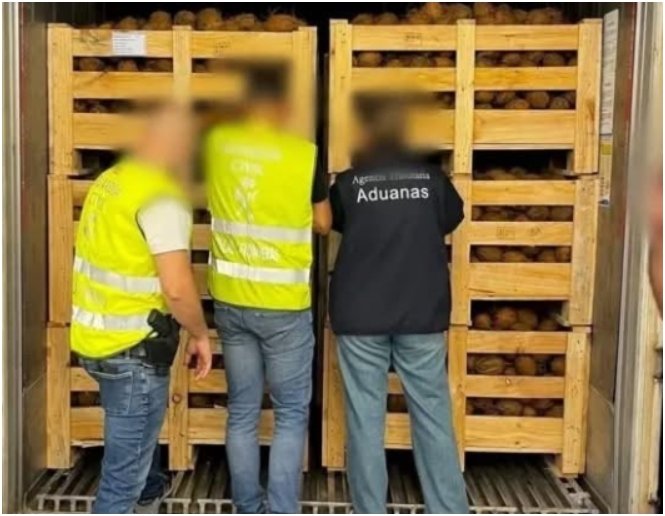
Per reporting by the Daily Graphic, an examination of the declared cargo revealed that the wooden boxes used to transport the coconuts had been fitted with concealed false bottoms.
Beneath these compartments, investigators found layers of packages commonly used to transport cocaine. The drugs were not hidden inside the coconuts themselves but underneath specially constructed structures within the wooden crates.
Spanish authorities said the packages contained a white powder whose characteristics were consistent with cocaine hydrochloride. Screening tests subsequently confirmed that the substance was cocaine, with the total quantity recovered amounting to 2,600 kilograms.
The concealment method allowed the illicit cargo to be transported alongside legitimate agricultural produce, disguising the drugs within packaging designed for an ordinary commercial shipment.
Investigators tracked the cargo beyond Valencia
The discovery at the port did not immediately bring the investigation to an end. After seizing the cocaine and completing the necessary customs procedures, investigators launched a surveillance operation to track the remaining goods as they continued towards their intended destination.
The cargo was transferred from the port into two refrigerated lorries, which travelled to a warehouse at the La Juaida industrial estate in Almería.
Officers maintained surveillance of the vehicles and the subsequent unloading operation at the warehouse in Viator. The operation culminated in the arrest of two individuals allegedly connected with the importation and unloading of the goods.
Spanish authorities identified one suspect as the importer of the shipment and the other as the person responsible for receiving and unloading it.
The official announcement did not disclose the identities or nationalities of the two men, nor did it provide details about the individuals who may have organized or facilitated the concealment of the cocaine.
Joint operation by Spanish customs and law enforcement
The seizure resulted from a coordinated operation involving Spain’s Tax Agency Customs Surveillance Service and the Civil Guard.
The initial inspection was undertaken after the Entry Summary Unit of the Customs Surveillance Service identified the containers as requiring additional scrutiny. The subsequent tracking and arrests involved operational units in Valencia and Almería, as well as organized crime and border investigation personnel from the Civil Guard.
The operation highlights the role of customs risk assessment, cargo inspections and coordinated law enforcement surveillance in detecting attempts to move illicit substances through international commercial shipping channels.
Questions surrounding the use of legitimate export cargo
Although the shipment originated from Ghana, the Spanish authorities’ announcement does not establish where the cocaine was introduced into the containers, who arranged the concealment or whether anyone in Ghana was involved in the trafficking operation.
The discovery nevertheless draws attention to the potential exploitation of legitimate international trade routes by organized criminal networks seeking to move large quantities of narcotics across borders.
For Ghana, the distinction is particularly important: the fact that the containers were loaded at Tema does not establish that the country’s coconut producers, exporters or shipping operators had knowledge of the concealed drugs.
The Spanish investigation has so far publicly confirmed the seizure of the 2.6 tons of cocaine and the arrest of two people in Almería. Further details about the wider trafficking network, the origin of the drugs and any possible accomplices have not been established in the announcement.
The case adds another major international drug seizure involving cargo shipped from Ghana to the European market, placing renewed attention on the security of commercial supply chains and the need to prevent legitimate exports from being exploited for illicit purposes.
Ghana News
Ghanaian Regulators Test Local Innovator’s Plastic-Derived Fuel, Finds Petrol and Diesel Fall Short of Required Standards

Ghana’s National Petroleum Authority (NPA) has conducted preliminary quality tests on petrol and diesel produced by a young innovator in Asesewa in Ghana’s Eastern Region through a process that converts waste plastics into fuel.
Reports indicate that initial results show that the products do not yet meet the required standards for automotive use.
According to popular digital creator, Nana Tea, known for promoting the Asesewa township, the assessment followed a visit by the NPA Regional Director, Mr Salifu S. Nagumsi, and his team, who travelled to meet the innovator after a video demonstrating his plastic-to-fuel project attracted widespread attention on social media.
The team brought a mobile laboratory kit to conduct preliminary tests on the fuel produced through the initiative, seeking to establish whether it was suitable for use in motor vehicles.
However, the initial findings showed that the petrol and diesel samples fell short of the quality requirements for automotive applications.
Further laboratory analysis planned
Despite the preliminary results, the NPA team collected samples of the fuel for further laboratory examination, indicating that the assessment process would continue beyond the initial field tests.
The Authority also expressed its willingness to engage the innovator in further discussions on how the project could be improved and developed.
The engagement suggests an opportunity for the young inventor to receive technical input and professional guidance as he works to refine the process and address the quality concerns identified during the preliminary assessment.
The NPA team commended his creativity and initiative, particularly his effort to transform discarded plastics into potentially useful products.
Innovation meets safety and quality requirements
The initial test results highlight an important distinction between demonstrating that waste plastics can be converted into a liquid fuel and producing fuel that meets the technical specifications required for use in vehicles.
Petrol and diesel intended for automotive applications must satisfy established quality requirements. Meeting those standards is essential to ensuring that fuel performs as expected and does not create avoidable risks for vehicle engines, users or the environment.
The preliminary findings therefore point to the need for further research, technical refinement and quality improvements before the products can be considered suitable for automotive use.
The results should not necessarily be viewed as the end of the project. Rather, the collection of additional samples and the NPA’s willingness to continue engaging the innovator provide an opportunity for further investigation into the technology and its potential.
Plastic waste management and alternative fuel research
The development has also drawn attention to the wider potential of exploring innovative approaches to plastic waste management in Ghana.
Plastic pollution remains an important environmental concern, and technologies that can recover value from discarded materials are attracting interest in different parts of the world. Converting waste plastics into fuel is one approach being explored, although the technical process, environmental implications and quality of the resulting products require careful evaluation.
For the Asesewa innovator, the next stage will be particularly important in determining whether the process can be improved to produce fuel that meets the necessary standards.
The NPA’s visit represents an encouraging engagement between a local innovator and a national regulatory institution. It also reinforces the importance of ensuring that promising ideas receive appropriate technical assessment rather than being judged solely on their initial demonstrations.
While the preliminary tests have established that the fuel is not yet suitable for automotive use, further laboratory analysis and continued technical discussions could help determine what improvements are possible.
The central challenge now is to establish whether the innovation can progress from an intriguing waste-conversion experiment into a technically reliable, environmentally responsible and commercially viable solution.


Beneath the Velvet: Exploring the Uncomfortable Truths Hidden Behind Beauty

Heritage Notes and Heartbreak: Ghana’s Social Media Mood on November 12

Flu Prevention Starts at Home: Five Everyday Habits That Protect Your Family
-

 Ghana News1 day ago
After COVID-19 Exposed Africa’s Vaccine Dependence, Ghana’s NVI and Africa CDC Embark on a New Path to Secure Health Sovereignty
-

 Business1 day ago
Ghanaian Pharmaceutical Manufacturers Begin Breaking Into African Markets Thanks to Africa CDC’s Pooled System
-

 Ghana News1 day ago
Africa Cannot Build Its Pharmaceutical Future on Imports: Ghana and Africa CDC Seek a New Way Forward
-
 Taste GH1 day ago
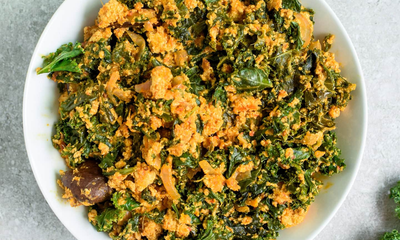
Vegan Kontomire Stew: A Ghanaian Classic Reimagined with Tofu and Melon Seeds
-

 Festivals & Events1 day ago
Samanpiid Festival: Bawku’s Celebration of Harvest, Renewal and Kusasi Heritage
-
 Sights and Sounds1 day ago
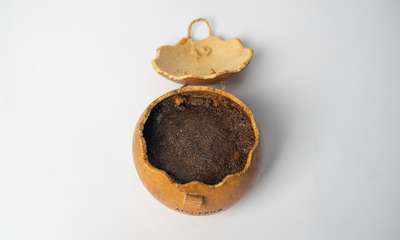
Shea Butter and African Black Soap: Ghana’s Natural Skincare Gifts to Take Home
-
 Festivals & Events1 day ago
Ghana Food Festival: Diaspora Experience 2026 Celebrates Food, Culture and Connection
-

 Homes & Real Estate1 day ago
Building in Ghana? How to Test Your Blocks Before They Become Part of Your Home