
Arts and GH Heritage
Ama Ata Aidoo: Celebrating the Life, Legacy, and Lionhearted Spirit of a Literary Titan


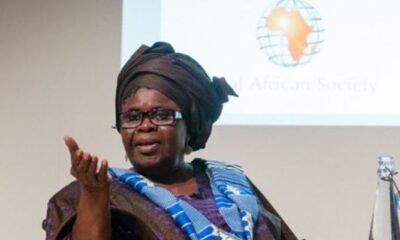
Ama Ata Aidoo (1942–2023) did not simply write stories. She shifted the continent’s literary center of gravity. A novelist, playwright, poet, educator, feminist, and cultural theorist, Aidoo spent six decades carving out a space where African women could speak in their own voices, on their own terms, with clarity, courage, and thunder.
Her passing in 2023 marked the end of a physical journey, but her intellectual and artistic imprint remains immovable.
A Fierce Feminist and Anti-Colonial Thinker
Aidoo’s work—and her life—was grounded in a sharp, unapologetic critique of colonialism and patriarchy. Long before global feminism embraced African voices, she insisted that African women were not silent, oppressed figures waiting to be rescued. They were thinkers, leaders, rebels, lovers, mothers, and dreamers—complicated, fully human beings worthy of nuanced representation.
Her characters were bold because she was bold.
Her ideas challenged the world because she refused to shrink herself to fit it.
A Literary Trailblazer
From her early days as a University of Ghana student, where she wrote and staged The Dilemma of a Ghost, Aidoo was destined to break barriers. When the play was published in 1965, she became the first African woman dramatist to be published, opening doors for generations of African women storytellers.
Her works—Anowa (1970), Our Sister Killjoy (1977), Changes (1991)—remain cornerstones of African literature classrooms worldwide. She dissected migration, love, identity, colonial tensions, and the lives of African women with unmatched precision and wit.
Awards and recognition followed naturally: Mbari Club Prize (1962), Nelson Mandela Prize for Poetry (1987) & Commonwealth Writers’ Prize (Africa Region, 1992).
But even these accolades fall short of capturing her cultural magnitude.
A Scholar and Public Servant
Aidoo was not content to remain an observer of national life—she stepped directly into it. As Ghana’s first woman Secretary for Education, she pushed passionately for free education, believing literacy was a cornerstone of liberation. Though her tenure was brief, it signalled her lifelong belief that knowledge must be accessible to all.
Her academic influence stretched across Ghana, the United States, Kenya, and Zimbabwe. Whether lecturing at the University of Ghana or conducting research on Fanti drama, she taught with the same fire she wrote with.
A Champion of African Women Writers
Aidoo believed deeply in the power of the written word—and in the responsibility to nurture new voices. In 2000, she founded the Mbaasem Foundation to support African women writers, long before literary empowerment became a global buzzword.
In 2013, she helped establish what is now the 9mobile Prize for Literature, Africa’s first major award for debut fiction writers. Her name continues to live on through the Aidoo-Snyder Book Prize, awarded for scholarship that centers African women’s experiences.
A Legacy Etched Across Continents
Ama Ata Aidoo was born in Abeadzi Kyiakor in the Gold Coast, and from that small town emerged a global literary icon. She navigated worlds—African and diaspora, academic and artistic, political and personal—without losing her moral clarity.
In a moving tribute, her longtime friend Dr. Rashidah Ismaili described her as a “dynamic spirit of blazing eyes and searing brilliance,” a sister-in-arms in the fight for African autonomy and dignity. Their decades-long friendship—rooted in activism, art, and Pan-African dreams—speaks to the emotional depth Aidoo carried into every relationship and every room.
The Eternal Voice
Aidoo has joined the ancestors, but hers is not a silent departure. Her plays are still performed. Her books are still taught. Her essays continue to provoke. The writers she mentored still carry her lessons. Her laughter, her audacity, her intellectual clarity—these remain.
For readers, writers, feminists, scholars, and dreamers across the world, Ama Ata Aidoo is not just a memory. She is an invitation:
Write boldly. Live consciously. Speak truthfully. Love Africa fiercely.
She rests in peace, but her words remain gloriously alive.




Arts and GH Heritage
When Second-Hand Clothes Become a Playground for Community
Using Broni Wawu garments purchased at a local market, Bamfo creates enclosed and open environments designed for participation rather than distant observation.

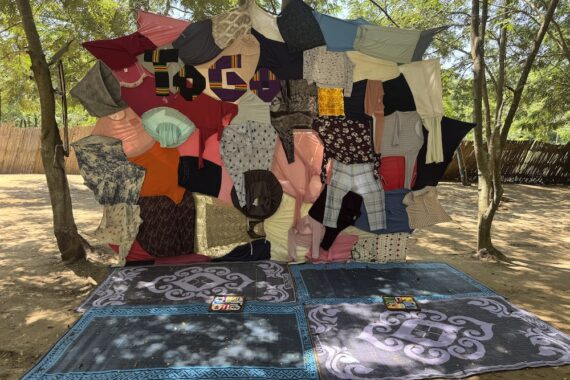
In Atakpamé, Ghanaian artist Dr. Frederick Bamfo transforms discarded garments into interactive spaces where children, cultural memory and collective play meet.
A discarded shirt can carry more than the memory of a former owner. In the hands of Ghanaian artist and academic Dr. Frederick Bamfo, it can become part of a place where children gather, games begin and strangers find reasons to connect.
His installation, The Games Feast, developed during the Karp Artists’ and Researchers’ Residency in Atakpamé, Togo, gives second-hand clothing a new social life.

Using Broni Wawu garments purchased at a local market, Bamfo creates enclosed and open environments designed for participation rather than distant observation.
The choice of material speaks to a familiar West African reality. Second-hand clothing circulates through markets, connecting consumers to international trade networks while raising questions about consumption, waste and the afterlife of textiles.
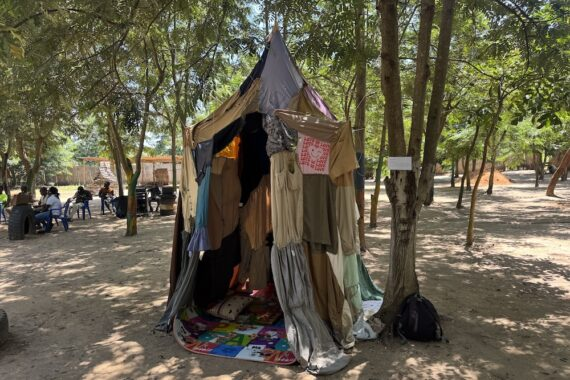
Often valued primarily for their usefulness or affordability, these garments become something different in Bamfo’s work: vessels of memory and possibilities for human connection.
The installation’s defining feature, however, is not simply its reuse of clothing. It is what happens inside these improvised spaces.
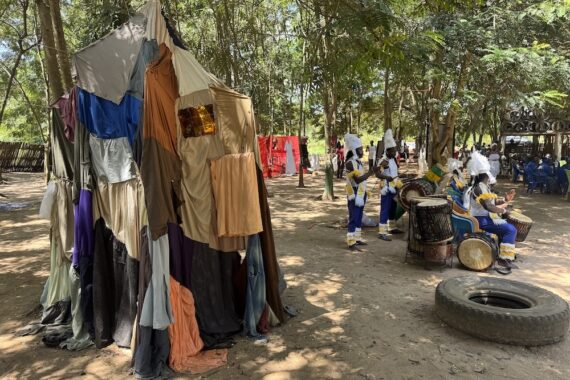
Children help shape the project’s collaborative spirit, while games such as ludo and oware, alongside dancing and skipping, turn the artwork into a setting for shared experience.
These activities draw on familiar forms of play that have long helped communities build relationships and pass cultural knowledge between generations.
Here, they also challenge conventional ideas of an art installation as something to admire without touching or entering.
For Bamfo, the transformation is both material and social. Clothing once associated with individual bodies becomes a collective environment, while everyday games become tools for participation.
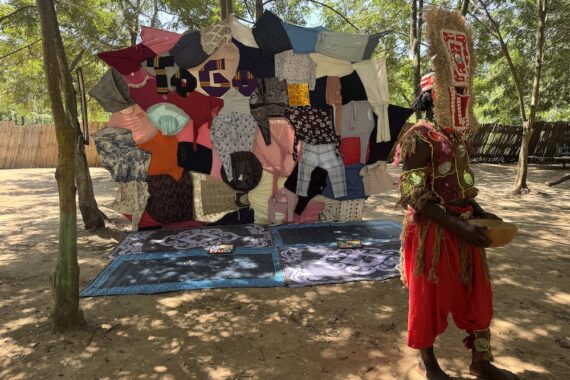
In Atakpamé, The Games Feast suggests that the most meaningful second life of a discarded garment may not be another wardrobe, but a space where people come together.
Arts and GH Heritage
Who Owns the Right to Be Called an Artist? A Debate in Togo Challenges the Rules of Art
From Ghana’s traditional craftsmen to self-taught street artists, creative excellence rarely follows a single road.
An artist may spend years in a university studio learning perspective, composition and art history.
Another may acquire the same confidence with materials through years of observation, experimentation and work passed down through generations. Which deserves greater recognition?
At Hotel Hong Kong in Atakpamé, Togo, this question became a starting point for a wider conversation about who gets to define artistic excellence.
Beyond the walls of the academy
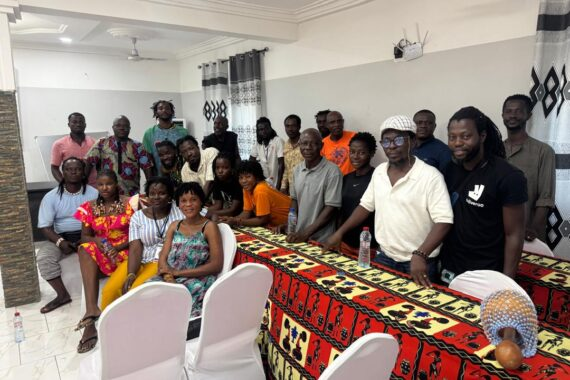
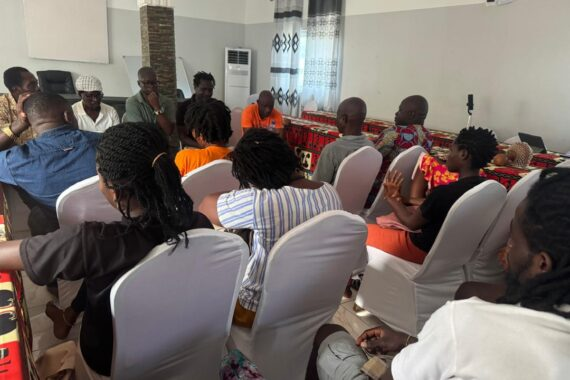
The panel discussion, organised as part of the ongoing Karp Kamina Artists and Researchers Residency, brought together Ghanaian artists Frederick Bamfo, Livingstone Amoako and Ray Agbo.
Moderated by Kojo Biney, with Samuel Olou, the residency’s director, translating into French, the conversation examined the opportunities and limitations of formal and self-directed artistic education.
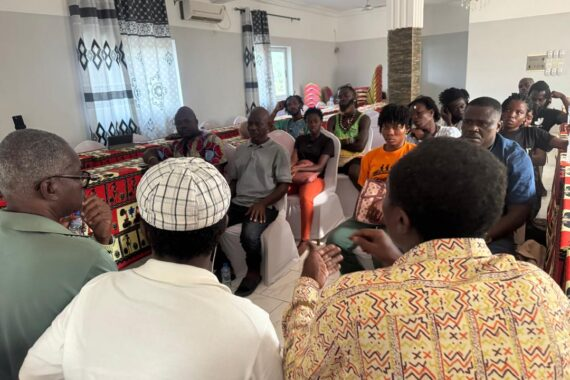
Art academies offer structured training, experienced mentors, studio facilities and access to professional networks.
Yet these advantages do not automatically produce originality. Outside institutional settings, artists often develop distinctive approaches through everyday encounters, community knowledge, apprenticeships and experimentation.
Ghana’s traditions offer another lesson
Ghana’s fantasy coffin makers illustrate why artistic knowledge cannot be measured by academic qualifications alone.
These craftspeople transform wood into elaborate forms representing professions, personal identities and family histories.
Their expertise is built through practical experience, inherited techniques and close relationships between makers and their communities.
Such traditions challenge institutions to reconsider what counts as legitimate artistic training and whose work deserves exhibition space, critical attention and commercial support.
Making room for different creative journeys
The discussion at Hotel Hong Kong did not present formal education and independent practice as opposing forces.
Instead, it highlighted the need for an art world that values technical knowledge without dismissing unconventional paths.
For African artists navigating galleries, museums and international exhibitions, that distinction matters.
Creativity may begin in a classroom, a workshop or on the street. The greater challenge is ensuring that opportunity does not depend solely on where an artist learned to create.
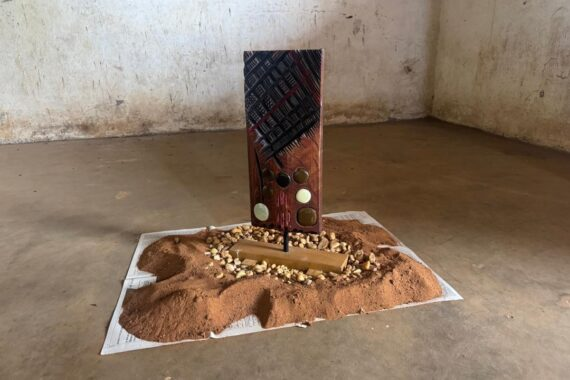
An old building can hold more than dust and silence. In Atakpamé, Togo, an abandoned German colonial structure is finding a new purpose as a space where African cultural expression challenges the weight of history.
Through Conversations: Symbolism and Lifestyle, Ghanaian artists Kojo Biney and Ray Agbo invite audiences to look afresh at the ordinary encounters that bind communities together.
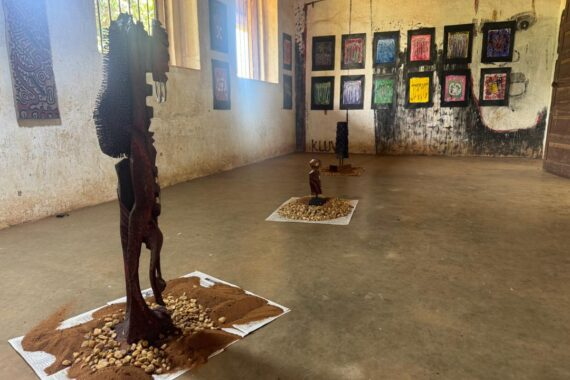
Their paintings and sculptures explore a language that often needs no words: the exchange of kola nuts, bargaining between market traders and customers, and the sharing of palm wine.
These gestures may appear familiar, yet each carries social meaning. They can express welcome, negotiate relationships, establish trust and pass knowledge between generations.
By bringing such moments into the gallery, the artists suggest that culture is not preserved only in museums or ceremonial performances. It lives in everyday interactions.
A building becomes part of the conversation
Presented during the Karp Kamina Artists and Researchers Residency 2026, the exhibition draws on Atakpamé’s cultural landscape, where Ana and Ewe-speaking communities meet. Known as the “city of seven hills”, the town provides a fitting setting for an exploration of identity and shared heritage.
The installation also places paintings alongside newspaper pages, linking artistic interpretation with the ways public events and personal memories become part of the historical record.
Yet the building itself may be the exhibition’s most powerful statement. Once associated with German colonial rule, the structure now houses contemporary African perspectives. Its past is not erased; instead, it becomes part of the encounter.
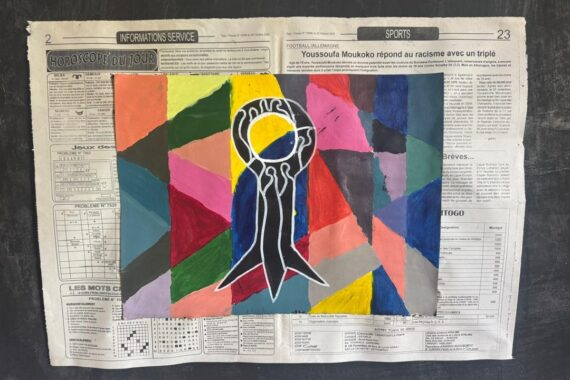
For older visitors, the space may recall another era. For younger audiences, it offers an opportunity to question how history shapes the present.
As the exhibition closes on Friday, October 16, 2026, its lasting invitation is to recognise that heritage is not frozen in time. Like conversation itself, it remains alive through the meanings people continue to create and share.


Funding Fears Loom For Ghana’s Life-Saving Malaria Vaccine Five Years After Roll Out

‘There was a Coordinated Disclosure Plan’: AI-Discovered Flaw in PHP Triggers Global Internet Chaos as Cybercriminals Race to Exploit It
