
Ghana News
Top Ghana Headlines: December 8, 2025: ECOWAS deploys to Benin, Cedi Depreciation, Kufuor’s Freemason Ties, Plus More


A compilation of leading stories from major news outlets in Ghana on December 8, 2025, highlights developments in regional stability, cedi fluctuations, institutional controversies, and notable personal disclosures.
- ECOWAS Deploys Standby Force to Benin Amid Coup Attempt: The Economic Community of West African States (ECOWAS) has swiftly mobilized a standby force to Benin to restore and protect the constitutional order after a group of mutinous soldiers attempted to overthrow President Patrice Talon on December 7.
- Benin’s Interior Minister confirmed the plot was foiled, but the regional intervention underscores ECOWAS’s renewed commitment to democratic governance in the face of rising instability across West Africa. This move is seen as a deterrent to further unrest in the subregion.
Read more here: CitiNewsroom - Cedi Trades at GH¢11.41 to $1 on Interbank Market: Ghana’s cedi experienced a slight depreciation, closing at GH¢11.41 against the US dollar on the interbank market, reflecting ongoing pressures from global commodity prices and domestic fiscal adjustments. Economists attribute the marginal slide to seasonal import demands, though stabilization measures by the Bank of Ghana are anticipated to curb further erosion. This rate impacts importers and signals the need for sustained export growth to bolster reserves.
Read more here: GhanaWeb - MIIF Rejects False Allegations as Orchestrated Smear Campaign: The Minerals Income Investment Fund (MIIF) has vehemently denied recent reports accusing its CEO of seeking unauthorized audits, labeling them as fabricated headlines designed to undermine the institution’s credibility. Examples include baseless claims like “Auditor-General Rejects MIIF CEO’s Rogue Request,” which MIIF calls a coordinated effort to malign its operations in the mining sector. The fund vows to pursue legal action against the perpetrators to protect investor confidence.
Read more here: MyJoyOnline - Former Buffer Stock CEO Challenges EOCO Asset Freeze in Court: The ex-Chief Executive Officer of the National Food Buffer Stock Company has filed a petition with the High Court to vacate an Economic and Organised Crime Office (EOCO) freeze on properties he claims were wrongly tagged in a money laundering probe. The hearing is slated for December 18, with the petitioner arguing procedural flaws in the asset seizure process that involved over GH¢40 million in alleged transfers. This case highlights ongoing scrutiny of public procurement scandals.
Read more here: GhanaWeb - Tiwaa of Yaw Sarpong and Asomafo Passes Away: The wife of veteran highlife musician Yaw Sarpong, known affectionately as Tiwaa, has died, leaving a void in Ghana’s gospel and highlife music community. Tributes are pouring in for her unwavering support of her husband’s career and her own contributions to family-oriented gospel works. Funeral arrangements are pending, with the arts scene mourning the loss of a quiet pillar.
Read more here: MyJoyOnline - Kufuor Speaks Openly About His Freemason Ties: In a candid interview on the Delay Show on December 6, 2025, former President John Agyekum Kufuor shared the story of his personal journey into Catholicism and Freemasonry, revealing how family ties and personal reflections shaped his path. Originally not a Catholic, Kufuor recounted how his wife, a devoted chorister at Christ the King Church, drew the entire household into the faith. She consistently took them to services, exposing him to the Catholic practices. His children also played a pivotal role, pointing out his habit of dropping them off at church before leaving, while noting that all the other parents attended with their classmates. Contemplating this, Kufuor realized that whether in the Anglican, Methodist, or Catholic tradition, they all served the same God. This insight prompted his conversion, leading him to become a practicing Catholic and fully join the family in their religious life. His entry into Freemasonry occurred in 1967, when he was a young lawyer.
- The decision stemmed from the influence of close relations; his uncle, senior brother, and several friends were already members of the fraternity. Motivated by these familial and social connections, Kufuor joined, embracing the bonds of camaraderie and shared values. Reflecting on misconceptions, Kufuor firmly refuted claims that Freemasonry was an occult group involved in sinister rituals, akin to the Illuminati. He explained that while the fraternity’s activities might appear mysterious—such as wearing black ties, bowing, or singing during funerals—these were harmless traditions. People often fear the unknown, he noted, but there is nothing evil in their practices; they do not, for instance, aim to resurrect the deceased as some rumors suggest. Through these experiences, Kufuor highlighted how personal relationships and a quest for unity in faith guided his profound life commitments.
Read more here: GhanaWeb
Check out the front pages of major newspapers in Ghana on Monday, December 8, 2025













Ghana News
Javits Frimpong’s Murder: One Suspect Arrested, Two Still Wanted as Bullying Questions Remain Unanswered

The arrest of a 17-year-old boy in connection with the fatal shooting of 15-year-old Ghanaian immigrant Javits Frimpong has marked a significant breakthrough in the investigation, but two other suspects remain wanted as police continue examining the circumstances surrounding the teenager’s killing in New York.
Frimpong was shot on October 29, 2026, while walking to school in the Bronx. The teenager was attacked near the intersection of East 171st Street and Third Avenue, in an incident that left his family devastated and raised questions about the safety of young people travelling to school.
The New York Police Department (NYPD) announced the arrest on Wednesday, November 11, identifying the development as the result of an investigation by its Violent Crimes Task Force.
The suspect, identified by law enforcement sources as Thierno Jalloh, was charged with second-degree murder, manslaughter and criminal possession of a weapon. He was remanded without bail following his arraignment at Bronx Criminal Court.
However, the arrest has not resolved some of the most troubling questions surrounding the killing, particularly allegations that Frimpong had experienced bullying shortly before his death.
Investigators are also continuing their search for two additional suspects believed to have been involved in the shooting.
Three suspects reportedly fled after the shooting
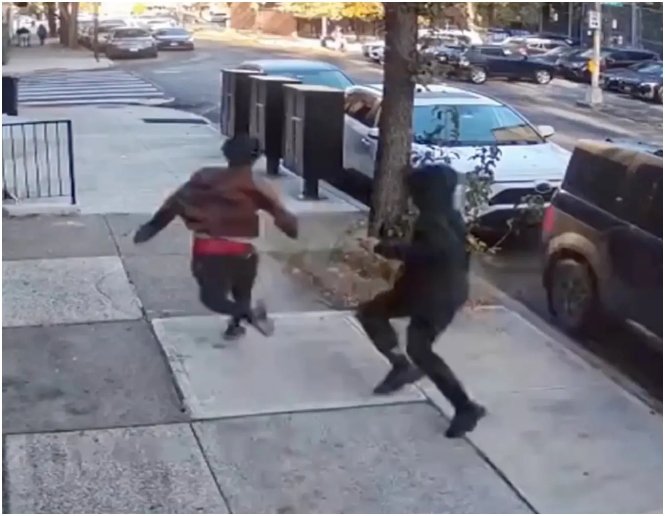
According to police information previously released in the case, three males dressed entirely in black were seen fleeing the scene after the gunfire. They were believed to be between 16 and 18 years old.
Harrowing surveillance footage reportedly showed Frimpong, gravely wounded, running for his life before collapsing. He later died from his injuries.
The arrest of Jalloh represents the first major breakthrough in identifying a suspect, but authorities have not publicly explained the precise roles allegedly played by the three individuals or disclosed what led to the confrontation.
Law enforcement sources told the New York Post that Jalloh was not a student at the same school as Frimpong.
The identities of the two remaining suspects have not been publicly disclosed, and police have not announced further arrests.
For the victim’s family, the investigation cannot end with one suspect in custody.
“One in the bag, two to go,” Frimpong’s uncle, Mohamed Doumouaian, told the New York Post after the arrest was announced.
“Everybody involved in the murder of my nephew, I want them to be held accountable. All three of them should be charged with murder,” he said.
Father says school reported bullying two days before the murder
One of the most significant unresolved aspects of the case concerns allegations that Frimpong had been bullied at 329 The DreamYard Preparatory School in the Bronx.
His father, Thomas Frimpong, 60, said his son had experienced bullying at the school and believes it may have been connected to his death.
According to his account, the school’s principal contacted him just two days before the fatal shooting to inform him that two boys had been fighting with his son.
Thomas Frimpong said the two students were suspended following the incident.
The timing of that reported school intervention has raised questions about whether the shooting could have been connected to an earlier dispute and whether the teenager’s family or school officials had reason to anticipate further trouble.
However, the alleged bullying has not been established as the motive for the murder.
NYPD Chief of Detectives Joseph Kenny previously confirmed that investigators were examining the issue alongside other possible explanations.
Kenny described the reported bullying as “one aspect that we’re looking at, as well as some others.”
The distinction is important. While the father’s account provides a significant line of inquiry, investigators have not publicly established that the alleged bullying led to the shooting.
There is also the question of how the arrested teenager, who reportedly did not attend the same school, may have been connected to Frimpong or the events preceding his death.
Police have not publicly provided an explanation.
Police say teenager was focused on education, not gang activity
As investigators worked to establish a motive, Chief of Detectives Kenny described Frimpong as a student who appeared committed to his education and was trying to build a future in the United States.
He said the teenager would return home, complete his homework and occasionally use his phone.
Kenny also said investigators had found nothing indicating that Frimpong was involved in gang activity.
“All indications are that he was trying to live the American dream. He was trying to get ahead by going to school,” the detective chief said.
“Seems like he was just a very good kid,” he added.
The police assessment has become an important part of the public understanding of the case, particularly because the motive remains unknown.
Frimpong’s sister, Millicent Frimpong, said her younger brother dreamed of becoming a doctor and hoped to join the United States military after graduating from high school.
She revealed that three of his siblings had served in the US Army, with one still serving. She is also a military veteran.
His family described him as a quiet, studious teenager whose ambitions centred on education and service.
Mother travels from Ghana to demand justice
The case has also drawn attention to the difficulties faced by families separated across international borders when tragedy strikes.
Frimpong’s mother, Doris Adu Gyamfi, had been in Ghana when her son was killed. She was subsequently able to travel to New York after Mayor Zohran Mamdani appealed to US President Donald Trump to expedite her visa.
Trump agreed to grant the visa, allowing her to reach the United States to mourn her son and be with her family.
On Wednesday, hours before the arrest was announced, she spoke publicly about the killing for the first time at a press conference in Harlem.
Standing alongside civil rights activist Rev. Al Sharpton and family attorney Ben Crump, she made an emotional appeal for accountability.
“I need justice for my child,” she said through tears. “I have only one child. I have only one child.”
Her appearance brought renewed attention to the family’s grief and its determination to see everyone responsible brought before the courts.
Arrest marks progress, but legal process is just beginning
Jalloh was arraigned in Bronx Criminal Court on Wednesday evening and charged with second-degree murder, manslaughter and criminal possession of a weapon.
He was remanded without bail. He was scheduled to appear before Family Youth Court on Thursday, reflecting the fact that he is being prosecuted as a juvenile.
His attorney, Thomas Klein of the Bronx Defenders, declined to comment after the arraignment.
The NYPD Detectives Endowment Association praised the investigators responsible for the arrest.
Its president, Scott Munro, described the development as the product of detectives’ sustained investigative efforts, while acknowledging the devastating loss suffered by Frimpong’s loved ones.
The arrest is an important step in the investigation, but a criminal charge is not a conviction. The suspect remains entitled to the presumption of innocence as the case proceeds through the justice system.
Questions that remain unanswered
With one suspect in custody and two others still being sought, several central questions remain unresolved.
Police have not disclosed what motivated the shooting, whether the alleged school bullying was connected to it, how the three individuals allegedly became involved or what roles each may have played.
It also remains unclear whether investigators have established any connection between the reported school dispute and the circumstances of the fatal attack.
For the Frimpong family, the arrest provides some movement towards accountability but does not yet deliver the answers they are seeking.
Their demand is that everyone responsible for the teenager’s death be identified and prosecuted.
As the investigation continues, the case also raises wider concerns about violence affecting young people and the importance of taking reports of bullying seriously before disputes escalate.
For now, the search for the two outstanding suspects continues, while the circumstances that led to the death of a 15-year-old boy walking to school remain the subject of an active police investigation.
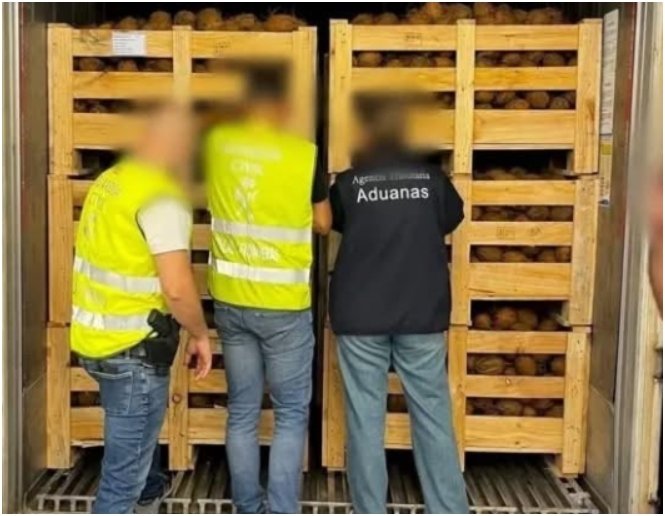
Spanish authorities have seized 2,600 kilograms of cocaine concealed in a shipment of coconuts originating from Ghana, uncovering an elaborate concealment system in two shipping containers that travelled from the Port of Tema to Spain.
The seizure, announced on November 11, 2026, by Spain’s Tax Agency and the Civil Guard, resulted in the arrest of two men in the municipality of Viator, in the province of Almería.
The suspects were identified by authorities as the importer of the goods and the person responsible for unloading the shipment.
The cocaine was discovered at the Port of Valencia after customs officials selected the two containers for inspection, having identified them as presenting a high-risk profile during routine controls on international trade.
According to the Spanish authorities, the containers were loaded at Tema Port on August 2, 2026, and arrived in Valencia on August 22 aboard a container vessel.
Cocaine hidden beneath false bottoms in coconut crates
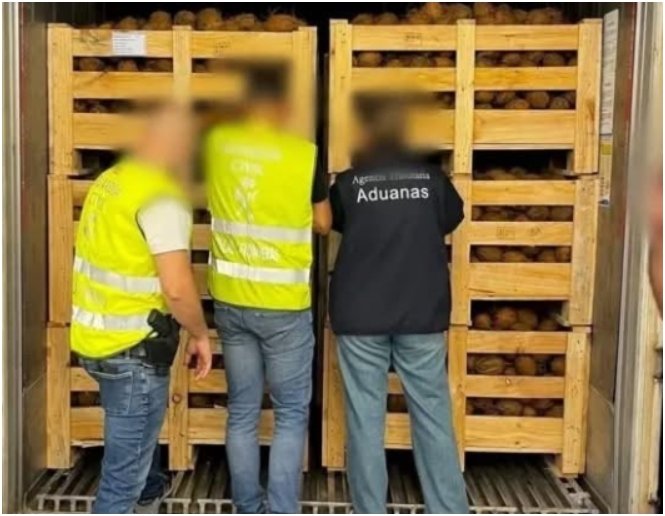
Per reporting by the Daily Graphic, an examination of the declared cargo revealed that the wooden boxes used to transport the coconuts had been fitted with concealed false bottoms.
Beneath these compartments, investigators found layers of packages commonly used to transport cocaine. The drugs were not hidden inside the coconuts themselves but underneath specially constructed structures within the wooden crates.
Spanish authorities said the packages contained a white powder whose characteristics were consistent with cocaine hydrochloride. Screening tests subsequently confirmed that the substance was cocaine, with the total quantity recovered amounting to 2,600 kilograms.
The concealment method allowed the illicit cargo to be transported alongside legitimate agricultural produce, disguising the drugs within packaging designed for an ordinary commercial shipment.
Investigators tracked the cargo beyond Valencia
The discovery at the port did not immediately bring the investigation to an end. After seizing the cocaine and completing the necessary customs procedures, investigators launched a surveillance operation to track the remaining goods as they continued towards their intended destination.
The cargo was transferred from the port into two refrigerated lorries, which travelled to a warehouse at the La Juaida industrial estate in Almería.
Officers maintained surveillance of the vehicles and the subsequent unloading operation at the warehouse in Viator. The operation culminated in the arrest of two individuals allegedly connected with the importation and unloading of the goods.
Spanish authorities identified one suspect as the importer of the shipment and the other as the person responsible for receiving and unloading it.
The official announcement did not disclose the identities or nationalities of the two men, nor did it provide details about the individuals who may have organized or facilitated the concealment of the cocaine.
Joint operation by Spanish customs and law enforcement
The seizure resulted from a coordinated operation involving Spain’s Tax Agency Customs Surveillance Service and the Civil Guard.
The initial inspection was undertaken after the Entry Summary Unit of the Customs Surveillance Service identified the containers as requiring additional scrutiny. The subsequent tracking and arrests involved operational units in Valencia and Almería, as well as organized crime and border investigation personnel from the Civil Guard.
The operation highlights the role of customs risk assessment, cargo inspections and coordinated law enforcement surveillance in detecting attempts to move illicit substances through international commercial shipping channels.
Questions surrounding the use of legitimate export cargo
Although the shipment originated from Ghana, the Spanish authorities’ announcement does not establish where the cocaine was introduced into the containers, who arranged the concealment or whether anyone in Ghana was involved in the trafficking operation.
The discovery nevertheless draws attention to the potential exploitation of legitimate international trade routes by organized criminal networks seeking to move large quantities of narcotics across borders.
For Ghana, the distinction is particularly important: the fact that the containers were loaded at Tema does not establish that the country’s coconut producers, exporters or shipping operators had knowledge of the concealed drugs.
The Spanish investigation has so far publicly confirmed the seizure of the 2.6 tons of cocaine and the arrest of two people in Almería. Further details about the wider trafficking network, the origin of the drugs and any possible accomplices have not been established in the announcement.
The case adds another major international drug seizure involving cargo shipped from Ghana to the European market, placing renewed attention on the security of commercial supply chains and the need to prevent legitimate exports from being exploited for illicit purposes.
Ghana News
Ghanaian Regulators Test Local Innovator’s Plastic-Derived Fuel, Finds Petrol and Diesel Fall Short of Required Standards

Ghana’s National Petroleum Authority (NPA) has conducted preliminary quality tests on petrol and diesel produced by a young innovator in Asesewa in Ghana’s Eastern Region through a process that converts waste plastics into fuel.
Reports indicate that initial results show that the products do not yet meet the required standards for automotive use.
According to popular digital creator, Nana Tea, known for promoting the Asesewa township, the assessment followed a visit by the NPA Regional Director, Mr Salifu S. Nagumsi, and his team, who travelled to meet the innovator after a video demonstrating his plastic-to-fuel project attracted widespread attention on social media.
The team brought a mobile laboratory kit to conduct preliminary tests on the fuel produced through the initiative, seeking to establish whether it was suitable for use in motor vehicles.
However, the initial findings showed that the petrol and diesel samples fell short of the quality requirements for automotive applications.
Further laboratory analysis planned
Despite the preliminary results, the NPA team collected samples of the fuel for further laboratory examination, indicating that the assessment process would continue beyond the initial field tests.
The Authority also expressed its willingness to engage the innovator in further discussions on how the project could be improved and developed.
The engagement suggests an opportunity for the young inventor to receive technical input and professional guidance as he works to refine the process and address the quality concerns identified during the preliminary assessment.
The NPA team commended his creativity and initiative, particularly his effort to transform discarded plastics into potentially useful products.
Innovation meets safety and quality requirements
The initial test results highlight an important distinction between demonstrating that waste plastics can be converted into a liquid fuel and producing fuel that meets the technical specifications required for use in vehicles.
Petrol and diesel intended for automotive applications must satisfy established quality requirements. Meeting those standards is essential to ensuring that fuel performs as expected and does not create avoidable risks for vehicle engines, users or the environment.
The preliminary findings therefore point to the need for further research, technical refinement and quality improvements before the products can be considered suitable for automotive use.
The results should not necessarily be viewed as the end of the project. Rather, the collection of additional samples and the NPA’s willingness to continue engaging the innovator provide an opportunity for further investigation into the technology and its potential.
Plastic waste management and alternative fuel research
The development has also drawn attention to the wider potential of exploring innovative approaches to plastic waste management in Ghana.
Plastic pollution remains an important environmental concern, and technologies that can recover value from discarded materials are attracting interest in different parts of the world. Converting waste plastics into fuel is one approach being explored, although the technical process, environmental implications and quality of the resulting products require careful evaluation.
For the Asesewa innovator, the next stage will be particularly important in determining whether the process can be improved to produce fuel that meets the necessary standards.
The NPA’s visit represents an encouraging engagement between a local innovator and a national regulatory institution. It also reinforces the importance of ensuring that promising ideas receive appropriate technical assessment rather than being judged solely on their initial demonstrations.
While the preliminary tests have established that the fuel is not yet suitable for automotive use, further laboratory analysis and continued technical discussions could help determine what improvements are possible.
The central challenge now is to establish whether the innovation can progress from an intriguing waste-conversion experiment into a technically reliable, environmentally responsible and commercially viable solution.


Javits Frimpong’s Murder: One Suspect Arrested, Two Still Wanted as Bullying Questions Remain Unanswered

Ghana Coconut Shipment Used to Conceal 2.6 Tons of Cocaine Bound for Europe

Ghanaian Regulators Test Local Innovator’s Plastic-Derived Fuel, Finds Petrol and Diesel Fall Short of Required Standards
-

 Ghana News1 day ago
After COVID-19 Exposed Africa’s Vaccine Dependence, Ghana’s NVI and Africa CDC Embark on a New Path to Secure Health Sovereignty
-

 Business1 day ago
Ghanaian Pharmaceutical Manufacturers Begin Breaking Into African Markets Thanks to Africa CDC’s Pooled System
-

 Ghana News1 day ago
Africa Cannot Build Its Pharmaceutical Future on Imports: Ghana and Africa CDC Seek a New Way Forward
-
 Festivals & Events24 hours ago
Ghana Food Festival: Diaspora Experience 2026 Celebrates Food, Culture and Connection
-

 Taste GH24 hours ago
Vegan Kontomire Stew: A Ghanaian Classic Reimagined with Tofu and Melon Seeds
-

 Festivals & Events20 hours ago
Samanpiid Festival: Bawku’s Celebration of Harvest, Renewal and Kusasi Heritage
-

 Homes & Real Estate20 hours ago
Building in Ghana? How to Test Your Blocks Before They Become Part of Your Home
-

 Health & Wellness2 days ago
The Fitness Secret Is Not More Discipline, but Building Habits You Can Maintain