
Festivals & Events
From London to Accra: The Fitness Party Turning Workouts into a Night Out

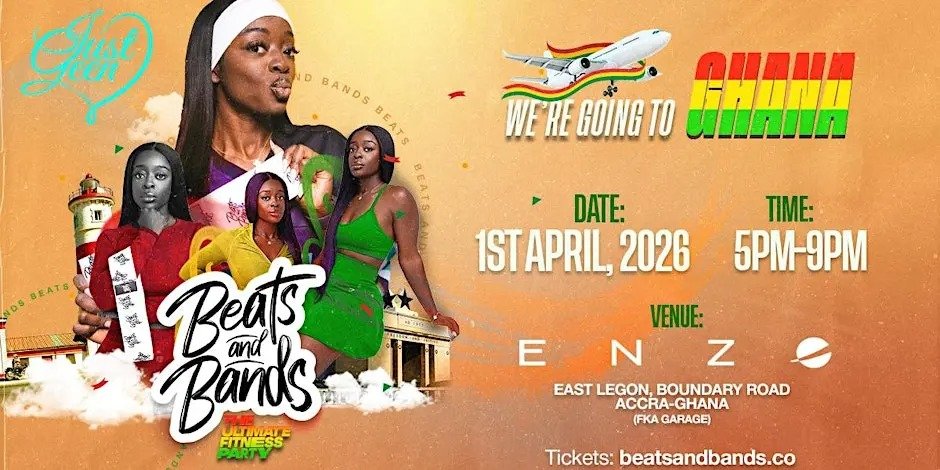
A fitness party that has energized crowds in London is making its way to Accra—and it promises to change how people think about working out.
Beats And Bands – The Ultimate Fitness Party arrives in the Ghanaian capital on April 1, bringing with it a concept that blends exercise, music, and social connection into a single high-energy experience.
Set along Boundary Road from 5 p.m. to 9 p.m., the event is expected to draw a lively crowd eager to try something different from the typical gym routine.
The idea behind Beats & Bands first gained popularity in London, where fitness enthusiasts began gathering for sessions that felt more like concerts than workouts. Instead of quiet gym floors and solitary routines, participants move together under low lights with DJs blasting heavy beats.
The result is a shared experience where the atmosphere pushes people to move harder, laugh louder, and stay longer.
Accra now gets its turn.
At the heart of the event is a resistance-band workout focused on the lower body. Participants will go through choreographed movements, bursts of cardio, and strength exercises—all synchronized with music that keeps the energy high. Resistance bands may be simple pieces of equipment, but they can turn ordinary movements into powerful muscle-building exercises.
Yet the appeal of Beats & Bands goes beyond the workout itself. Once the exercise session ends, the evening shifts into a playful sports-day-style social. Expect friendly competitions, interactive games, and plenty of laughter as participants connect with one another.
For visitors exploring Ghana, the event offers a chance to experience the city’s social culture from a fresh angle. Travelers often come to Accra for its beaches, music scene, and historic sites, but gatherings like this reveal the city’s growing wellness culture and its openness to global lifestyle trends.
For locals, the event arrives at a time when many people are looking for creative ways to stay active without sacrificing the fun of social life. Beats & Bands delivers both in one evening—movement, music, and community all in the same space.
The journey of this fitness party from London to Accra reflects a wider shift in how people approach wellness. Exercise no longer has to feel isolated or routine. Sometimes it can look like a celebration, sound like a concert, and end with new friendships.
If the crowd energy matches the music on April 1, Accra may soon prove that the future of fitness feels a lot like a party.











For years, the map of global beauty was drawn in Paris, Milan, and New York. You followed the lines to the fashion capitals, to the glossy magazines, to the places that decided what was beautiful and what was not.
But maps, like beauty standards, are meant to be redrawn. And this time, the compass is pointing somewhere else entirely.
On March 21st, 2026, the coordinates shift to a palm-fringed stretch of sand in Accra. La Palm Royal Beach Hotel won’t just be hosting an event; it will become the epicentre of a movement that started, as most real things do, in a moment of quiet personal transformation.
The hook that should snag the attention of every woman from Brixton to Brooklyn, from Toronto to Johannesburg, is this: The woman who turned a haircut into a global conversation is calling us all home.
Read Also: The Whispering Rocks of Tengzug: Invoking the Rain at the 2026 Gologo Festival
Her name is Abena Boateng. And her story is not one of sudden fame, but of slow, deliberate roots.
Back in 2014, Abena did what millions of women do every day: she cut her hair. But for a Black woman, a haircut is rarely just a haircut. It’s a statement, a shedding, a confrontation with a lifetime of conditioning about what your hair should be. She began sharing that raw, unfiltered journey online. Not as an expert, but as a student of her own crown.
What grew from those early posts wasn’t just a following; it was a fellowship. A quiet understanding passed between women across oceans who saw themselves in her struggle with shrinkage, her experiments with shea butter, her moments of doubt and triumph.
She didn’t just build a community; she nurtured it. She caught the attention of the giants—Cantu, Shea Moisture—but she never stopped speaking like the woman next door who simply wanted to love her hair.
Now, she is launching the maiden edition of Crowned & Nurtured (CAN) 2026, and it feels less like a debut and more like a reunion.
This is not your typical expo with sterile booths and aggressive sales pitches. This is a one-day cultural current.
The schedule reads like a love letter to the culture: masterclasses where you learn the difference between a twist-out and a braid-out from someone who actually knows; a fashion runway where the models’ crowns are the main event; a village of vendors selling not just products, but solutions.
There will be kids running around in the activation zone, getting their first lessons in self-love. There will be art on the walls that tells the story of our hair through pigment and canvas.
There will be grooming sessions for the men who are finally ready to learn what their mothers never taught them.
And when the sun dips behind the Atlantic, the panels and chairs will be pushed aside for an after-party where the conversations continue, this time to a beat.
But the most interesting thread in the fabric of CAN 2026 is the quiet intention woven into its seams. Abena is using this platform to push past the mirror.
By introducing financial literacy through merchandise and publications for young people, she’s asking a radical question: What if loving your hair could also teach you how to build your future?
It’s a festival that understands a profound truth: A woman who knows how to nurture her crown is a woman who knows how to nurture her potential.
So, mark the date. Pack your scarf and your curiosity. The global beauty conversation has found a new accent, and it sounds like the waves of Accra meeting the laughter of women finally comfortable in their own skin.
The world is invited. But more importantly, the world is needed. Because a movement this big requires all of us to show up.
As the harsh harmattan winds of the north begin to soften and the cracked earth of the Upper East Region thirsts for relief, a transformation takes place in the hills of Tengzug.
While much of the world is caught in the frantic pace of the modern spring, the Talensi people are stepping back into a rhythm as old as the rocks themselves.
Throughout March 2026, the Gologo Festival (often called the Golib) serves as a profound spiritual negotiation between humanity and the divine for the survival of the coming year.
The Divine Regulator of the Harvest
To understand Gologo, you must understand the relationship the Talensi have with their land. This isn’t just a party; it is a vital agricultural necessity. The festival is centered around the Nnoo Shrine and the Golib god, the deity believed to hold the keys to the heavens.
In a region where the success of the early millet crop determines the well-being of every household, the stakes are high.
From March 1 to March 31, the air in the Tengzug hills is thick with the scent of traditional brews and the smoke of sacred sacrifices.
The chiefs and elders lead the community in seeking protection from the earthly gods, ensuring that when the seeds finally hit the soil, the rains will follow in abundance.
Read Also: The Sacred Weight of the President’s Sword
A Sensory Journey for the Global Soul
If you are a tourist venturing into Ghana this March, the Gologo Festival offers an experience that defies the typical “safari and beach” itinerary.
Tengzug is famous for its unique architecture and its incredible rock formations, which are integrated into the very homes of the people.
During the festival, these rocks become the stage for mesmerizing dances and rhythmic chanting that vibrate through your chest.
Participating in Gologo means stepping into a living museum. You aren’t just a spectator; you are a witness to a community reinforcing its identity.
You’ll see the traditional attire—richly woven smocks and intricate beadwork—and hear the distinct sounds of the Talensi flutes that signal the transition from the dry season to the life-giving rains.
For the native Ghanaian, Gologo is a powerful reminder of our indigenous resilience. In an era of climate uncertainty, there is something deeply grounding about watching a community come together to honor the earth.
It is a time to strip away the complexities of city life in Accra or Kumasi and reconnect with the foundational belief that we are stewards of the land, dependent on the grace of the ancestors and the environment.
Why You Can’t Miss the 5:00 PM Finale on March 31
The month-long celebration builds toward a crescendo that balances solemnity with communal joy.
By the time the festival officially concludes at 5:00 pm on March 31, the spiritual “green light” has been given for the sowing of the early millet.
To be present during these final hours is to feel a collective sigh of relief and hope. It is the moment when the community shifts from petition to preparation, ready to face the planting season with the backing of the Golib god.
Recommendation
If you make the trip to the Upper East Region, stay in Zuarungu or Bolgatanga and hire a local guide who understands the nuances of Talensi customs.
To truly appreciate the heritage, visit the Tongo Whistling Rocks, where the wind through the stones creates a haunting melody that many locals believe is the voice of the spirits themselves.
Pack light, stay hydrated, and bring an open heart; the dust of Tengzug will wash off, but the memories of the Gologo songs will stay with you forever.
If you think a festival is just about the drumming and the dancing, you’ve clearly never been to Techiman during Apoɔ.
Imagine a place where, for a few weeks, the social hierarchy dissolves, and you are legally and spiritually permitted to tell your boss, your neighbor, or even the highest King exactly what you think of them—without fear of retribution.
This isn’t a modern social media “call-out” culture; it is a sacred, ancient Bono tradition of psychological and spiritual purging that has kept this community vibrant for centuries.
From March 7 to April 5, 2026, the Techiman Traditional Council invites the world to witness this extraordinary spectacle under the theme: “Showcasing our heritage and uniting for ancestral blessings.”
The Art of “Rejecting” Evil
The word Apoɔ comes from the Bono root “po,” which literally means to reject. Historically, the festival emerged as a response to the authoritarian rule of past leaders. The people needed a vent for their frustrations, so they consulted the gods, who sanctioned a period where grievances could be aired through proverbs, songs, and lampoons.
Today, this “rejection” isn’t just about politics; it’s a massive spiritual cleanup. Before the main events, you’ll see priests performing Hyiretuo (spiritual cleansing) and women gathering white clay from the Aponkosu River to decorate shrines. It is a time when the “dirty” air of grudges and social evils is cleared to make room for fresh ancestral blessings.
Why You Must Be in Techiman This Year
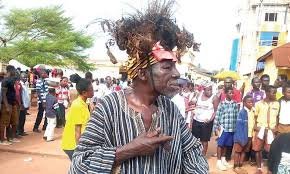
For the global traveler, Apoɔ is a masterclass in indigenous democracy. Watching the Akokobonee (early morning songs) or the flamboyant processions where participants smear themselves in charcoal and clay is a sensory overload in the best way possible. It is one of the few places on earth where you can see ancient African conflict resolution in its rawest, most artistic form.
For the native Ghanaian, especially those in the diaspora, this is a homecoming with a purpose. After the disruptions of the past few years, the 2026 festival is a pivotal moment for “uniting for ancestral blessings.” It is about settling family feuds, reconnecting with the Bono-Manso roots, and standing in the presence of the Omanhene as he pours libation to the ancestors who founded one of the earliest Akan states.
What to Expect
As the festival climaxes toward the final 5:00 pm curtain call on April 5, expect the town of Techiman to be a kaleidoscope of color. You will witness:
- The Apoɔ Procession: A rhythmic, satirical parade where “insults” are turned into high art.
- Ancestral Rites: Solemn visits to the royal cemetery to bridge the gap between the living and the dead.
- The Great Friday: The peak of the celebrations, where the unity of the Bono people is most palpable.
Recommendation
If you are planning to attend, book your accommodation in the Bono East Region early. Beyond the festival grounds, take a day trip to the nearby Boabeng-Fiema Monkey Sanctuary or the Fuller Falls.
To truly “humanize” your experience, don’t just watch from the sidelines—learn a few Bono proverbs and join the singing. There is no better way to feel the pulse of Ghana than by participating in the “rejection” of the old to welcome the new.


Global Arts Community Condemns Police Assault on Ghanaian Artist Ibrahim Mahama

Renowned Civil Rights Attorney Ben Crump to Join Global Leaders at UN Panel As Ghana Presents Motion for Reparatory Justice for Slave Trade

Rev Al Sharpton Backs Ghana’s UN Slave Trade Initiative, Attorney-General Dragged to Court Over Kotoka Airport Renaming, and Other Big Stories in Ghana Today (March 24)
-

 Business22 hours ago
KNUST Graduates Build Ghana’s First AI-Powered Farming Robot
-

 Ghana News2 days ago
This is How Airline Passengers Can Access Ghana’s Newly Launched Dedicated Complaints Portal
-

 Ghana News1 day ago
Ghana Confident UN Will Back Slave Trade Resolution as Mahama Presents Draft March 25
-

 Ghana News2 days ago
Brazil Joins Ghana’s UN Campaign to Declare Transatlantic Slave Trade the Gravest Crime Against Humanity
-

 Diaspora Investment Guide2 days ago
Ghana’s “Raw Material” Export Era Ends: These 3 Value-Added Products Emerge as 2026 Goldmines
-

 Ghana News2 days ago
President Mahama Responds to Calls to Seek 3rd Term, Three-Year-Old Killed in Bee Attack, and Other Big Stories in Ghana Right Now (March 22)
-
 Ghana News2 hours ago
Renowned Civil Rights Attorney Ben Crump to Join Global Leaders at UN Panel As Ghana Presents Motion for Reparatory Justice for Slave Trade
-
 Business1 day ago
The $1 Billion Forecasting Error That Exposed Ghana’s Broken Cocoa Model