
Culture
Gospel Legend Ron Kenoly Passes Away at 81, Leaving Enduring Legacy in Worship Music

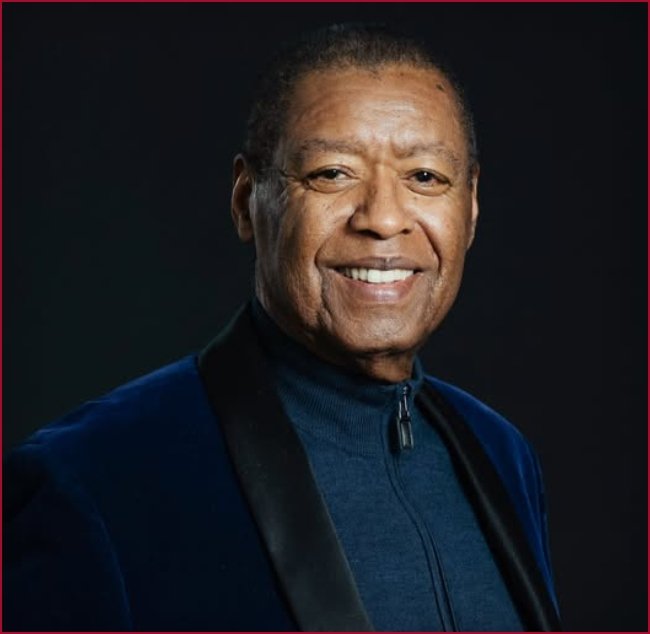
The global Christian community is mourning the loss of renowned American gospel singer, worship leader, and pastor Ron Kenoly,.
He died on February 3, 2026, at the age of 81. His longtime music director and close associate, Bruno Miranda, announced the news via a heartfelt post on Kenoly’s official Instagram account, confirming that the influential figure passed away that morning. No cause of death has been publicly disclosed.
Kenoly, born December 6, 1944, in Coffeyville, Kansas, rose to prominence as a pioneering voice in contemporary worship music. His energetic, participatory style revolutionized praise in churches worldwide, blending gospel, contemporary Christian elements, and powerful congregational choruses often backed by large choirs.
His breakthrough came with the 1992 album Lift Him Up, a landmark release that popularized vibrant worship formats still used today. Iconic songs such as “Ancient of Days,” “Jesus Is Alive,” “All Honor,” “Majesty,” “Righteousness, Peace & Joy,” and “Sing Out” continue to resonate in congregations across Africa, Europe, the Americas, and beyond. Other acclaimed albums include Ron Kenoly, God Is Able, Welcome Home, and Sing Out with One Voice.
Beyond recording, Kenoly served as a pastor and worship leader at Jubilee Christian Center in San Jose, California, for many years.
He later founded Ron Kenoly Ministries in Orlando, Florida. A sought-after speaker and facilitator, he ministered at international conferences and crusades, with a particularly deep connection in Africa where his music found lasting resonance. Nigerian bishop Francis Wale Oke, who hosted him multiple times, paid tribute on Facebook: “Farewell to a True Worshipper Ron Kenoly. A man of humility, a vessel of grace, and a true worshipper who gave his life to the glory of God… His Spirit-filled songs, his legacy, and his impact will continue to speak across generations.”
Bishop Oke added:
“Though our hearts are heavy, we submit to the perfect will of God… We commiserate with his beloved family, his wife, children, grandchildren, and pray that the Holy Spirit will comfort, strengthen, and abide with them… Blessed are the dead which die in the Lord… that they may rest from their labours; and their works do follow them” (Revelation 14:13).
Tributes poured in from artists and leaders worldwide, highlighting Kenoly’s humility, spiritual depth, and commitment to worship as service rather than performance. He is survived by his wife Diana (a United Nations Ambassador, whom he married in 2014), children, and grandchildren.
Kenoly’s music and ministry touched millions, shaping how generations approach praise and worship. His works will undoubtedly continue to inspire and uplift the faithful for years to come.



Arts and GH Heritage
The Architecture of Grief: Gabriel Selassie Tsagli Paints a Portrait of Home and Loss

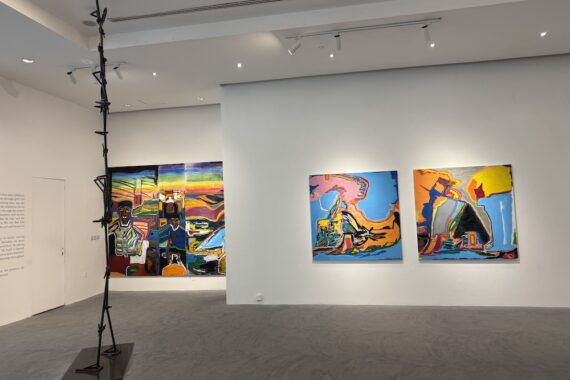
There is a particular quality of light in Accra that never fully leaves you. For Gabriel Selassie Tsagli, a Ghanaian artist living between Accra and Berlin, it is this light—alongside the memory of a specific mother and a specific city—that anchors his first solo exhibition in his birthplace.
Son of Kafui at Gallery 1957 is a homecoming in the truest sense. The title itself is an intimacy: Kafui, meaning “love” or “son of God’s own,” was the name of Tsagli’s late mother.
Following his return to Accra in 2025, Tsagli has created a body of work that doesn’t merely depict grief but gives it form, movement, and colour.
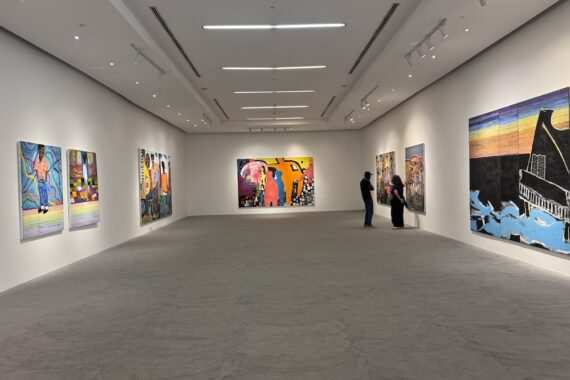
The exhibition begins where all loss begins—in the body’s remembrance of place. Tsagli’s paintings emerge from lived experience rather than pre-imagined form.
He builds surfaces through accumulation, layering, pressing, and scraping paint until figures appear “as though remembered rather than constructed”.
This is not figurative painting in the traditional sense; here, figuration and abstraction overlap, allowing bodies and faces to emerge and recede like recollections themselves.
Colour serves as a generative force. Orange suggests action and vitality, while blue becomes a space for reflection and articulation. Held in tension, these chromatic forces create an emotional architecture that resists closure, sustaining ambiguity across the works.
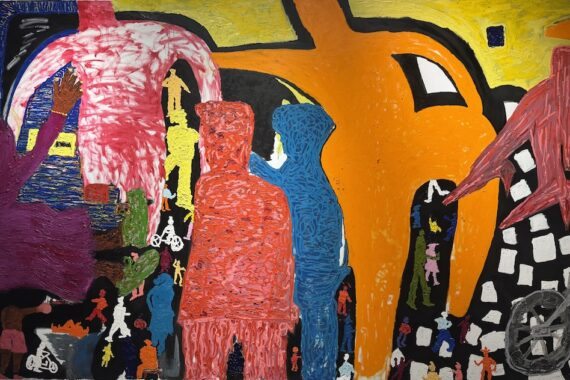
The figure of his mother recurs throughout, not as a portrait or a likeness, but as atmosphere, material trace, and presence suspended in the space between what is here and what is gone.
Curated by Marina Paulenka, the exhibition considers return not as resolution but as an ongoing negotiation.
Accra itself becomes a living presence, a shifting organism that evolves alongside the artist’s understanding of home—an understanding complicated by a life shaped by movement between Ghana and Germany.
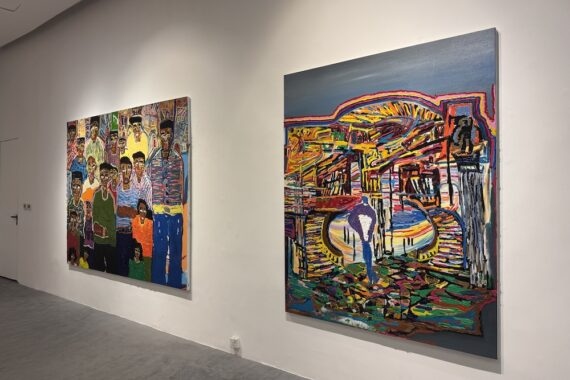
What makes Son of Kafui remarkable is its refusal to resolve grief. Instead, Tsagli invites us to remain with what resists closure, to encounter meaning as it unfolds.
In doing so, he transforms personal loss into a broader reflection on how we carry people, places, and histories within us. The exhibition runs at Gallery 1957 until 12 September 2026.
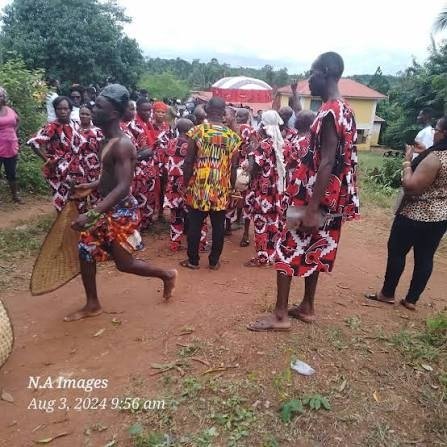
The first drumbeat rolls across Abura like a heartbeat returning home. Soon, the streets come alive with swirling cloth, elders carrying symbols of authority, and young dancers moving to rhythms that seem to echo from another century.
As traditional horns cut through the air, the community gathers for Ahoba Kuma Festival, a celebration that transforms memory into movement and history into living tradition.
Observed occasionally in June by the Abura people in Ghana’s Central Region, Ahoba Kuma commemorates the community’s ancestral migration while paying tribute to the warriors who protected their people during uncertain times.
Rather than allowing those stories to fade into folklore, the festival keeps them alive through ceremonies that remind each generation where they came from and what their ancestors endured to build the community they call home.
The festival unfolds with colourful processions led by chiefs, queen mothers and elders dressed in striking kente, beads and ceremonial regalia.
Traditional musicians fill the streets with the sounds of talking drums, horns and songs that recount bravery, sacrifice and unity. Dancers perform with energetic precision, while community members follow the procession, turning the town into a shared stage where every step carries historical meaning.
Beyond the public celebrations, moments of reflection remain at the festival’s heart. Elders share oral histories with younger generations, prayers are offered for peace and prosperity, and families reunite to strengthen bonds that stretch far beyond bloodlines.
These rituals ensure that remembrance is not confined to the past but becomes part of everyday identity.
Today, Ahoba Kuma serves as both a cultural inheritance and a community reunion, drawing people back to their roots while welcoming curious visitors into its story.
For travellers exploring Ghana’s heritage, experiencing this festival offers something rare: the chance to witness history not preserved behind museum glass, but carried proudly through the streets in music, movement and collective memory.
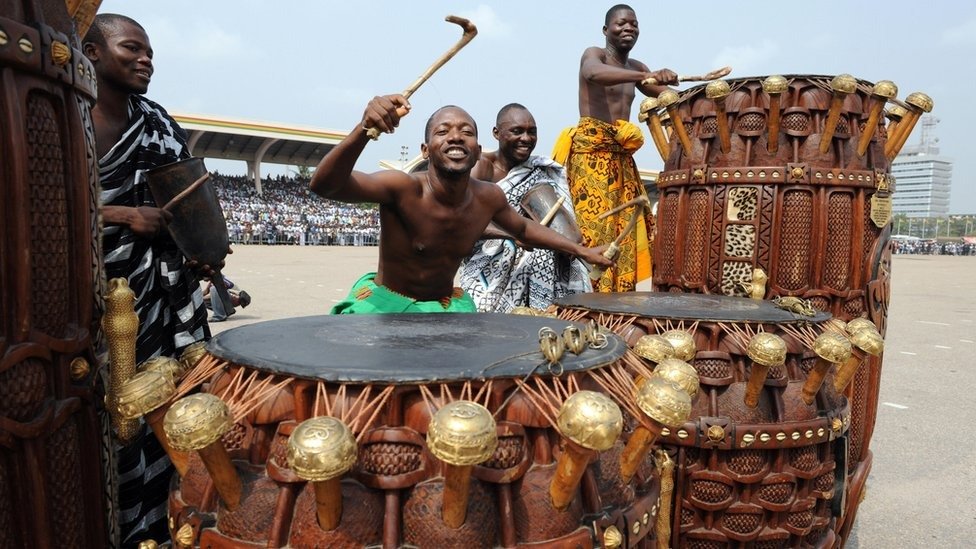
As June settles over the rolling Kwahu hills, Kwahu Tafo wakes to the deep rhythm of talking drums, the gleam of colourful kente cloth, and the steady procession of chiefs carried beneath ceremonial umbrellas.
The streets fill with cheers as families reunite, visitors gather, and elders exchange greetings that carry generations of history. This is Gyenpren Festival, a celebration where gratitude, unity and hope for the seasons ahead meet in one unforgettable spectacle.
Observed by the people of Kwahu Tafo in Ghana’s Eastern Region, Gyenpren is rooted in the community’s enduring connection to the land.
For generations, farming has shaped life in the area, making the festival an important moment to seek blessings for abundant harvests while strengthening the peace that keeps the community thriving.
It also serves as a reminder that prosperity grows not only from fertile soil but from harmony among neighbours and respect for tradition.
The festival’s centrepiece is the durbar of chiefs, where traditional leaders appear in magnificent regalia, accompanied by queen mothers, elders and cultural groups.
The procession transforms the town into a moving gallery of royal symbolism, with gold ornaments, intricate fabrics and beautifully crafted stools reflecting the authority of the Kwahu people.
Traditional drumming, dancing and libation ceremonies accompany the gathering as prayers are offered for rainfall, fertile farms, healthy families and peaceful coexistence.
Beyond the formal ceremonies, Gyenpren becomes a homecoming. Relatives return from across Ghana and abroad, local businesses come alive, and younger generations learn customs by watching elders perform rituals passed down through time.
For today’s Kwahu Tafo, Gyenpren remains both a cultural anchor and a celebration of collective identity.
For travellers, it offers something equally valuable: the chance to witness a living tradition where every drumbeat, greeting and royal procession tells the story of a community that continues to honour its past while looking confidently toward the future.


The Architecture of Grief: Gabriel Selassie Tsagli Paints a Portrait of Home and Loss

Nine Hours That Changed the Gold Coast: The Legacy of the Battle of Katamanso

Ahoba Kuma Festival: How the Abura People Keep Their Warrior Legacy Alive
-

 Ghana News19 hours ago
Top Headlines from Ghanaian Newspapers: Monday, August 24, 2026
-

 Ghana News18 hours ago
American Expats in Ghana Get a Helping Hand to Vote in 2026 U.S. Midterm Elections
-
 Africa Watch18 hours ago
The West Africa Corridor’s Dirty Secret: Liberia’s Record Cocaine Bust Exposes State-Sanctioned Trafficking
-

 Reels & Social Media Highlights1 day ago
A Preacher, A GoFundMe, and A Viral Legend: Decoding Ghana’s Sunday Social Media Storm
-
 Festivals & Events22 hours ago
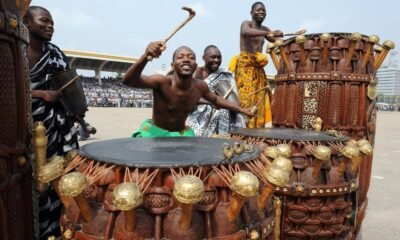
Drums, Chiefs and Blessings: Inside Kwahu Tafo’s Gyenpren Festival
-
 Festivals & Events10 hours ago
Ahoba Kuma Festival: How the Abura People Keep Their Warrior Legacy Alive
-

 Health & Wellness1 day ago
The Surprising Bone and Circulation Benefits of 100 Daily Jumps
-
 Homes & Real Estate21 hours ago
How to Capitalise on the $7.8 Billion Diaspora Cash Fueling Ghana’s Real Estate Boom