
Tech
Nigeria Poised for First AI Data Centre by 2026 as Digital Infrastructure Accelerates


Nigeria appears increasingly likely to commission its first true artificial intelligence (AI)–focused data center by 2026.
This marks a significant milestone in West Africa’s digital transformation and strengthening the region’s position in the global technology economy.
According to an in-depth analysis by global crypto exchange and digital infrastructure watcher MEXC, Nigeria’s expanding data center pipeline, combined with rising AI workloads and sustained investor interest, suggests the country is closer than ever to hosting facilities capable of supporting AI at scale—though key challenges remain.
Rapid Growth in Data Infrastructure
Nigeria currently hosts 17 operational data centers, with at least nine additional facilities under construction or in advanced planning stages. Among the most anticipated projects is Equinix’s LG3 carrier-neutral data center on Victoria Island in Lagos, a 1-megawatt facility scheduled for commissioning in the first quarter of 2026.
Installed data center capacity in Nigeria is estimated at 65 to 86 megawatts, but industry projections cited by MEXC indicate this could exceed 400 megawatts within the next three to five years, driven by demand from cloud service providers, fintech firms, telecom operators, and AI-driven enterprises.
A Verraki report published in December 2025 values Nigeria’s data center market at approximately $1.4 billion, with projections pointing to $2.7 billion by 2035, reflecting a compound annual growth rate of about 7%. Analysts note that Nigeria’s scale and strategic location position it as a digital gateway not only for its domestic market but also for the wider West African sub-region, including Ghana.
Why AI Changes the Stakes
MEXC’s analysis highlights that AI workloads fundamentally alter data center requirements. Traditional enterprise facilities typically operate at 10–15 kilowatts per rack, while AI-focused deployments—especially those supporting large language models and GPU clusters—can demand 60–100 kilowatts per rack, often requiring liquid cooling and highly resilient power infrastructure.
“An AI data center is fundamentally about high rack density,” said Krish Ranganath, Regional Executive for West Africa at Africa Data Centers, a Cassava Technologies subsidiary. He noted that while entry-level AI workloads can run on lower densities, truly AI-native facilities require long-term power certainty and scalable design.
Construction timelines remain a constraint, with most high-capacity data centers taking 16 to 20 months to complete, excluding power connections and commissioning.
Economic and Employment Impact
Beyond technology, the economic case for AI data centers is compelling. MEXC cites Verraki modelling showing that a $10 million, 1-megawatt Tier III data center can generate $17 million in economic output during construction, rising to over $39 million over ten years when operational spending is included.
Employment benefits are also substantial. A single 1-megawatt facility can support around 700 construction jobs and 20–30 operational roles annually, contributing to more than 1,600 cumulative jobs over a decade—a key consideration for governments seeking skilled technical employment growth.
Major Investments Signal Confidence
Global and regional operators are already committing significant capital. Open Access Data Centers has established facilities in Lagos following a $500 million Africa-wide investment, while Equinix announced a $390 million commitment to the continent over five years.
Telecom giants are also entering the space. MTN Nigeria is developing a 1,500-rack Tier IV facility, and Airtel Africa’s Nxtra project—a $120 million investment designed specifically for AI compute—is expected to go live in Nigeria by early 2026, with high-performance GPUs already delivered in late 2025.
Kasi Cloud Emerges as a Strong Contender
The clearest signal that Nigeria could host its first AI-native data center by 2026 is Kasi Cloud’s LOS1 hyperscale campus in Lekki, Lagos. Backed by a $250 million investment and supported by the Nigeria Sovereign Investment Authority, the facility is designed to handle extreme AI power and cooling demands.
Spanning 4.2 hectares with up to 172,000 square feet of white space, the campus can host 3,000–4,000 racks at full build-out. Its dedicated substation offers up to 100 megawatts of power capacity, with rack densities scaling from 8 kilowatts to 100 kilowatts per rack—levels typically associated with liquid-cooled AI systems.
According to Alex Tsado, co-founder of Ahura AI and a founding member of the Alliance for Africa’s Intelligence (Alliance4AI), the facility has already opened its doors and is optimized for AI GPUs. Kasi Cloud is partnering with UduTech, a GPU cloud platform, to provide affordable AI compute services tailored to African startups and researchers.
Remaining Constraints
Despite the momentum, MEXC cautions that challenges persist. Most specialized equipment—including GPUs and advanced cooling systems—is imported, exposing projects to currency volatility and supply chain risks. Reliable, high-quality power remains the most critical constraint, alongside dense, low-latency network connectivity.
Still, transitional “AI-ready” facilities, such as Rack Centre’s 12-megawatt LGS2 site launched in 2025, and pan-African GPU initiatives involving NVIDIA and Cassava Technologies, are helping bridge the compute gap for African innovators.
Outlook for 2026
While Nigeria may not instantly become a global AI hyperscale hub, MEXC concludes that at least one AI-focused data center is likely to be fully operational by late 2026, with projects such as Kasi Cloud and Airtel Nxtra leading the way. For Ghana and the wider region, Nigeria’s progress underscores a broader West African shift toward high-value digital infrastructure—one that could reshape economic competitiveness across the continent.
Attribution: This report is based on analysis and data published by MEXC, with additional industry commentary cited within the original MEXC story.












The United States is positioning emerging technologies including artificial intelligence, drone logistics, and rural 5G connectivity as the next frontier in its bilateral relationship with Ghana.
The move signals a strategic shift from traditional aid toward investment-driven partnership, Chargé d’Affaires Rolf Olson has announced.
Speaking at a celebratory event marking the 250th anniversary of American independence, Olson declared that the U.S.-Ghana relationship is entering a new phase defined by “not dependence, but resilience” and “a two-way exchange of investment, innovation, and expertise.”
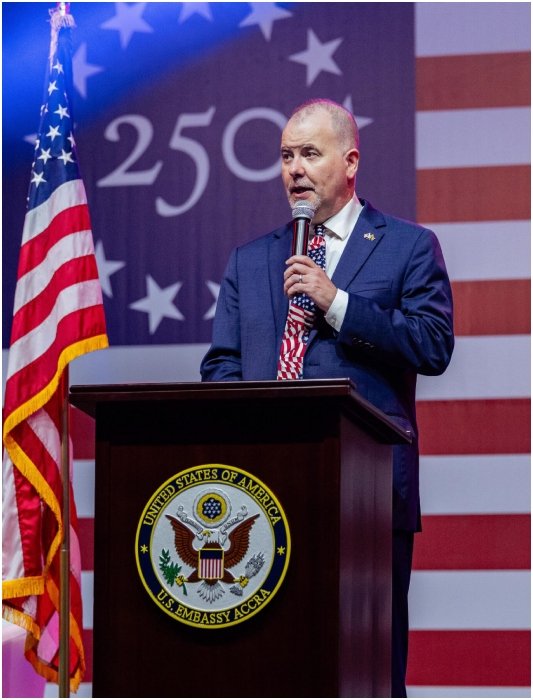
While acknowledging ongoing changes to the US foreign assistance framework, he emphasized that America remains the largest financial contributor to health emergencies across Africa — including $200 million to the current Ebola response — but pointed to commercial technology ventures as the model for future collaboration.
“As we greet this next phase of our partnership, we see enormous potential for U.S.-Ghana collaboration and commerce in emerging sectors – from digital technology to artificial intelligence, from advanced agriculture to cutting-edge energy techniques,” Olson told an audience of government officials, diplomats, and business leaders in Accra. “Ghana’s young innovators are positioned well to seize these types of opportunities.”
The Chargé d’Affaires highlighted concrete examples of technology-driven partnerships already underway.
He cited Zipline’s drone delivery network, which has completed 800,000 medical deliveries in Ghana since 2019, saving an estimated 10,000 lives, including 1,600 through emergency transport of snake anti-venom alone.
He also revealed US support for deploying “cutting-edge wireless technology at hundreds of base stations across Ghana,” aimed at expanding rural connectivity and bridging the digital divide across West Africa.
Olson framed the vision within a broader narrative of economic self-sufficiency, noting that more than 100 American companies are active in Ghana across energy, technology, and agriculture.
He pointed to Newmont, the single largest taxpayer in Ghana, where 99% of the workforce, including the Country Manager, is Ghanaian. Bilateral trade in goods and services reached approximately $4 billion last year, a figure Olson said “can grow.”
The diplomatic push comes alongside deepened security cooperation. Olson confirmed that just this week, US law enforcement handed over Sedina Tamakloe Attionu to Ghanaian authorities, fulfilling an extradition request, while Ghana has extradited multiple individuals wanted in the US for cyber-related fraud that has stolen tens of millions of dollars from American victims.
Reflecting on the historical ties that bind the two nations, from Richard Nixon meeting Martin Luther King Jr. in Accra in 1957 to Ghana being the first country to welcome Peace Corps volunteers in 1961, Olson concluded that the relationship is now mature enough to pivot toward technology, trade, and mutual resilience.
“Two hundred and fifty years into America’s independence and nearly 70 years into Ghana’s, we look to the future with optimism, confidence, and renewed purpose,” he said.

ACCRA – The Bank of Ghana has intervened to stop a proposed 0.75 percent fee on direct wallet-to-bank transfers, directing Mobile Money Fintech Limited to suspend the charge just days before it was set to take effect.
The fee, which had been scheduled to come into force on June 1, 2026, will now not be implemented until further consultations are completed, the central bank announced in a press release on Tuesday.
The directive means millions of Ghanaians who rely on mobile money for daily transactions—including paying utility bills, sending remittances, and moving funds to bank accounts—will not face the additional cost for the foreseeable future.
In its statement, the Bank of Ghana said the decision reflects its commitment to ensuring that any changes to charges within the mobile financial services ecosystem are introduced fairly.
“The Bank of Ghana is committed to ensuring that any changes to charges within the mobile financial services ecosystem are introduced in a manner that is fair, protects consumers, and supports their financial wellbeing,” the central bank said.
Mobile Money Fintech Limited had not publicly announced the planned fee, and it is unclear how widely customers were informed ahead of the proposed 1 June rollout. The 0.75 percent charge would have applied to every direct transfer from a mobile money wallet to a bank account, potentially adding up to significant costs for frequent users.
The central bank’s last-minute halt is likely to come as a relief to consumer advocacy groups and ordinary users, many of whom had raised concerns about the cumulative burden of multiple charges within the mobile money ecosystem.
Industry observers noted that while fintech companies face mounting operational costs, the lack of prior consultation appeared to be the central bank’s primary concern.
The Bank of Ghana did not specify a timeline for the consultation process or indicate whether the fee could be reintroduced in a modified form. It also did not disclose whether any other mobile money operators are considering similar charges.
Mobile Money Fintech Limited had not issued a response to the central bank’s directive as of Tuesday evening.
For now, wallet-to-bank transfers remain free of the proposed 0.75 percent charge, though customers and industry stakeholders will be watching closely to see what emerges from the mandated consultations.
Business
Ghana’s Proposed ICT Law Would Jail Unlicensed Website Builders and Phone Repairers, Analysts Warn

A draft bill being considered by Ghana’s Ministry of Communications, Digital Technology, and Innovations would transform the National Information Technology Agency (NITA) into a powerful digital-sector regulator with authority to imprison individuals who operate unlicensed ICT businesses, potentially including freelance web developers, phone repairers, software programmers, and even self-taught AI users.
Section 35 of the draft NITA Bill states that no person may “engage in a business or related activity in the ICT sector” without a licence from NITA, expressly including the installation of ICT infrastructure, development or provision of ICT products and services, and activities requiring licensing or certification . Violators face fines of 2,000 to 5,000 penalty units and up to two years in prison.
Technology policy analyst Bright Simons, vice president of IMANI Africa, warns that the bill’s sweeping language would criminalize everyday digital work.
“Is the government of Ghana going to insist on licensing every single person who builds a website, uses Microsoft Power BI to create charts for a company, or deploys AI to craft flyers?” Simons writes in a detailed critique.
The penalties extend further. Section 46 of the bill would prohibit any public or private institution from appointing an “ICT professional” unless certified by NITA. Section 90 makes providing ICT services without a license, or falsely claiming certified status, equally punishable.
“The Real Threat Picture”
The proposed law has drawn sharp condemnation from technology professionals, startup founders, and policy analysts who describe it as a potential “digital command economy” that could cripple Ghana’s nascent tech sector.
In a detailed analysis widely circulated on social media, a commentator writing as BlackStarPatriot warned that Parliament is considering “a bill that decides who can build Ghana’s digital future, who can work in it, and who can go to prison for touching a keyboard without permission.”
The post added: “We are not talking about fraud or cybercrime. We are talking about writing code and shipping products without a government permission slip.”
Technology blogger and digital policy commentator MacJordan Degadjor focused particular criticism on Sections 35 to 37, warning that provisions limiting licenses to companies wholly owned by Ghanaian citizens would deter foreign investment and venture capital.
“This directly threatens the foreign capital, partnerships, and expertise that fuel Ghanaian success stories,” he said, citing homegrown firms Hubtel and mPharma as examples of what is at stake.
Data scientist Alfred, posting on X, warned that Ghana risked undoing years of digital sector progress. He specifically criticized proposals requiring technology professionals to obtain NITA certification before working in either the public or private sector.
The Legal Foundation Dispute
The government has pushed back forcefully against the criticism. Communications Minister Samuel Nartey George insists that NITA is simply enforcing existing legislation, not proposing new powers.
“The Ministry is simply ENFORCING existing legislation that has been on our books since 2008, 2023 and 2025. The proposed new legislation has NOT even been laid before Parliament,” George said in a Facebook post.
He cited the National Information Technology Agency Act, 2008 (Act 771), the Electronic Transactions Act, 2008 (Act 772), the Fees and Charges (Miscellaneous Provisions) Regulations, 2023 (L.I. 2481), and the 2025 amendment, L.I. 2512, as the legal basis for NITA’s current enforcement regime . George challenged critics to identify any enforcement action by NITA that falls outside the scope of these existing laws and described allegations against the agency as “spurious,” accusing critics of jumping on “bandwagon trends” without understanding the legal framework.
NITA itself issued a clarification arguing that its authority predates the draft bill and is grounded in Acts 771 and 772 of 2008, as well as Legislative Instruments passed by Parliament.
The agency noted that accreditation fees of 20,000 cedis (approximately US$1,900) for fintech firms and 10,000 cedis for e-commerce operators already exist under current regulations and are not newly created by the pending legislation.
A “Ridiculous” Definition of ICT Professionals
Simons argues that the fundamental flaw in the bill is its attempt to treat “ICT professional” as a unified category requiring state licensing, comparable to nurses, lawyers, or engineers, when in reality the term covers vastly different occupations.
“Is the government of Ghana going to insist on licensing every single person in Ghana who builds a website?” Simons asks.
He notes that international occupational systems such as Eurostat and O*NET list dozens of distinct computer occupations, software developers, network architects, cybersecurity analysts, database administrators, web developers, data scientists, support specialists, QA testers, and IT project managers, among them, all operating under the vague “IT professional” umbrella.
He warns that under no circumstances should any government “poke its long nose into stuff like ‘writing code,’ ‘installing a router,’ ‘maintaining a school website,’ ‘handling some graphic design,’ ‘being a product manager at a food delivery company,’ ‘using AI to generate a UI for a service,’ or ‘working in an IT department of a small law firm’”.
The risks, he argues, are not national-scale, and employers should be left to manage their own personnel validation.
The rise of AI, Simons adds, has thrown a wrench into the entire definition. “A founder describes an app to a model, a non-technical employee uses AI to build an internal workflow, a designer generates front-end code… Who is the ‘ICT professional’ here? The geography graduate with a few hours on Reddit typing out prompts? The AI tool vendor? The person who clicks deploy?”
Citizen-Only Ownership Clause Raises Investment Fears
Section 37 of the draft bill requires that any license applicant must be an adult Ghanaian citizen or a company “wholly owned by a citizen.” Simons describes this clause as “potentially devastating,” warning that Ghanaian startups with foreign venture capital, non-citizen co-founders, regional holding structures, offshore investors, or employee stock held by non-citizens would struggle to qualify for ICT licenses.
“The same government that markets Ghana as a digital hub is writing ‘locals only’ into law,” the BlackStarPatriot analysis noted.
Analysts warn this could contradict Ghana’s commitments under ECOWAS free movement and establishment principles and the African Continental Free Trade Area (AfCFTA) services liberalization framework.
Overlapping Regulation and Informality Concerns
Simons and other analysts also highlight the problem of regulatory duplication. A fintech company in Ghana already faces potential oversight from the Cyber Security Authority, Data Protection Commission, National Communications Authority, Bank of Ghana, Ghana Standards Authority, Public Procurement Authority, GIPC, and the Engineering Council. The NITA bill would add another layer of licensing, audits, and approvals.
John Sitsofe Mensah, a technology policy analyst at IMANI Africa, described NITA’s push as “regulation by invoicing”—attempting to extract a substantive regulatory mandate out of a consolidated financial instrument. He noted that Section 38(1) of Act 772 contains an explicit prohibition: “A license shall not be issued or granted by the Agency to an individual” .
The informal ICT economy, laptop repairers, phone technicians, CCTV installers, router vendors, fiber contractors, school computer-lab maintainers, POS support agents, market traders selling peripherals, and cybercafé operators, could be devastated, analysts warn.
“If enforced aggressively, the scheme could raise the cost of basic repairs and installations, push informal technicians further underground, create opportunities for inspectors to extract bribes, and reduce access to affordable hardware support in rural and low-income areas,” Simons writes.
Path Forward
Simons and other analysts have proposed a more targeted approach: replace the broad Section 35 ban with a schedule of genuinely high-risk activities (critical public digital infrastructure, financial services cybersecurity auditing, Tier II and III data center operations); rewrite Section 46 so certification applies only to defined risk roles in the public sector; add exemptions for small businesses, hobbyists, and internal IT work; and remove the citizen-only ownership rule.
“A careful NITA law could be one of Ghana’s most groundbreaking digital economy reforms—especially if it focuses on fixing wasteful, opaque public ICT procurement,” Simons concludes. “But a careless version could become a massive burden on a struggling, still nascent technology sector. The draft bill tilts more to the latter than the former.”
The Ministry of Communications maintains that the draft bill remains under stakeholder consultation and has not yet been laid before Parliament. However, with mounting opposition from across Ghana’s tech ecosystem, the legislation faces an uncertain path forward.
Key Facts at a Glance
| Aspect | Details |
|---|---|
| Proposed Law | Draft NITA Bill (under stakeholder consultation, not yet before Parliament) |
| Key Provision (Section 35) | No person may engage in ICT business without NITA licence |
| Penalties | Fines of 2,000–5,000 penalty units + up to 2 years imprisonment |
| Scope | Includes software dev, web design, phone repair, cloud hosting, SaaS, digital platforms |
| Ownership Rule (Section 37) | Licences only for adult Ghanaian citizens or wholly citizen-owned entities |
| Certification (Section 46) | No public/private institution may appoint ICT pro without NITA certification |
| Government Position | Enforcing existing laws (Acts 771, 772; L.I. 2481, 2512) – not a new bill |
| Critics | Bright Simons (IMANI), MacJordan Degadjor, tech startups, freelance developers |



-

 Ghana News1 day ago
OBITUARY: Gamal Gorkeh Nkrumah, Son of Ghana’s Founding President, Dies in Cairo
-

 Sights and Sounds2 days ago
EPP BookShop at Legon: A Destination for Students, Families and Book Lovers
-

 Health & Wellness1 day ago
Walking Is More Than Exercise: Small Steps That Can Transform Your Health
-

 Festivals & Events1 day ago
MaddFest 2027: Welcome the New Year with a Night of Celebration in Accra
-

 Homes & Real Estate2 days ago
Building Smarter in Ghana: Could Plastic Rebar Clips Improve Construction Efficiency?
-

 Arts and GH Heritage1 day ago
Inside Togo’s Abandoned Colonial Building, African Artists Reclaim Cultural Memory
-

 Global Update1 day ago
Wave of Student Killings at Mexico Universities Raises Safety Concerns
-

 Ghana News1 day ago
Mahama to Churches: The Real Sermon Is Written After the Closing Prayer